ASTM A312 specifies austenitic stainless steel pipe for high-temperature and corrosive service, including seamless, welded, and heavily cold-worked welded types. It sets requirements for grades, chemistry, heat treatment, mechanical properties, testing, workmanship, marking, and traceability. It does not design piping systems or define all dimensions; ASME B36.19M and ASME B31.3 often apply separately. Correct compliance depends on grade choice, schedule, documentation, and inspection. The sections below clarify each requirement and common ordering mistakes.
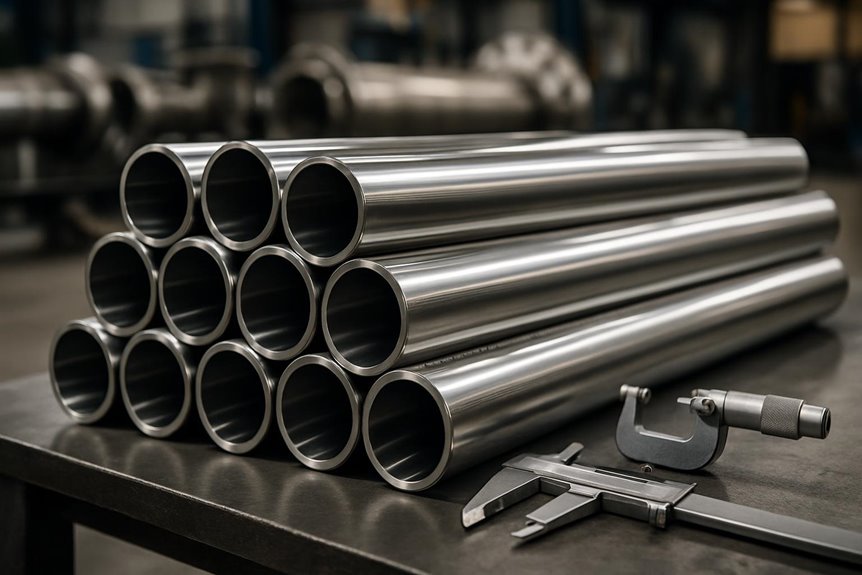
Scope matters: ASTM A312/A312M defines the product requirements for seamless, straight-seam welded, and heavily cold-worked austenitic stainless steel pipe intended for high-temperature and general corrosive service.
The ASTM A312 pipe specification controls grade selection, manufacturing route, chemical composition, mechanical properties, heat-treatment condition, dimensional tolerances, required testing, workmanship, marking, and traceability. It tells a buyer what an ASTM A312 stainless steel pipe must be before it enters service.
Because ASTM standards address attributes such as chemical composition and heat treatment, they help buyers make precise grade selection decisions based on required properties and service conditions.
It does not design the piping system. Standard stainless pipe dimensions normally come from ASME B36.19M. ASTM A312 also relies on required testing and inspection, including chemical analysis, to verify material composition and product integrity.
Process-piping design, when applicable, comes from ASME B31.3. Fittings, flanges, and pressure ratings come from separate specifications, codes, and calculations. Material selection should still account for the process medium, contaminants, temperature, pressure, and chloride exposure before the pipe is released for service. Pipe descriptions should also state outer diameter, wall thickness, length, and material grade so purchasing documents match the applicable standards.
This separation prevents uncontrolled assumptions when supplier pages combine product standards, dimensional standards, and system codes as one authority. ASTM A312 is commonly associated with the 300 series austenitic grades, such as 304 and 316, which are widely used where corrosion resistance is required.
ASTM A312 permits stainless steel pipe to be produced by more than one manufacturing route.
The main product forms are seamless A312 pipe, welded A312 pipe, and heavily cold-worked welded pipe.
Each form differs in how it is made, inspected, and suited to pressure, temperature, and corrosive service conditions.
Pipe schedule also affects wall thickness and internal diameter, which can influence pressure capacity and flow performance.
For pressure-service applications, a test pressure is often applied and held to confirm leak-tight performance before use.
Related stainless steel tubing standards also emphasize testing methods such as hydrostatic testing to check for leaks under pressure.
During production, quality inspection helps verify mechanical properties, weld integrity, and compliance before the pipe is marked and packaged.
Proper grade selection is also important because chloride content, temperature, and operating conditions can affect corrosion resistance in chemical service.
A seamless A312 pipe is produced without a longitudinal manufacturing weld, typically by forming the stainless steel into pipe through a seamless process rather than joining strip or plate edges.
Under ASTM A312, this is one permitted manufacturing route, not a blanket guarantee of suitability for every service condition. The purchaser still controls grade, size, wall thickness, heat treatment, testing, and supplementary requirements through the order.
An ASTM A312 seamless stainless steel pipe may be selected where the absence of a seam supports the project’s design basis, inspection strategy, or pressure-boundary preferences. In contrast, welded tubing is often selected for cost-effective availability in long lengths where the applicable standard and service conditions permit its use.
However, compliance is determined by the full ASTM A312 pipe requirements, including chemistry, mechanical properties, heat treatment, and required examination. Other stainless standards, such as ASTM A554 for welded mechanical tubing, also define mechanical properties and dimensional expectations for quality control.
Related stainless tubing specifications, such as ASTM A269, may cover seamless and welded tubes for general service in various industries.
Seamless pipes generally offer uniform strength and fewer potential weak points, which is why they are often considered for high-stress environments.
Because seamless production is more complex than welding formed strip or sheet, it may involve longer lead times and more limited size options.
Seamless construction is thus a manufacturing classification, not a substitute for specification review and acceptance criteria.
Select welded A312 pipe when a straight-seam product manufactured to ASTM A312 requirements fits the project’s design, size, and procurement criteria.
In this category, control begins with confirming the pipe is produced by automatic welding and meets the standard’s grade, heat treatment, mechanical testing, and inspection provisions.
An astm a312 welded stainless steel pipe should not be evaluated by assuming the seam is a defect; it should be evaluated by documented weld consistency and compliance evidence.
For astm a312 tp304l, the purchaser should verify chemical limits, solution heat treatment, surface condition, and required tests such as tension, flattening, and applicable nondestructive examination or pressure testing. Related sanitary specifications such as ASTM A270 also rely on chemical composition verification, mechanical requirements, and inspection evidence to confirm stainless steel tube suitability.
Supplier evaluation should also consider ISO certification, ASTM compliance, production capacity, quality assurance testing, and delivery logistics before placing the order.
When sourcing from China, buyers often compare suppliers in Jiangsu Guangdong Zhejiang and other stainless steel production hubs to balance availability, quality control, and logistics.
A matching Mill Test Certificate also supports traceability by documenting chemical composition, mechanical test results, and compliance with the applicable specification.
Clear purchase order requirements help fix tolerances, marking, certification, and any supplementary expectations before material is released for fabrication or service. Before release, stored pipe should undergo a final documented check for identity, surface condition, bore cleanliness, and traceability records.
Distinguish heavily cold-worked welded pipe from conventional welded pipe by the deformation step applied after welding: under ASTM A312, HCW pipe is welded and then cold worked to achieve substantial wall-thickness reduction before final annealing.
This creates a separate category because the weld seam and base metal are mechanically reduced together, then solution annealed to restore the required austenitic structure and properties.
Conventional welded pipe is formed and automatically welded without filler metal, but it does not receive the same mandated heavy reduction. Related stainless tube specifications, such as ASTM A249, define requirements for welded tubes used in boiler and heat exchanger applications.
For ASTM A312 TP316L, heavily cold-worked welded pipe may be selected when the specification calls for this route and its dimensional, mechanical, and inspection controls.
The lower carbon content of 316L can support improved corrosion resistance in demanding service environments.
Because 316L contains molybdenum, it offers stronger chloride resistance than 304 in marine or chlorinated service conditions.
The presence of molybdenum in 316-family stainless steels is a key reason for their improved pitting resistance in chloride-bearing environments.
Manufacturing may also include pickling and passivation after heat treatment to remove surface impurities and improve oxidation resistance.
Manufacturing route should follow the required standard, dimensions, service conditions, inspection requirements, and project specification—not a blanket “seamless is always better” rule.
Which ASTM A312 grade is appropriate depends on the service environment rather than a simple “best grade” ranking.
For astm a312 stainless pipe, TP304/TP304L is commonly controlled for general corrosive service where chloride exposure is limited.
TP316/TP316L is selected when conditions demand improved resistance to localized corrosion, but it is not automatically superior in every duty.
H grades suit elevated-temperature service where creep and stress-rupture behavior govern design.
Other A312 grades are specified only when defined temperature, corrosion, or process conditions justify them.
In food-grade systems, 316L may be preferred where acids, chlorides, or frequent cleaning chemicals create higher corrosion resistance demands.
L grades often matter when welding is involved because their lower carbon content helps reduce sensitization risk in the heat-affected zone.
A smooth, polished surface finish can also support hygienic service by reducing surface roughness and making cleaning easier.
For pharmaceutical or hygienic applications, documentation and traceability help verify material quality throughout manufacturing and procurement.
For high-temperature or corrosive service, ASTM A312 also requires testing such as hydrostatic tests to help verify pipe compliance.
In chloride-bearing or marine environments, molybdenum-containing 316 grades are often specified because molybdenum improves resistance to pitting and crevice corrosion.
Selection should be tied to process media, chloride concentration, temperature, cleaning chemistry, external exposure, and specified astm a312 pipe sizes in the procurement documents.
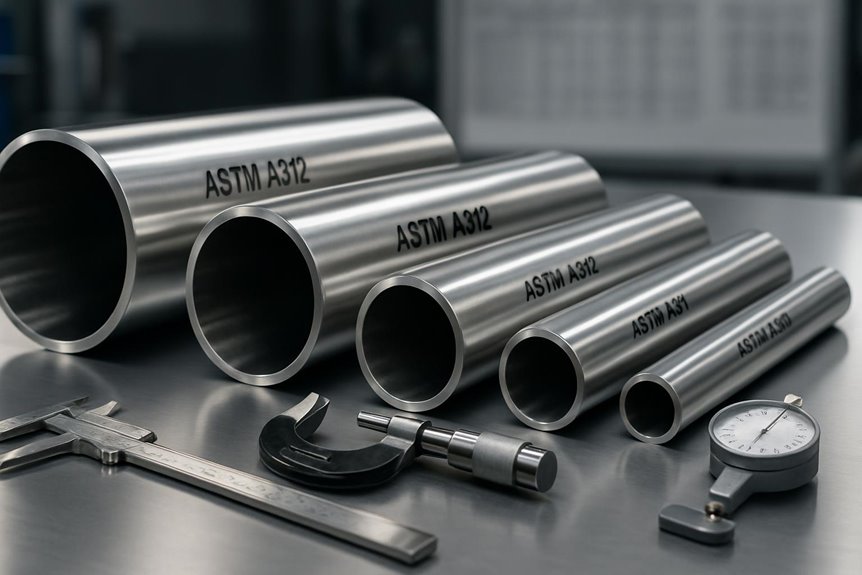
ASTM A312 stainless steel pipe is typically ordered by nominal pipe size (NPS) together with a schedule number or specified wall thickness. The order may also define required length, end preparation, and the applicable dimensional standard.
For stainless steel pipe, NPS is a nominal designation rather than the actual outside diameter. Standard outside diameters and wall thicknesses are commonly referenced to ASME B36.19M, which covers stainless steel pipe dimensions.
| Order Item | Example | What It Defines |
|---|---|---|
| NPS | 2, 6, 12 | Nominal pipe size |
| Schedule | 5S, 10S, 40S, 80S | Standard wall thickness |
| Length | 6 m, 12 m, custom | Delivery length |
| Dimensional Standard | ASME B36.19M | OD and wall dimensions |
Common stainless steel schedules include 5S, 10S, 40S, and 80S, although ASTM A312 pipe is not limited to these standard wall thicknesses. Other thicknesses may be specified when required by the design or project specification.
As the schedule increases, the pipe wall generally becomes thicker for the same NPS. This reduces the internal diameter and can increase pressure-handling capability, although actual allowable pressure still depends on the material grade, temperature, applicable design code, and service conditions. The relationship between schedule number and stainless steel pipe thickness is especially important when balancing pressure requirements with internal flow area.
Accurate control of outside diameter, wall thickness, internal diameter, and length is important for fitting compatibility, welding, flow calculations, and installation. Projects that rely on tight dimensional matching also benefit from understanding available stainless steel round pipe sizes before finalising fittings and fabrication details.
Unlike stainless steel tubing, which is usually specified directly by outside diameter and wall thickness, pipe uses the NPS and schedule system. This distinction between stainless steel pipe and tube dimensions is one of the main reasons pipe and tube specifications should not be treated as interchangeable.
Because ASTM A312 pipe is intended for pressure and corrosive service, the standard requires it to be supplied in the specified heat-treated condition to restore the required austenitic microstructure, control carbide precipitation, maintain corrosion resistance, and achieve the specified tensile and yield properties.
ASTM A312 heat treatment ensures pressure-service pipe retains corrosion resistance, austenitic structure, and required mechanical properties.
For austenitic grades, this generally means solution heat treatment: the pipe is heated to the temperature required for its grade, held sufficiently to dissolve harmful carbides and homogenize the structure, then rapidly cooled to prevent sensitization. The specified condition is also important because 316 stainless steels rely on controlled alloy chemistry, including chromium, nickel, and molybdenum content, to support corrosion resistance after processing.
This controlled condition matters after welding, hot working, or heavy cold working, where uncontrolled thermal history can reduce corrosion performance or alter strength. Proper heat treatment also helps improve dimensional stability by reducing residual stresses that can otherwise contribute to distortion in finished pipe. For applications involving extensive welding, 316L stainless steel is often selected because its lower carbon content reduces the risk of carbide precipitation while maintaining corrosion resistance comparable to 316.
In chloride-bearing or marine environments, the molybdenum in 316 stainless steel improves resistance to pitting corrosion compared with 304 stainless steel. Surface treatments such as passivation can further enhance corrosion resistance where the service environment justifies additional finishing.
Purchasers should verify the grade-specific heat-treatment condition in ASTM A312 rather than rely on generic annealing terms.
For deeper background, see Heat Treatment of Stainless Steel Pipes.
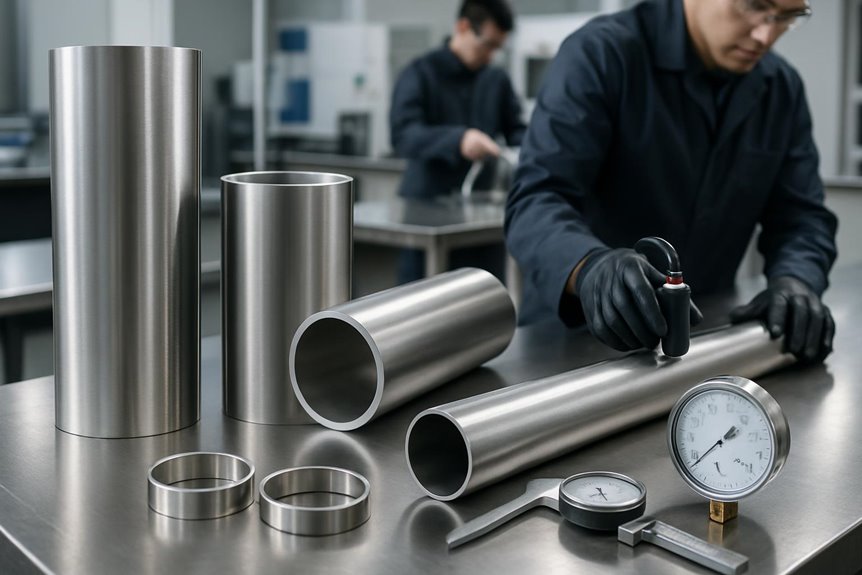
ASTM A312 pipe must meet the required mechanical, integrity, and dimensional checks for the specified grade and product condition. Core controls include tensile-property requirements, mechanical testing, and either hydrostatic or permitted nondestructive electric testing, depending on the applicable requirements.
| Test / Inspection | What It Verifies |
|---|---|
| Tensile testing | Required yield strength, tensile strength, and elongation |
| Flattening test | Ductility and integrity of the pipe and weld where applicable |
| Hydrostatic or nondestructive electric test | Pressure-boundary or defect-detection integrity |
| Dimensional inspection | Compliance with ordered size, wall thickness, length, and tolerances |
For pressure-service applications, hydrostatic testing of stainless steel pipe helps confirm that the pipe can withstand the specified test conditions without leakage or unacceptable deformation. Where nondestructive electric testing is permitted, the objective is to identify discontinuities that could affect service reliability.
Additional visual or nondestructive examinations may also be specified where the project requires closer control of weld condition, surface imperfections, or internal defects. These inspections complement broader stainless steel tube testing methods used to verify dimensional consistency and material integrity.
Supplementary tests are not automatically required for every ASTM A312 order. Extra examinations, corrosion tests, PMI, or project-specific acceptance criteria must be defined in the purchase specification when needed.
Test results should remain traceable to the supplied pipe through the stainless steel mill test certificate, with the heat number, grade, dimensions, and reported inspection results matching the delivered material.
Traceability is the core meaning of “ASTM A312 compliant” on a mill test certificate. The certificate should let the purchaser verify, not assume, conformity. It should identify the manufacturer, product description, ASTM A312/A312M designation, grade, heat number, dimensions, manufacturing method, and heat-treatment condition.
It should also report chemical analysis, mechanical-test results, applicable test results, and certificate authorisation. For potable-water applications, purchasers may also need evidence that the pipe meets recognised safety requirements such as NSF/ANSI 61. For hygienic service, documented surface condition may also matter because a polished surface finish helps minimise crevices where bacteria can accumulate.
The heat number is critical. It should connect the reported chemistry and tests to the delivered pipe or bundle through markings, tags, or controlled documentation. If that link is broken, control is lost. When reviewing certification and quotes together, purchasers should also compare the documented specification against quality standards, shipping terms, and any volume discounts rather than judging the offer on base price alone.
A certificate stating only “316L” does not establish ASTM A312 conformity. Grade identification is only one element; the standard requires documented evidence that the supplied pipe meets the specified requirements. Because stainless steel pipes are often chosen for corrosion resistance in plumbing and industrial systems, documented conformity helps confirm the material is suitable for its intended service. In chloride-rich or humid environments, even austenitic stainless steels can be vulnerable to pitting corrosion if material selection, surface condition, and maintenance are not properly controlled.
ASTM A312 and ASTM A358 can both apply to austenitic stainless steel pipe, but they are not interchangeable standards for welded pipe. The correct specification depends on the required manufacturing route, pipe dimensions, weld construction, and inspection requirements.
| Point | ASTM A312 | ASTM A358 |
|---|---|---|
| Product scope | Seamless, straight-seam welded, and heavily cold-worked austenitic pipe | Electric-fusion-welded austenitic pipe |
| Manufacturing route | Multiple permitted manufacturing methods | Fusion-welded construction |
| Typical selection basis | General process, corrosive, and high-temperature service | Projects specifically requiring the A358 welded-pipe construction and inspection framework |
| Inspection focus | Requirements defined within A312 and the purchase specification | Weld class, radiographic examination, heat treatment, and other A358-specific requirements |
| Best fit | Standard stainless process pipe in common sizes and schedules | Welded pipe where the project specification specifically calls for A358 |
The key point is that a pipe should not move from ASTM A312 to ASTM A358 simply because it is welded. ASTM A312 already includes welded pipe within its scope.
ASTM A358 becomes relevant when the required product form and project specification call for its electric-fusion-welded construction, weld classification, and inspection requirements.
Selecting the correct standard at the specification stage helps avoid mismatches in manufacturing method, weld examination, documentation, and final material acceptance.
Why is “316L ASTM A312 pipe” not enough for a reliable quotation? It leaves too many controls undefined.
A disciplined RFQ should state the ASTM A312/A312M edition, grade such as TP316L or TP304L, manufacturing route—seamless, welded, or HCW—NPS, wall schedule or exact thickness, and required length.
It should also define end finish, including plain, bevelled, or threaded where applicable.
For procurement control, the request should specify surface condition, heat-treatment condition, standard testing plus any supplementary tests, and documentation such as MTC or EN 10204 certification.
Marking requirements should cover project identification and traceability. Quantity must be expressed clearly in pieces, metres, or weight.
Packaging should identify domestic handling or export preservation.
This checklist gives Vinmay the data needed to quote accurately.
A complete RFQ reduces ambiguity, but common ASTM A312 mistakes can still lead to wrong material, delays, or non-compliant deliveries.
Buyers often confuse pipe OD with NPS, or specify ASTM A312 for sanitary, OD-based tube where another standard applies. Omitting schedule or exact wall thickness also removes dimensional control.
Material selection is another risk: TP316L should not be assumed suitable for every corrosive fluid without checking chemistry, temperature, chlorides, and service conditions.
Some orders request seamless pipe without a technical basis, adding cost or limiting availability. Others fail to state supplementary inspection requirements when additional testing is needed.
ASTM A312 should not be treated as the system design code.
Finally, the MTC must be checked against heat numbers marked on the delivered pipe before acceptance.
Vinmay supports stainless steel pipe and tube projects with welded manufacturing capability, specification review, inspection support, and international delivery services.
For orders involving ASTM A312 stainless steel pipe requirements, the technical review can cover the specified grade, dimensions, wall thickness, surface condition, testing requirements, documentation, and delivery format before production. This helps ensure that the supplied product is aligned with the project specification rather than being selected only by grade or nominal size.
Vinmay works with stainless steel grades including 304, 304L, and 316L and can support customized requirements for surface finish, length, and other dimensional details. Material samples, measurement verification, and online factory inspections can also be arranged to support qualification before full-order production.
For international projects, Vinmay supplies customers across more than 100 countries and supports flexible payment terms including T/T, L/C, D/P, and O/A, together with logistics and customs-clearance coordination.
Send Vinmay your required ASTM A312 grade, NPS, wall thickness or schedule, length, testing requirements, and destination to confirm the available manufacturing and documentation options for your project.
Yes—ironically, a pipe built for pressure and corrosion can serve sanitary duties only when its finish, cleaning, passivation, grade, and fabrication controls meet hygienic requirements. A312 alone does not grant sanitary compliance or surface quality.
Yes. ASTM A312 austenitic stainless pipe may suit cryogenic service when the selected grade, heat treatment, toughness, and project code requirements are verified. The spec alone should not be treated as automatic cryogenic approval.
ASTM A312 itself does not set a universal records-retention period. The purchaser, manufacturer, or project authority should define retention in purchase documents, quality procedures, or code requirements, commonly preserving MTRs through service life or contractually specified periods.
Yes. ASTM A312 pipe may be polished after production if dimensional tolerances, cleanliness, corrosion resistance, marking, and any ordered finish requirements remain controlled. The purchaser should specify polishing grade, acceptance criteria, and post-polish inspection.
No. ASTM A312 does not inherently require third-party inspection. It leaves that added assurance step to the purchase order or project specification, giving the buyer control to request independent witnessing, review, or certification.
ASTM A312 is more than a material designation. It defines the manufacturing, heat treatment, mechanical-property, testing, dimensional, and marking requirements that stainless steel pipe must meet before it can be accepted to the specification.
Correct use of the standard starts with more than selecting a grade such as TP304L or TP316L. The manufacturing route, NPS, wall thickness, testing requirements, documentation, and intended service all need to be specified consistently.
When those requirements are aligned from purchase order through material certification and final inspection, ASTM A312 stainless steel pipe can be selected and verified with much greater confidence as part of a reliable process or corrosive-service piping system.