
Selecting the right stainless steel pipe for chemical processing depends on chemical type, concentration, and environmental conditions. Grades 304/304L offer cost-effective solutions for moderate environments, while 316L and Duplex 2205 are suited for high chloride and aggressive conditions due to superior corrosion resistance. Seamless pipes are ideal for high-pressure scenarios; welded tubes suit lower-pressure needs. Proper fabrication, surface treatment, and adherence to ASTM standards are critical. Explore further insights into optimizing stainless steel usage in such systems.
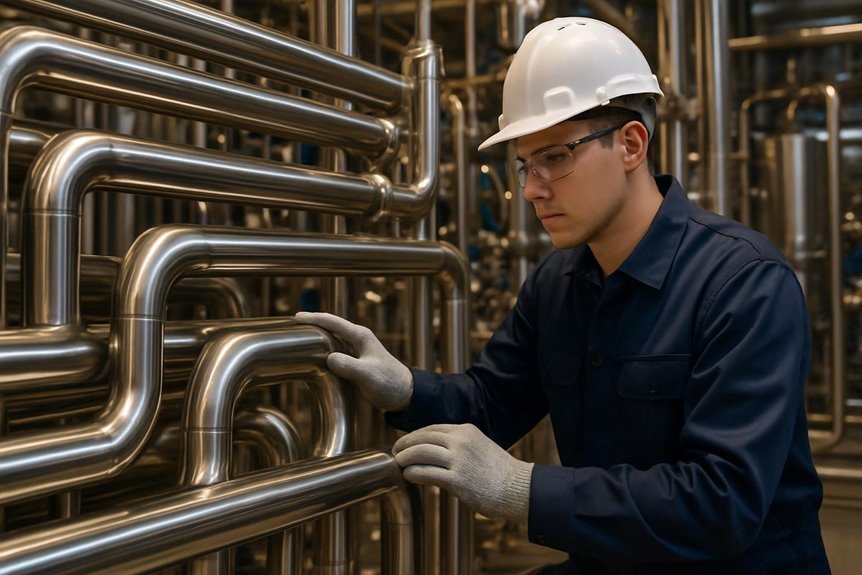
While stainless steel is a common choice in chemical processing, its suitability hinges on multiple factors such as the specific chemical involved, its concentration, temperature, presence of contaminants, and overall operating conditions.
The selection of stainless steel pipe material requires a thorough understanding of these parameters to guarantee compatibility and performance. Standards such as ASTM A312 help define requirements for seamless, welded, and drawn stainless steel pipes used in demanding service conditions.
A comprehensive grasp of these parameters is crucial for ensuring compatibility and optimal performance in stainless steel pipe selection.
Chemical resistant stainless steel pipe, like 316L or Duplex 2205, offers excellent resistance to corrosion and pitting, especially in chloride-rich environments.
For welded systems, 316L stainless steel is often preferred because its low carbon content helps reduce carbide precipitation and preserve corrosion resistance after welding.
However, relying solely on grade names for selection can lead to premature failure, as evidenced by cases where inadequate selection resulted in rapid degradation. In 316 stainless steel, molybdenum improves resistance to chloride-related corrosion compared with 304 stainless steel.
A smooth surface finish can also improve hygienic performance and corrosion resistance by reducing surface roughness and limiting contaminant adhesion. Regular cleaning and inspection support long service life by helping identify corrosion, leaks, or wear before they compromise the piping system.
Consequently, a precise evaluation of the process conditions and material properties is essential for the best stainless steel pipe material selection in chemical processing applications.
Stainless steel pipe selection for chemical processing should begin with the actual service environment, not simply the preferred alloy grade. The process medium, operating conditions, cleaning regime, and external exposure all influence corrosion risk, mechanical requirements, and expected service life.
| Chemical or Operating Condition | Why It Matters | Pipe Selection Consideration |
|---|---|---|
| Chemical type and concentration | Different acids, alkalis, solvents, and process fluids attack stainless steel differently. A change in concentration can significantly alter corrosion behavior. | Confirm chemical compatibility before selecting 304, 316L, duplex, or another alloy. |
| Chloride content | Chlorides can break down the passive layer on stainless steel and increase the risk of pitting, crevice corrosion, and stress corrosion cracking. | 316L is often preferred over 304 where chloride exposure is moderate. Higher-risk conditions may require duplex stainless steel or a more corrosion-resistant alloy. |
| Operating temperature | Higher temperatures can accelerate corrosion and reduce the safety margin of a material that performs well at ambient conditions. | Evaluate the chemical, concentration, and temperature together rather than using room-temperature compatibility data alone. |
| Pressure and flow velocity | Pressure affects required wall thickness, while high flow velocity, suspended solids, or turbulent flow can contribute to erosion-corrosion. | Specify the correct tube dimensions, wall thickness, and product standard for the design pressure and flow conditions. |
| Cleaning and CIP chemicals | Cleaning media may be more aggressive than the main process fluid, particularly when alkaline cleaners, acids, chlorides, or high-temperature cycles are involved. | Include all cleaning, sterilization, and flushing chemicals in the material-selection review. |
| External environment | Humid, coastal, chemical-plant, or poorly ventilated environments can cause external corrosion even when the internal process medium is controlled. | Consider 316L or a higher-grade material where external chloride or chemical exposure is significant. |
| Surface condition and fabrication | Rough surfaces, weld heat tint, embedded iron, and untreated weld zones can become localized corrosion initiation points. | Specify suitable surface finish, controlled welding, pickling, and passivation where required. |
For many welded chemical-process systems, 316L stainless steel is selected because its molybdenum content improves resistance to localized corrosion compared with 304 stainless steel, while its lower carbon content helps reduce the risk of carbide precipitation and intergranular corrosion in welded areas. However, 316L is not a universal solution. High chloride levels, elevated temperatures, concentrated acids, or severe crevice conditions may require duplex stainless steel or another alloy with higher corrosion resistance.
A reliable specification should therefore consider the complete service profile: process chemical, concentration, temperature, pressure, flow conditions, cleaning media, external exposure, and required surface condition.
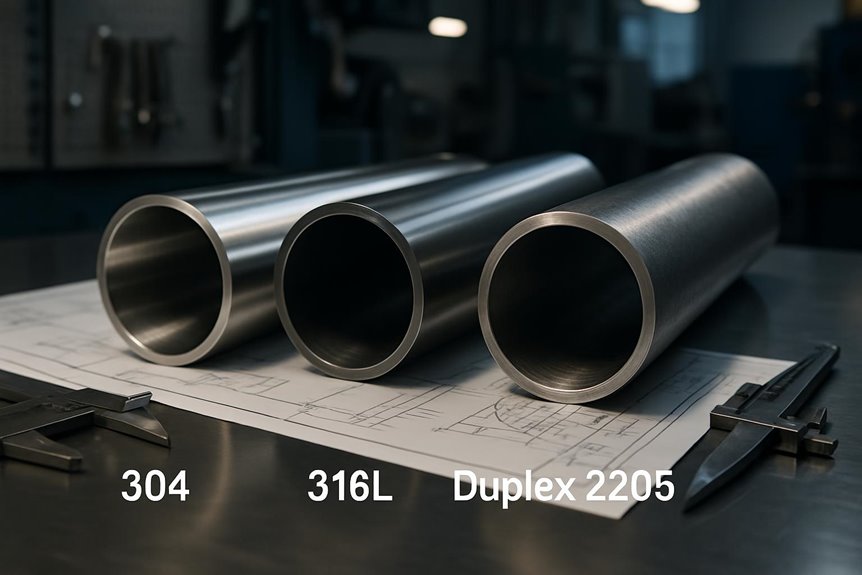
Selecting the appropriate stainless steel grade for chemical processing involves evaluating operational requirements and environmental conditions. ASTM standards also help verify chemical composition and material properties for compliant grade selection.
Grade 304 or 304L is typically suitable for general applications with moderate corrosion exposure, while 316L offers enhanced resistance in chloride-rich and high-temperature environments. The molybdenum content in 316L improves resistance to pitting and harsh chemical attack compared with 304. In warm chloride environments, 304 stainless steel can be vulnerable to chloride pitting and stress corrosion cracking, making routine inspection important.
For highly aggressive conditions, Duplex 2205 provides superior strength and pitting resistance, making it a valuable consideration in demanding chemical processes. Proper surface treatments such as passivation or electropolishing can further improve corrosion resistance and long-term durability in harsh processing environments.
Relevant ASTM specifications, such as ASTM A312, help define requirements for stainless steel pipes used in high-temperature and corrosive service.
In the domain of stainless steel selection for chemical processing, 304 and 304L are often suitable for applications where extreme corrosion resistance is not the primary concern. These grades offer a balance of affordability and adequate performance for less aggressive environments. Compared with 201 stainless steel, 304 provides better corrosion resistance largely due to its higher nickel content.
When considering stainless steel pipe for chemical processing, the following factors highlight their suitability:
For fabricated piping supports or related structural tube components, ASTM A554 304 stainless is valued for its heat resistance and corrosion resistance.
The chromium content in 304 stainless steel helps form a passive oxide layer that supports its corrosion resistance in suitable environments.
These factors make 304 and 304L viable choices in controlled conditions where cost and simplicity are prioritized. Their low maintenance requirements can further reduce lifecycle costs in appropriate chemical processing applications. For tubing and piping components, 304 stainless steel is also available in seamless and welded forms to suit different fabrication and structural requirements.
Why does 316L stand out when evaluating corrosion resistance among stainless steels? Its higher molybdenum content enhances resistance to pitting and crevice corrosion, essential for the chemical industry.
Unlike 304, 316L excels in handling chlorides and acidic environments.
In comparing welded vs seamless pipe for chemical service, 316L offers reliable performance in both forms, though seamless pipes are preferred for high-pressure applications due to their uniformity.
While duplex stainless steel pipe provides superior strength, 316L remains a cost-effective choice where moderate corrosion resistance suffices.
Its versatility and availability make it a preferred option for diverse chemical processing systems, ensuring durability and operational efficiency. Regular inspection can help identify early signs of pitting corrosion before tube or pipe integrity is compromised.
Proper TIG or MIG welding can help preserve the alloy’s structural integrity by reducing the risk of fabrication-related defects.
In lower-cost alternatives such as 201 stainless steel, a chromium-rich oxide film helps prevent rust but can be compromised by dust, organic acids, and pollutants. In 304 stainless steel, crevice corrosion can occur in confined areas where oxygen depletion weakens the protective surface film.
In medical applications, 316L is also valued for corrosion resistance against bodily fluids and repeated sterilization cycles.
Although 316L stainless steel is a popular choice for many applications, Duplex 2205 offers a compelling alternative when higher strength and enhanced corrosion resistance are required. This grade is particularly beneficial in chemical processing stainless steel tubing and chemical plant stainless steel piping. For applications where product purity and cleanability are critical, a smooth, non-porous surface finish can help reduce microbial adhesion and contamination risk.
Key considerations include:
For hygienic or process applications, stainless steel welded round tubes manufactured to standards such as ASTM A269 help ensure consistent quality and performance.
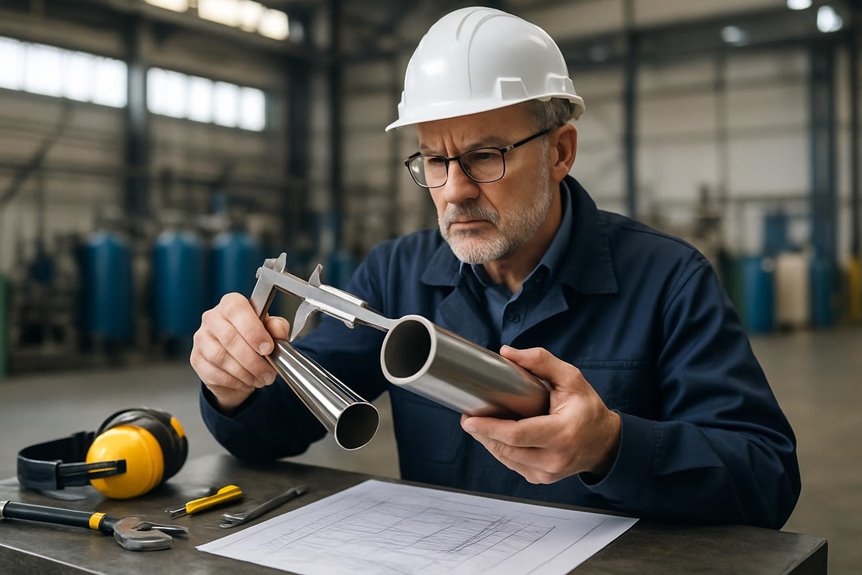
How does one determine the ideal choice between welded tube and seamless pipe for chemical service applications? The decision hinges on key specifications: pressure ratings, dimensional accuracy, corrosion allowance, and fabrication requirements.
Seamless pipes offer superior pressure resistance due to their uniform structure, making them suitable for high-pressure environments. Welded tubes, however, provide cost advantages and are ideal for lower-pressure applications where precise dimensions and corrosion resistance are vital. ASTM standards also define mechanical properties such as tensile strength, yield strength, elongation, and hardness to verify tube performance in demanding service.
Proper weld inspection is essential to guarantee integrity and compliance with industry standards. Selecting products made to applicable standards, such as ASTM, ensures performance and reliability. For welded stainless steel mechanical tubing, ASTM A554 sets requirements for dimensions, mechanical properties, and surface finish. Accurate specification should also include outer diameter, wall thickness, length, and material grade to support proper installation and standards compliance.
Advancements in welding technology have improved the strength and reliability of welded tubes, making them competitive for many industrial applications. For stainless steel pipe fabrication, shielding gas selection during GTAW or GMAW helps protect the weld area and support consistent corrosion-resistant joints.
Ultimately, the choice involves balancing these factors to meet specific operational demands and safety requirements within chemical processing systems.
Stainless steel pipes are integral to chemical plants, providing essential functionality across various systems. They are employed due to their reliability and resistance to corrosive environments, playing a vital role in maintaining operational efficiency. Grades such as 304 stainless steel are valued for corrosion resistance, durability, and ease of sanitation in demanding fluid-handling environments.
Selecting the right grade, such as 304 or 316 stainless steel, helps ensure compatibility with chloride-rich or chemically aggressive environments.
These applications highlight stainless steel's versatility, guaranteeing safety and durability in chemical processing.
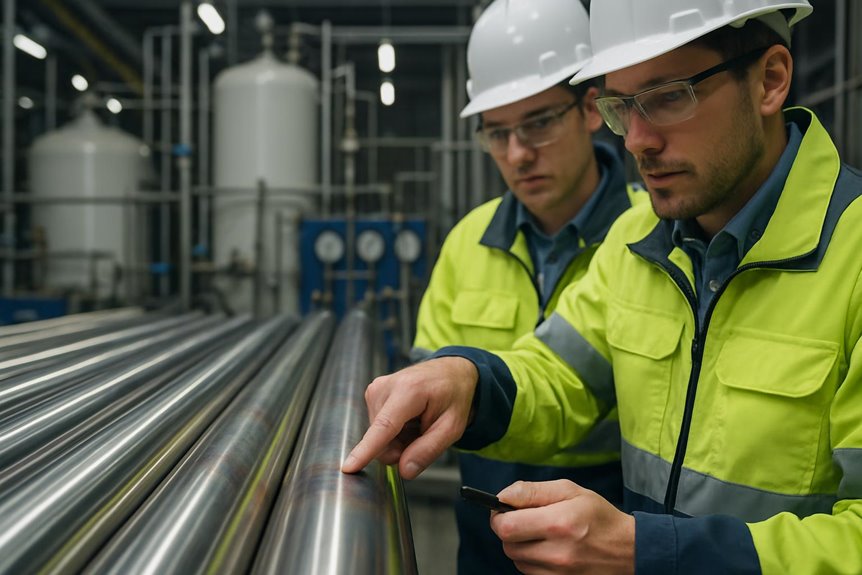
Corrosion in stainless steel pipes is a critical concern in chemical processing, where various forms of degradation can considerably reduce service life.
Pitting and crevice corrosion present significant risks, particularly in environments with high chloride concentrations. These localized attacks compromise the integrity of the pipe, leading to premature failures. Alloys with molybdenum, such as 316 stainless steel, are often preferred where chlorides are present because they provide better resistance to localized corrosion than 304 stainless steel.
Stress corrosion cracking (SCC) is another concern, especially in tensile-stressed environments with corrosive media. For hygienic or contamination-sensitive chemical service, ASTM A270 tubing requirements can support corrosion resistance through controlled chemistry, heat treatment, inspection, and surface quality.
Weld-related corrosion can occur if improper techniques are used, leading to weakened joints. Stainless steel’s chromium oxide surface film can self-heal when properly maintained, helping preserve corrosion resistance after minor surface disruption.
Additionally, external atmospheric corrosion, though less aggressive, can still impact pipes exposed to harsh environmental conditions. Surface damage, poor cleaning, and iron contamination can weaken the passive oxide layer that gives 304 stainless steel much of its corrosion resistance.
Understanding these risks is essential for selecting appropriate materials and implementing preventive measures such as regular inspections and protective coatings, ensuring long-term operational reliability.
In chloride-rich or aggressive environments, selecting Stainless Steel 316 can improve resistance to pitting because its molybdenum content enhances chloride corrosion resistance.
Fabrication and surface condition play a critical role in the performance of stainless steel pipes, just as much as the choice of grade. Guaranteeing ideal fabrication processes and surface conditions can greatly enhance the durability and efficiency of stainless steel in chemical processing systems. Custom fabrication should also account for wall thickness and dimensional tolerances to ensure proper pressure resistance, fitment, and compatibility with connected components.
Key considerations include:
Material Test Reports can verify chemical composition and mechanical properties, helping confirm that stainless steel materials meet required specifications before fabrication.
Relevant standards such as ASTM A270 can also guide tubing requirements where cleanliness, corrosion resistance, and fabrication quality are critical.
For cleanliness-critical systems, orbital welding can improve weld repeatability and help produce smooth, crevice-free joints that reduce contamination risks.
Smooth finishes such as mirror polish can further improve cleanability by minimizing bacterial adhesion and supporting corrosion resistance.
Attention to these factors guarantees longevity and reliability.
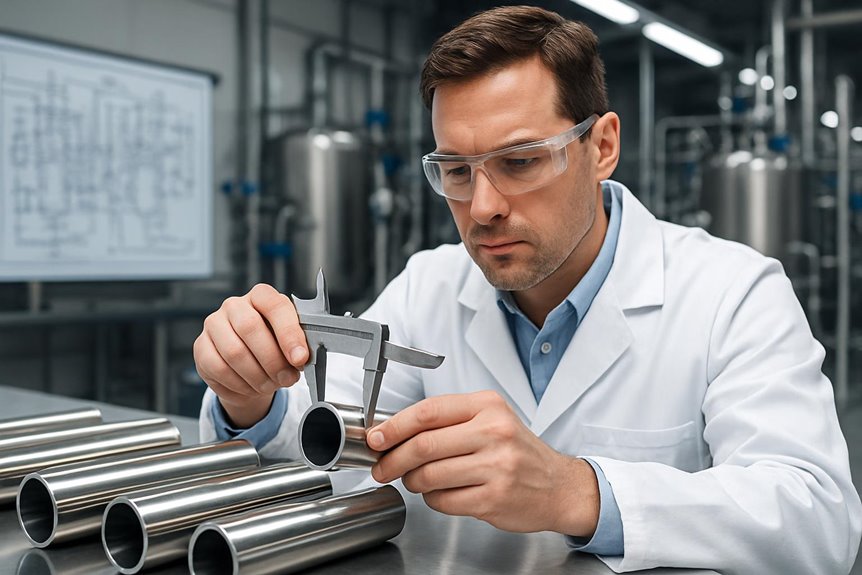
When sourcing stainless steel pipes for chemical processing, attention to detail in specifications is paramount to guarantee peak performance and longevity.
Key factors include selecting the appropriate grade and product form, such as welded or seamless construction. Compliance with standards like ASTM, EN, or DIN is essential.
Selecting the right grade and form, like welded or seamless, ensures compliance with ASTM, EN, or DIN standards.
Precise measurements for outer diameter (OD), wall thickness, and length must be defined. Surface finish and any necessary post-treatment should be specified based on chemical-service conditions.
Material test certificates and inspection requirements provide assurance of quality and conformity.
This meticulous approach allows for best functionality and durability in demanding environments, ensuring that the chosen materials effectively withstand corrosive conditions and operational stresses.
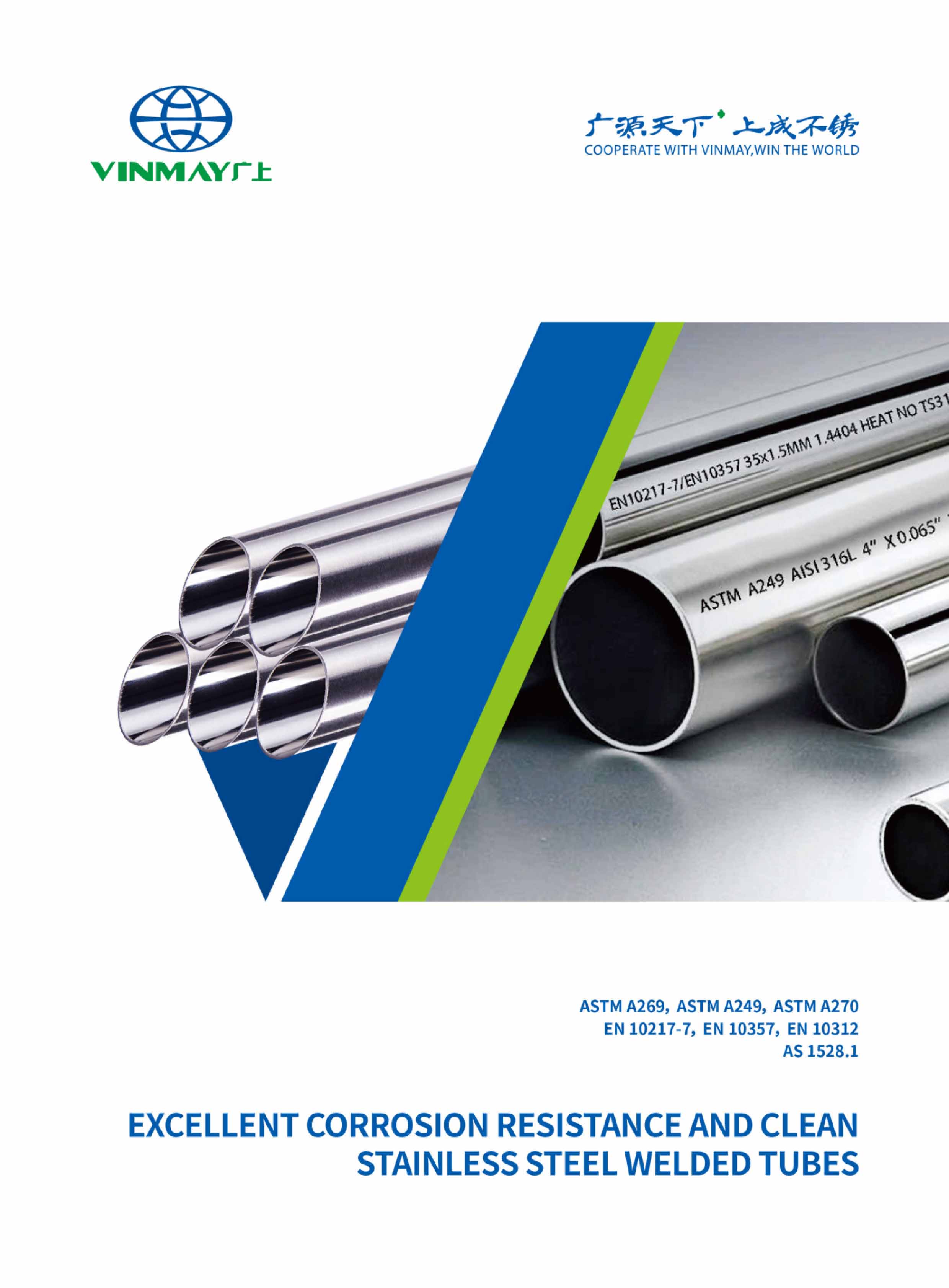
Vinmay supplies stainless steel welded tubing for chemical processing systems where material traceability, corrosion performance, and dimensional consistency are critical. Available grades include 304, 304L, 316L, and selected higher-corrosion-resistance options, with production aligned to relevant ASTM, EN, and DIN standards.
Each order can be supported by material documentation, controlled dimensional inspection, weld-quality checks, and surface-finish verification. This helps ensure the tubing supplied matches the specified process conditions, from chemical transfer lines and utility systems to cleaning and recovery applications.
Vinmay also supports project qualification through online factory audits, sample evaluation, and measurement verification before production or shipment. Custom dimensions, surface finishes, and lengths can be discussed according to the chemical media, operating temperature, pressure, and installation requirements.
With export logistics and customs-clearance support for international deliveries, Vinmay helps simplify sourcing for chemical processing projects across global markets.
Contact Vinmay to discuss your chemical service conditions and receive a suitable stainless steel tubing recommendation, technical data, or sample for evaluation.
Temperature affects stainless steel pipe performance by influencing its mechanical properties and corrosion resistance. As heat rises, like a conductor leading an orchestra, thermal expansion and stress levels increase, potentially compromising structural integrity and efficiency in chemical environments.
Maintenance for stainless steel pipes involves regular inspections for corrosion, cleaning to prevent buildup, and monitoring temperature fluctuations. Ensuring proper welding techniques and promptly addressing leaks or damage preserves integrity and extends service life.
Stainless steel pipes, the unrivaled titans of versatility, can indeed transport gases. Their superior corrosion resistance and mechanical strength guarantee safe conveyance, reducing leakage risks and maintaining integrity even under high pressure, assuring operational reliability.
Stainless steel pipes effectively manage thermal expansion due to their low thermal expansion coefficient and high thermal conductivity. This balance minimizes deformation under temperature fluctuations, ensuring structural integrity and reliability in varying thermal environments.
Stainless steel pipes impact the environment through mining, energy use, and emissions during production. However, they are recyclable, reducing landfill waste. Their durability minimizes resource consumption over time, aligning with sustainable practices in industrial applications.
Coincidentally, the meticulous selection of stainless steel pipes aligns seamlessly with the multifaceted demands of chemical processing systems. By integrating grades like 316L, 904L, and Duplex 2205, engineers fortuitously enhance corrosion resistance and mechanical integrity. This alignment, whether through seamless or welded configurations, underscores the crucial intersection of material science and industrial application. Such precision fortifies operational safety, minimizes maintenance, and inadvertently supports the sustainable advancement of the chemical industry.




[…] grade selection is also important because chloride content, temperature, and operating conditions can affect […]