
Choosing stainless steel process pipe starts with the service, not the alloy grade or pipe schedule. The material must be compatible with the process medium, while the pipe dimensions, construction method, surface condition, joint design, testing, and documentation must suit the operating pressure, temperature, flow conditions, cleanliness requirements, and governing code.
A grade that performs reliably in treated water may not be suitable for a chloride-bearing chemical stream. A schedule-based industrial pipe may fit a reactor transfer line but be inappropriate for a hygienic product-contact system that requires controlled internal roughness and drainable fittings. Welded and seamless products can both serve demanding systems when they are correctly specified, manufactured, inspected, and installed.
The correct decision therefore depends on a sequence of practical questions:
This guide explains how those decisions fit together.
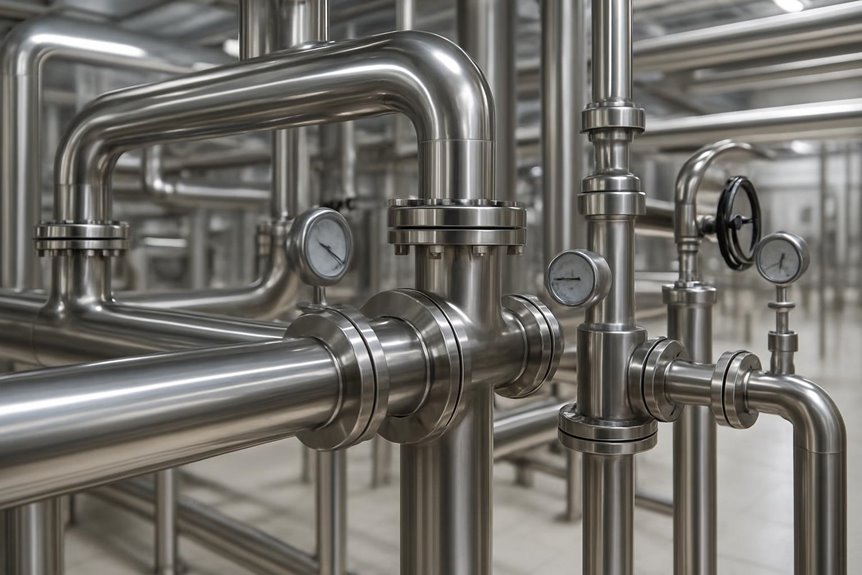
Stainless steel process pipe is piping used to transport liquids, gases, chemicals, steam, slurries, or other media involved in an industrial production, treatment, or conversion process.
The term describes the pipe’s function within the system. It does not identify one specific stainless steel grade, manufacturing route, wall thickness, or product standard.
A process line may connect:
The pipe may carry raw materials, intermediate products, finished products, cleaning solutions, process gases, or waste streams. Its specification is governed by the hazards and operating requirements of that service.
Stainless steel is commonly selected where carbon steel, galvanized steel, copper, or plastics would provide an insufficient combination of corrosion resistance, mechanical strength, temperature capability, cleanability, or product-purity control. However, stainless steel is not automatically resistant to every chemical environment. Grade selection must be based on the complete service envelope.
Process pipe may be manufactured as welded or seamless pipe. Some systems instead use stainless steel process tubing, pressure tubing, heat-exchanger tubing, or sanitary tubing. These products may look similar, but they follow different dimensional systems, manufacturing standards, tolerances, and surface requirements.
Grades such as 304L and 316L are frequently specified because their low carbon content helps reduce sensitization concerns during welding. The added molybdenum in 316L generally provides better resistance to pitting and crevice corrosion than 304L in many chloride-bearing environments. A detailed comparison is available in Vinmay’s guide to 304 vs. 316 stainless steel tubing.
Stainless steel process piping can carry a wide range of media, but suitability depends on more than the fluid’s general name. Concentration, contaminants, chlorides, temperature, pressure, aeration, velocity, stagnant conditions, and cleaning chemistry can significantly change corrosion behaviour.
| Process medium | Typical examples | Main selection concerns |
|---|---|---|
| Water-based fluids | Process water, treated water, cooling water, rinse water | Chlorides, dissolved oxygen, temperature, microbiological conditions |
| Chemicals | Acids, alkalis, solvents, additives, cleaning agents | Chemical compatibility, concentration, contaminants, temperature |
| Gases | Compressed air, inert gases, fuel gases, process gases | Pressure, leakage control, moisture, condensates, corrosion |
| Steam and condensate | Process steam, clean steam, condensate return | Temperature, pressure, condensate chemistry, surface condition |
| Product fluids | Food, beverages, dairy products, pharmaceutical media | Cleanability, product purity, internal finish, hygienic design |
| Slurries | Chemical mixtures, suspended solids, treatment residues | Abrasion, solids loading, velocity, corrosion-erosion interaction |
Water service is not automatically mild. Chlorides, temperature, stagnant zones, deposits, disinfection chemicals, and dissolved contaminants can all affect stainless steel performance.
304L may be suitable for many treated-water and low-chloride systems. Where chlorides are elevated or deposits may concentrate contaminants, 316L or a more resistant alloy may be required. Water-treatment systems should also be evaluated for crevice corrosion around gaskets, supports, flanges, and low-flow branches.
Chemical compatibility must be checked using the actual:
A stainless steel grade that resists a dilute chemical at room temperature may perform differently at a higher concentration or elevated temperature. Mixed chemicals can also behave differently from their individual components.
Material selection should therefore be based on corrosion data, plant experience, laboratory testing, or qualified engineering review rather than a general statement that a grade is “chemical resistant.”
Stainless steel pipe may be used for compressed air, inert gases, natural gas, fuel gas, hydrogen-containing streams, and other process gases when the material, pressure class, fittings, and joining method comply with the applicable system requirements.
Moisture and condensates can be as important as the gas itself. A nominally dry gas may produce corrosive condensate during shutdowns, pressure reduction, or temperature cycling.
Steam systems require consideration of:
Clean-steam systems may also require hygienic tubing, controlled internal finish, high-quality weld roots, and complete drainability.
Food, beverage, dairy, pharmaceutical, and biotechnology systems frequently use stainless steel because it combines corrosion resistance with cleanability and low contamination risk.
These applications often require more than a corrosion-resistant alloy. They may also require:
In these systems, ordinary schedule pipe may not satisfy the dimensional or hygienic requirements even if the alloy grade is chemically compatible.
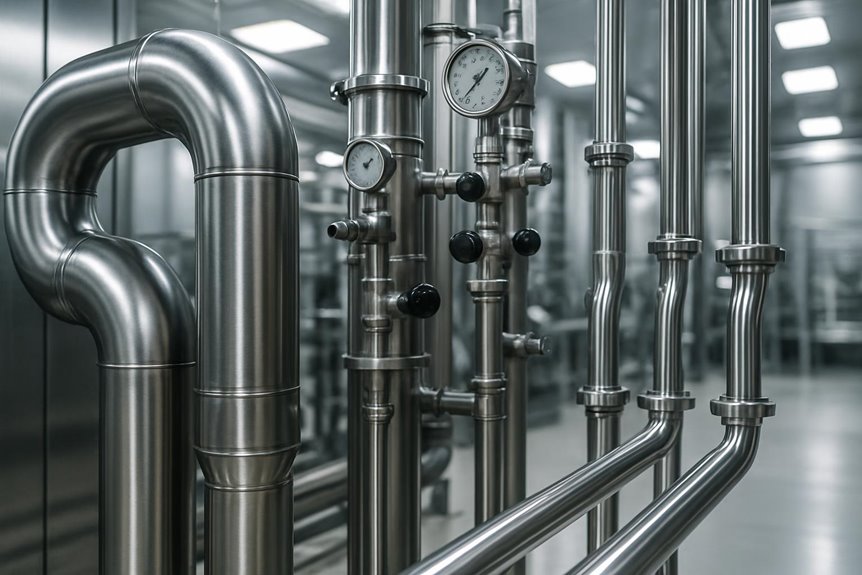
Not every stainless steel line inside a manufacturing facility is process piping. The correct category depends on what the line carries, how directly it affects production, and whether hygienic design is required.
| Piping Category | Primary Function | Typical Media | Main Specification Priorities |
|---|---|---|---|
| Process pipe | Carries raw materials, intermediate products, finished products, or media directly involved in production | Chemicals, gases, slurries, solvents, process water, product fluids | Chemical compatibility, pressure, temperature, corrosion resistance, process-piping code |
| Utility pipe | Supports plant operation without normally becoming part of the product | Cooling water, compressed air, steam, condensate, service water, inert gases | Reliability, pressure rating, energy efficiency, maintenance, utility-system requirements |
| Sanitary process tube | Carries products or cleaning media where contamination control and cleanability are critical | Food, beverages, dairy products, pharmaceutical media, purified water | Surface roughness, drainability, hygienic fittings, CIP/SIP compatibility |
A stainless steel line should generally be treated as process piping when the conveyed medium:
A utility line may still require stainless steel because of corrosion resistance, temperature, pressure, or service-life requirements. However, its specification is normally driven by plant reliability and operating efficiency rather than direct involvement in the manufactured product.
Sanitary process tube becomes appropriate when cleanability, product purity, microbial control, or residue-free drainage is critical.
Unlike ordinary schedule pipe, sanitary tube is typically specified by outside diameter and wall thickness. It may also require:
A line may carry a process fluid without requiring sanitary tubing. Sanitary construction is necessary only when the product, cleaning regime, or contamination risk creates specific hygienic requirements.
After identifying the system category, determine the correct dimensional system:
This distinction matters because pipes and tubes with similar nominal dimensions may not share the same actual outside diameter, wall thickness, fittings, or connection systems.
The system function should therefore be identified first. The dimensional product form—pipe or tube—should be selected second.
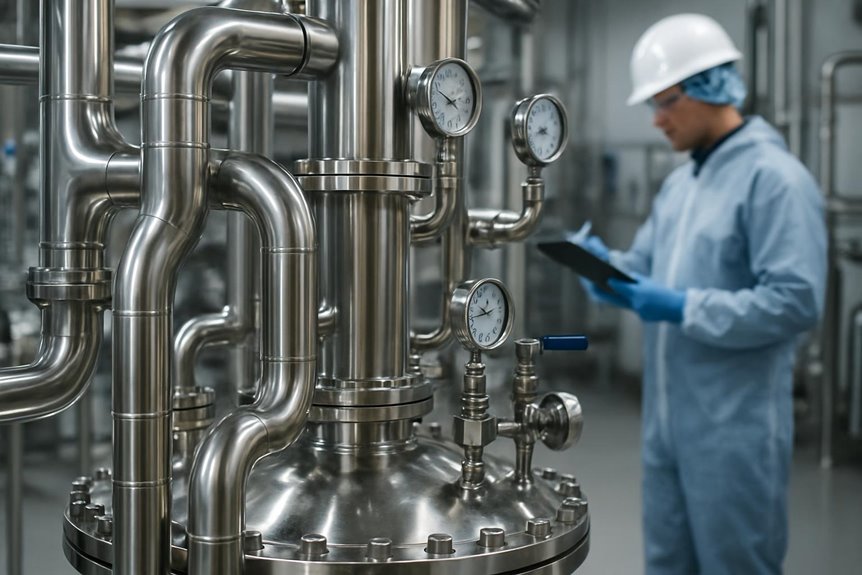
The stainless steel grade, wall thickness, construction method, surface condition, and testing requirements should only be selected after the actual service conditions have been defined.
| Selection factor | Information required | Why it matters |
|---|---|---|
| Process medium | Liquid, gas, chemical, steam, or slurry | Establishes basic material compatibility |
| Concentration | Normal, minimum, and maximum concentration | Corrosion behaviour can change with concentration |
| Chloride exposure | Process media, cleaning fluids, water, atmosphere | Influences pitting and crevice corrosion |
| Temperature | Operating, cleaning, startup, shutdown, and upset conditions | Affects corrosion rate, allowable stress, and expansion |
| Pressure | Normal pressure, design pressure, vacuum, surge conditions | Determines minimum wall thickness and joint rating |
| Flow conditions | Velocity, turbulence, solids loading, two-phase flow | May introduce erosion, vibration, or deposition |
| Cleaning method | Flush, chemical cleaning, CIP, or SIP | May expose the material to more aggressive conditions than normal service |
| External environment | Indoor, outdoor, coastal, humid, insulated, chemically aggressive | Influences external corrosion and insulation requirements |
| Failure consequence | Leakage impact, contamination risk, safety, downtime | Determines inspection, testing, and documentation levels |
The material must be evaluated against the real chemical composition of the process stream. The trade name of a product or a broad category such as “acid,” “solvent,” or “process water” is not enough.
The specification should identify:
Corrosion resistance can change substantially with temperature and concentration. A grade that performs well in a dilute solution may not remain suitable if the solution becomes concentrated during heating, drying, or shutdown.
Chlorides can break down the passive surface film on stainless steel and initiate localized corrosion. The main risks are:
316L usually offers greater resistance than 304L because of its molybdenum content, but 316L is not immune. High chloride levels, elevated temperature, deposits, poor drainage, or stagnant conditions may require duplex stainless steel or another more resistant alloy.
Vinmay’s guide to stainless steel tube corrosion explains the main corrosion mechanisms and preventive measures.
Design pressure and temperature determine more than wall thickness. They also affect:
Normal operating pressure should not be used as the sole design basis. The specification must account for the maximum credible pressure, including surge, pump shutoff, blocked outlet, thermal expansion, pressure relief settings, and startup or cleaning conditions.
Similarly, the maximum design temperature may occur during steam cleaning, sterilization, regeneration, or upset service rather than normal production.
Velocity affects pressure drop, pump demand, erosion risk, solids suspension, and deposition. Slurries or streams containing abrasive solids may require lower velocity, thicker walls, larger bend radii, or replaceable wear components.
Low velocity can also create problems. Stagnant regions and deposits may concentrate chlorides, exclude oxygen, and create conditions favourable to crevice corrosion or microbiologically influenced corrosion.
Pipe routing should therefore avoid unnecessary dead legs, poorly drained sections, and fittings that trap solids where the service makes these risks significant.
Cleaning chemistry may be more aggressive than the normal process medium. Alkalis, acids, hypochlorite solutions, oxidizing agents, and high-temperature cleaning cycles should be included in the corrosion review.
Shutdown conditions also matter. A line that performs well during continuous flow may corrode when:
The full operating cycle must be considered, not only the steady-state process.
Grade selection should provide an adequate corrosion and mechanical margin without assuming that the most highly alloyed material is always the best choice.
The most common starting points are 304L, 316L, and duplex 2205.
| Selection factor | 304L | 316L | Duplex 2205 |
|---|---|---|---|
| General corrosion resistance | Suitable for many mild services | Improved resistance in many chemical environments | Strong performance in selected aggressive environments |
| Chloride resistance | Limited compared with 316L | Better than 304L | Substantially better than conventional austenitic grades in many chloride services |
| Yield strength | Standard austenitic range | Standard austenitic range | Significantly higher |
| Welding | Generally straightforward with qualified procedures | Generally straightforward with qualified procedures | Requires tighter heat-input and procedure control |
| Typical use | Mild process water, general industrial service | Chloride-bearing water, food, pharmaceutical, chemical service | Brines, seawater-related systems, high-chloride process streams |
| Main limitation | Localized corrosion in chloride-rich service | Not immune to pitting, crevice corrosion, or SCC | More demanding fabrication and temperature limitations |
Select 304L stainless steel process pipe for water-based media and mildly corrosive industrial service where chloride exposure is low and operating conditions remain within the corrosion resistance limits of an austenitic 18Cr-8Ni alloy.
The low-carbon 304L grade supports welded construction by reducing carbide precipitation risk during fabrication and post-weld service. It is commonly specified where cleanliness, moderate chemical resistance, and controlled cost are required.
Selection should be verified against project corrosion data and governing specifications before procurement and installation.
316L contains molybdenum, which improves resistance to pitting and crevice corrosion in many chloride-bearing environments.
It is commonly considered for:
The low carbon content supports welded fabrication by reducing sensitization risk. However, 316L should not be described as universally resistant to acids or chlorides. Suitability depends on concentration, temperature, aeration, flow, deposits, and the presence of crevices.
Where the service exceeds the corrosion resistance of 316L, increasing wall thickness is not necessarily an adequate solution. Localized corrosion can penetrate a thick wall without producing uniform material loss. A more resistant grade or a change in system design may be required.
Duplex 2205 combines austenitic and ferritic phases. It provides substantially higher yield strength than 304L or 316L and improved resistance to chloride stress corrosion cracking and localized corrosion in many environments.
It may be considered for:
Duplex stainless steel requires careful fabrication control. Welding procedures must manage heat input, interpass temperature, filler selection, shielding, and cooling to preserve an acceptable phase balance and avoid harmful intermetallic phases.
Duplex 2205 is also not suitable for every high-temperature service. Its temperature limitations and the actual process chemistry must be evaluated before specification.
Welded and seamless stainless steel products can both provide reliable process service when they are manufactured, inspected, and applied correctly.
The choice should be based on:
| Selection issue | Welded pipe | Seamless pipe |
|---|---|---|
| Construction | Formed and longitudinally welded | Produced without a longitudinal manufacturing seam |
| Size availability | Broad dimensional and customization options | Availability may be more limited in certain dimensions |
| Weld inspection | Manufacturing seam requires controlled production and inspection | No longitudinal seam to inspect |
| Surface and dimensional control | Can be tightly controlled under the applicable standard | Depends on manufacturing route and finishing |
| Cost | Often more economical in suitable sizes | Typically higher production cost |
| Best selection basis | Standard, service, inspection, and manufacturing quality | Standard, service, availability, and project requirements |
A welded product should not be rejected merely because it has a longitudinal seam. Modern welded pipe and tube can be produced with controlled forming, automated welding, heat treatment, sizing, nondestructive testing, and documented traceability.
Likewise, seamless construction should not automatically be assumed to provide a smoother surface, better corrosion resistance, or greater dimensional accuracy. These characteristics depend on the grade, heat treatment, manufacturing process, finishing, inspection, and applicable standard.
For a detailed comparison, see our guide to welded vs. seamless stainless steel tubing.
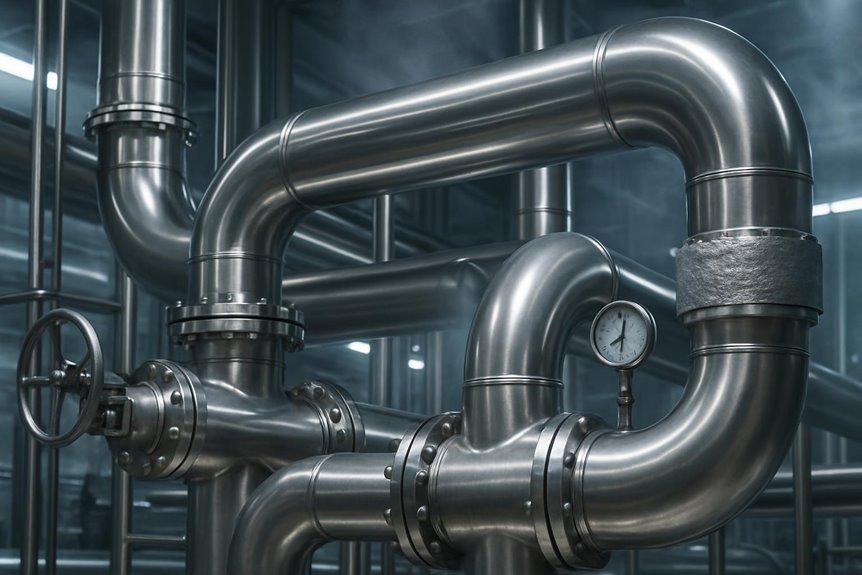
The pipe size and wall thickness must be determined through the applicable design code and system calculations. No single schedule is correct for every process service.
The required flow rate influences:
A thicker pipe wall reduces the internal diameter for a given outside diameter. Selecting a higher schedule than necessary can therefore increase material cost and pressure drop without providing a meaningful service benefit.
Design pressure affects:
The calculation should consider manufacturing tolerance, corrosion allowance, mechanical allowance, and any code-required factors.
Temperature influences:
The system must also account for differential expansion between stainless steel piping, equipment, supports, and connected materials.
Process piping may experience loads from:
High-cycle vibration can cause fatigue cracking even when the static pressure is modest. Small-bore branches, instrument connections, and unsupported valves require particular attention.
Vinmay’s explanation of stainless steel pipe schedules provides additional dimensional context, but the final schedule must always follow the project’s design calculation and governing code.
The stainless steel grade may be chemically suitable, yet the system can still fail prematurely if the surface is contaminated, the weld root is heavily oxidized, or crevices are introduced during fabrication.
For welded pipe and tube, the manufacturing weld should be evaluated for:
Field and shop welds should be produced under qualified procedures with suitable filler metals, shielding gas, purge practices, joint preparation, heat input, and inspection.
Heat tint forms when the stainless steel surface oxidizes during welding. Heavy oxidation can reduce the chromium content available at the immediate surface and impair corrosion resistance.
Internal root oxidation, sometimes called sugaring, can also create a rough surface that traps contaminants and reduces cleanability.
Back purging is commonly used where the internal weld root must be protected. The required acceptance level should be defined by the service, code, and project specification.
Pickling and Passivation
Pickling removes heat tint, scale, and embedded contamination, while passivation supports the formation of a clean, chromium-rich passive surface after fabrication and cleaning.
Although closely related, the two treatments serve different purposes and are not interchangeable. Our guide to pickling vs passivation explains the differences in process, purpose, and application in more detail.
Passivation cannot reliably remove heavy weld scale or severe heat tint. Where both oxide removal and passive-surface restoration are required, the treatment sequence should be specified accordingly.
Internal roughness becomes especially important in:
A smoother finish may improve cleanability, but the required surface roughness should be linked to the actual process. Specifying a highly polished surface for a general utility line can add cost without improving performance.
Contact with carbon-steel tools, grinding dust, storage racks, lifting equipment, or shared fabrication areas can deposit free iron on stainless steel. These deposits may rust and create apparent stainless steel corrosion.
Good fabrication controls include:
For hygienic weld requirements, Vinmay’s guide to sanitary stainless steel welding provides additional detail.
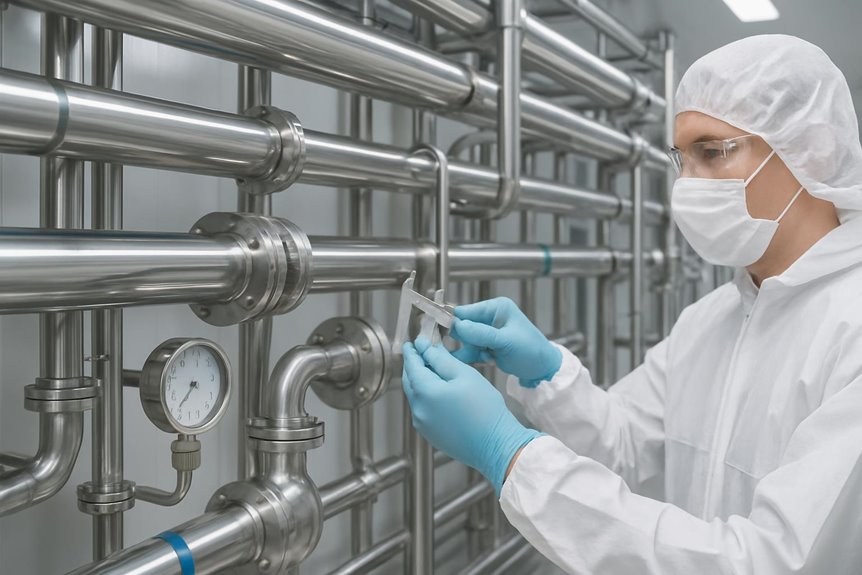
The applicable standard depends on both the system requirements and the product form being supplied. Schedule-based process pipe, general-service tubing, heat-exchanger tubing, pressure tubing, and hygienic process tube are not governed by the same specifications.
It is therefore important to distinguish between a piping code, which governs the completed piping system, and a product standard, which defines how the pipe or tube is manufactured, tested, and supplied.
| Standard | Product or System Scope | Typical Relevance |
|---|---|---|
| ASME B31.3 | Process-piping system code | Design, material selection, fabrication, examination, testing, and installation |
| ASTM A312 | Seamless, welded, and heavily cold-worked austenitic stainless steel pipe | Schedule-based pipe for high-temperature and general corrosive service |
| ASTM A790 | Seamless and welded ferritic/austenitic stainless steel pipe | Duplex stainless steel pipe for general corrosive service |
| EN 10217-7 | Welded stainless steel tubes for pressure purposes | Pressure tubing specified to European requirements |
| ASTM A269 | Seamless and welded austenitic stainless steel tubing for general service | OD-and-wall tubing where a tube specification is required |
| ASTM A249 | Welded austenitic steel boiler, superheater, heat-exchanger, and condenser tubes | Heat-transfer equipment rather than general schedule piping |
| ASTM A270 | Seamless and welded austenitic stainless steel sanitary tubing | Hygienic product-contact and clean-process systems |
| EN 10357 / DIN 11850 / AS 1528.1 | Hygienic stainless steel tubing | Food, beverage, dairy, pharmaceutical, and related clean-process applications |
| ASTM A554 | Welded stainless steel mechanical tubing | Mechanical, structural, and decorative applications rather than pressure-process service |
ASME B31.3 applies to the piping system as a whole. It addresses design conditions, allowable materials, fabrication, joining, examination, pressure testing, and installation.
A material specification such as ASTM A312 or ASTM A790 applies to the supplied pipe itself. It establishes requirements such as chemical composition, mechanical properties, heat treatment, dimensions, testing, and marking.
The piping code and product standard must therefore be specified separately. Compliance with a pipe or tube standard does not by itself confirm that the completed piping system satisfies ASME B31.3.
Use ASTM A312 when the system requires schedule-based austenitic stainless steel pipe, and ASTM A790 when duplex stainless steel pipe is specified.
Where the system uses OD-and-wall tubing rather than NPS pipe, standards such as ASTM A269 or EN 10217-7 may be more appropriate, depending on the pressure duty and project requirements.
Heat-exchanger and condenser tubes should be specified under a dedicated heat-transfer standard such as ASTM A249, rather than treated as general process pipe.
For hygienic systems, standards such as ASTM A270, EN 10357, DIN 11850, or AS 1528.1 may apply. These specifications place greater emphasis on dimensional compatibility, internal surface condition, cleanability, and hygienic service requirements.
The specification should state:
The supplier’s Material Test Report should confirm compliance with the selected product specification. It does not replace the design, fabrication, inspection, or testing requirements of ASME B31.3.
Once the governing piping code and product standard have been identified, the specification should translate the service requirements into a clear, verifiable RFQ. It should define the process medium, operating conditions, material grade, product form, dimensions, construction, surface condition, inspection requirements, documentation, and delivery details.
The first step is to state whether the requirement is for schedule-based pipe or OD-based tube. Process pipe is commonly specified by NPS and schedule, while general-service, heat-exchanger, and sanitary tubing is normally specified by outside diameter and wall thickness. Standards such as ASTM A249 and ASTM A269 apply to tubing rather than schedule pipe, so the product form and dimensional convention must be identified correctly.
Material selection should be based on the complete service environment. Specify the required grade and UNS designation, together with the process fluid, concentration, chloride level, operating temperature, cleaning chemicals, and expected corrosion conditions. For example, 304L may be suitable for mild service, while 316L may provide a better corrosion margin in chloride-bearing or more aggressive environments. Grade suitability should be confirmed against the actual service rather than assumed from the application name alone.
For welded products, define the required manufacturing process, heat treatment, weld condition, and inspection criteria. The specification should also state whether the material must be annealed, pickled, passivated, or polished, particularly where corrosion resistance, cleanability, or product purity is important.
| Specification item | Information to define | Verification basis |
|---|---|---|
| Service conditions | Medium, concentration, contaminants, pressure, temperature | Process data and code review |
| System category | Process, utility, sanitary, or heat-transfer service | P&ID and project specification |
| Product form | Pipe or tube | Dimensional and application requirements |
| Material | Grade and UNS designation | MTR and material standard |
| Construction | Welded or seamless | Product standard and project requirements |
| Dimensions | NPS and schedule or OD and wall thickness | Dimensional inspection |
| Surface condition | Annealed, pickled, passivated, or polished | Visual and surface-finish inspection |
| End preparation | Plain, bevelled, threaded, or other | Drawing and purchase specification |
| Inspection | Hydrostatic, eddy-current, ultrasonic, PMI, or other tests | Inspection and test reports |
| Documentation | MTR, EN 10204 certificate, heat number, traceability | Supplier documentation |
| Delivery | Length, quantity, marking, packaging, and shipment terms | Packing list and purchase order |
The RFQ should also define the required certificates and quality records. Where applicable, request EN 10204 inspection documentation, heat-number traceability, dimensional reports, surface-finish records, and inspection results. Supplier quality systems, including ISO 9001 certification, can support process control, but they do not replace product-specific material certificates or test reports.
Clear specification at the RFQ stage reduces the risk of receiving the wrong grade, dimensional system, surface condition, or documentation package and makes technical comparison between suppliers more reliable.
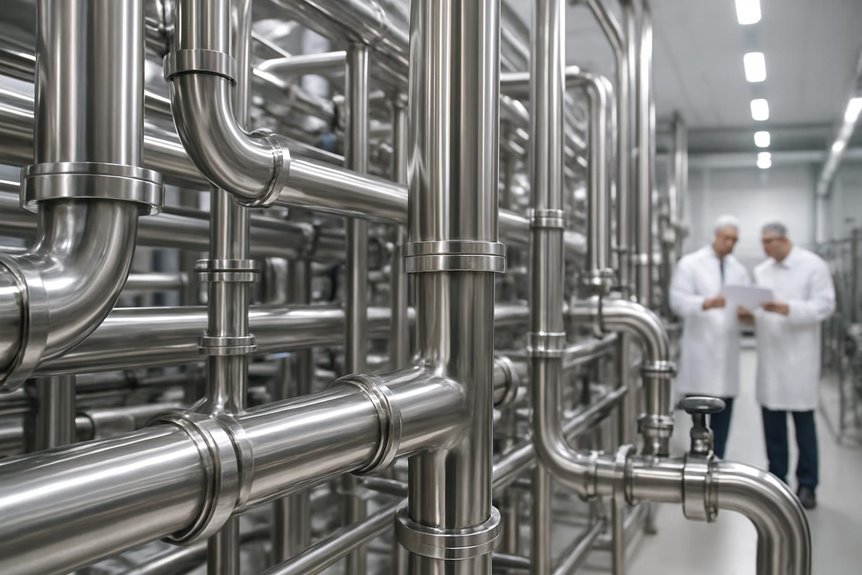
Vinmay supplies stainless steel welded tubes in grades including 304, 304L, and 316L, with production options aligned with relevant ASTM, EN, and DIN requirements.
Dimensional control, weld consistency, heat treatment, surface finish, pickling, passivation, testing, and documentation can be coordinated around the intended process, utility, or hygienic service.
Online factory inspections, material samples, measurement verification, and international logistics support allow technical requirements to be reviewed before full production.
Contact Vinmay with the process medium, operating conditions, system category, required dimensions, and applicable standard to discuss a suitable stainless steel pipe or tube specification.
Not exactly. Fluid pipe is a broad term for piping that carries liquids, gases, steam, or slurries. Process pipe is a more specific category used for media that directly participate in an industrial production or treatment process.
Process pipe carries raw materials, intermediate products, finished products, or process chemicals. Utility pipe supports plant operation through services such as cooling water, compressed air, steam, condensate, or service water.
Sanitary tube is required when cleanability, product purity, microbial control, or residue-free drainage is critical. It is commonly used in food, beverage, dairy, pharmaceutical, and high-purity water systems.
Yes. Welded stainless steel pipe can be suitable when it complies with the applicable standard and the weld seam, dimensions, heat treatment, inspection, and surface condition meet the service requirements.
304L may be suitable for mild process media with limited chloride exposure. 316L is generally preferred where chlorides, acidic residues, cleaning chemicals, or localized corrosion risks are more significant.
Duplex 2205 may be considered when the service requires higher strength, improved resistance to chloride stress corrosion cracking, or greater pitting and crevice corrosion resistance than 316L can provide.
Schedule-based process pipe is normally specified by nominal pipe size and schedule. Sanitary and precision process tubing is generally specified by actual outside diameter and wall thickness.
ASTM A312 is a material and manufacturing specification for austenitic stainless steel pipe. ASME B31.3 is a piping-system code covering design, fabrication, examination, testing, and installation.
The specification should define the process medium, concentration, contaminants, pressure, temperature, flow conditions, grade, product form, dimensions, construction method, surface condition, testing, documentation, and applicable standards.
No. The appropriate construction depends on the service conditions, applicable standard, pressure requirements, inspection criteria, size availability, and manufacturing quality. Neither type is universally superior.
Stainless steel process pipe should not be selected by grade, schedule, or manufacturing method alone. The correct specification begins with the role of the line within the facility.
First determine whether the system is carrying process media, supporting a plant utility, or handling a sanitary product or cleaning fluid. That decision establishes the appropriate product form, dimensional convention, surface requirements, fittings, and governing standards.
The process medium, concentration, pressure, temperature, flow conditions, cleanliness requirements, and corrosion risk can then be matched to the correct stainless steel grade and wall thickness. Product standards and piping codes should be applied only after these service conditions are clearly defined.
A well-written specification connects the system function with the appropriate pipe or tube dimensions, material grade, construction method, surface condition, inspection requirements, and documentation. This approach reduces specification errors and helps ensure that the supplied stainless steel product is suitable for its intended service.



[…] process tubing and sanitary tubing are not interchangeable […]
[…] selection should still account for the process medium, contaminants, temperature, pressure, and chloride exposure before the pipe is released for service. Pipe descriptions should also state outer diameter, wall […]