Understanding how to store stainless steel pipes correctly is essential for preventing contamination, corrosion, and physical damage. Stainless steel pipes should be kept clean, dry, elevated, and protected from impact, moisture, and debris. They should also be separated from carbon steel to prevent iron contamination and rust staining. Clean padded supports, end caps, and non-abrasive lifting equipment help prevent scratches, dents, and internal contamination. Stock should remain traceable by grade and heat number, with regular inspections for damage or condensation. The following guidance explains each storage control in greater detail.
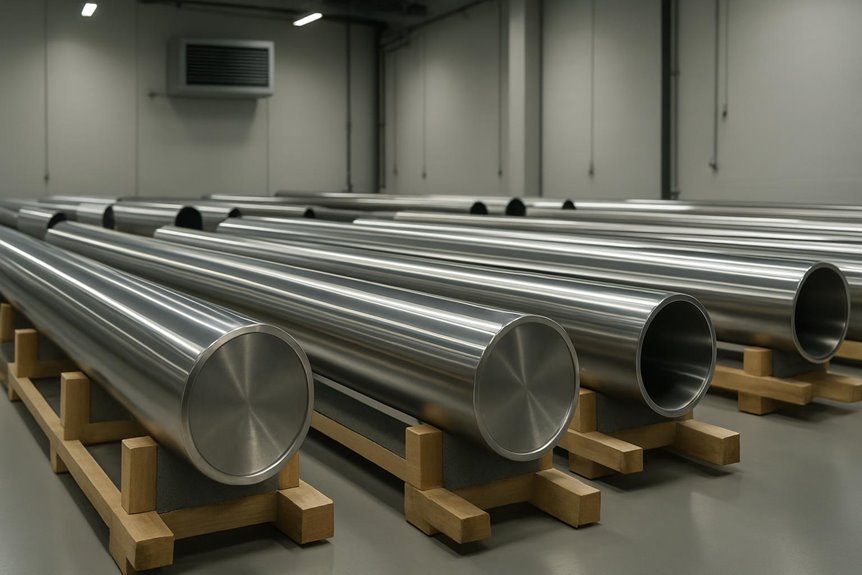
Stainless steel pipes require controlled storage because corrosion resistance does not make them immune to damage or contamination. Poor conditions can transfer iron particles from carbon steel, causing surface rust staining and compromising the passive surface.
Rough supports, dragging, and improper stacking can produce scratches, dents, distorted sections, and damaged pipe ends. Moisture trapped beneath wrapping or between pipes can promote staining, while dust, debris, and moisture entering open ends may create internal contamination. In chloride-prone locations, even small deposits can contribute to pitting corrosion and reduce long-term service performance.
Effective stainless steel storage guidelines protect more than a pipe’s appearance. They preserve corrosion resistance, dimensional condition, cleanability, and surfaces intended for welding. Use clean, non-abrasive supports and weather-resistant materials for racks, attachments, and fixtures to reduce surface damage and environmental exposure.
Controlled segregation also reduces stainless steel pipe contamination from incompatible metals, chemicals, and dirty handling equipment. Clear labeling and organized storage maintain traceability of grade, heat, specification, and batch, helping guarantee that the correct material remains identifiable throughout fabrication, transport, and final installation.
Keeping storage humidity below 60% and preventing condensation helps protect the passive oxide layer from moisture-related staining and corrosion. Regular inspections for corrosion, wear, or contamination allow for immediate damage attention before minor storage issues become costly defects. If contamination is found, prompt cleaning and thorough rinsing with deionized water can help prevent residue and mineral deposits.
Storage control starts at receiving, before any pipe is placed on a rack or combined with accepted inventory. A documented warehouse inspection establishes condition, traceability, and compliance before storage decisions are made. Personnel should inspect the pipes before they enter storage using a receiving-inspection table and retain supporting records.
Effective pipe storage begins at receiving, where documented inspection verifies condition, traceability, and compliance before inventory acceptance.
Confirm that the material identification and documentation align with applicable ASTM standards before accepting pipes into inventory. ASTM requirements help verify chemical composition and other material attributes needed for the specified grade.
Internal checks should identify water, dust, debris, insects, or packaging residue. Quality records should also confirm relevant ISO certifications and inspection requirements before the material is released for storage. Inspection should also verify that actual dimensions remain within permitted size tolerances for the ordered specification.
Damaged or uncertain material should be photographed, isolated, and documented immediately.
Every stainless steel pipe should be kept separate from carbon steel throughout storage and handling. Direct contact can transfer iron particles that later rust, creating carbon steel contamination and staining the stainless surface.
Pipes should never rest on bare carbon-steel racks, rusty containers, loose steel strapping, or shared fabrication tables. Carbon-steel chains, lifting forks, wire brushes, grinding dust, and weld spatter also require strict control.
Suitable pipe storage racks use stainless steel, timber, rubber-lined supports, plastic-covered surfaces, or other non-contaminating materials. This practice helps preserve the corrosion resistance needed for sanitary processing environments. Grade 304 is widely used because its 18/8 composition provides strong corrosion resistance for food-processing equipment.
Handling equipment should be dedicated to stainless steel where practical, with protective covers fitted to forks and contact points. When separate storage cannot be maintained, a durable physical barrier must prevent contact between materials.
Nearby carbon-steel cutting, grinding, and welding should also be controlled to keep airborne particles away from stored pipes. This is particularly important for pharmaceutical and food facilities, where contamination control supports hygienic fluid transport. Clean, polished surfaces also help limit bacterial adhesion and support effective sterilization in sanitary applications.
Regular visual inspections can identify rust staining or surface contamination early, allowing it to be removed before it affects pipe cleanliness or corrosion resistance.
Separation from carbon steel reduces contamination risk, but the storage environment must also match the pipe’s expected exposure. Effective stainless steel pipe storage uses a condition-based approach rather than one universal method. Indoor warehouses require clean handling, ventilation, and segregated areas to limit dust, condensation, and mixed-metal contact. Smooth surface finishes can also reduce contamination buildup and simplify cleaning before installation.
Long-term storage requires scheduled inspections, renewed packaging, and accurate records to preserve traceability. Proper pickling and passivation can help restore a protective oxide layer after contaminants are removed.
Moisture control is essential in every setting. Covers should shed direct weather while permitting ventilation and drainage; tightly sealed covers can trap condensation and increase corrosion risk. Regular rinsing with fresh water helps remove salt and chlorides from pipes stored in coastal or marine environments.
For pipes intended for demanding or chloride-prone environments, selecting 316 stainless steel can provide improved corrosion resistance during storage and service. Its molybdenum content improves resistance to pitting corrosion in chloride-containing environments.
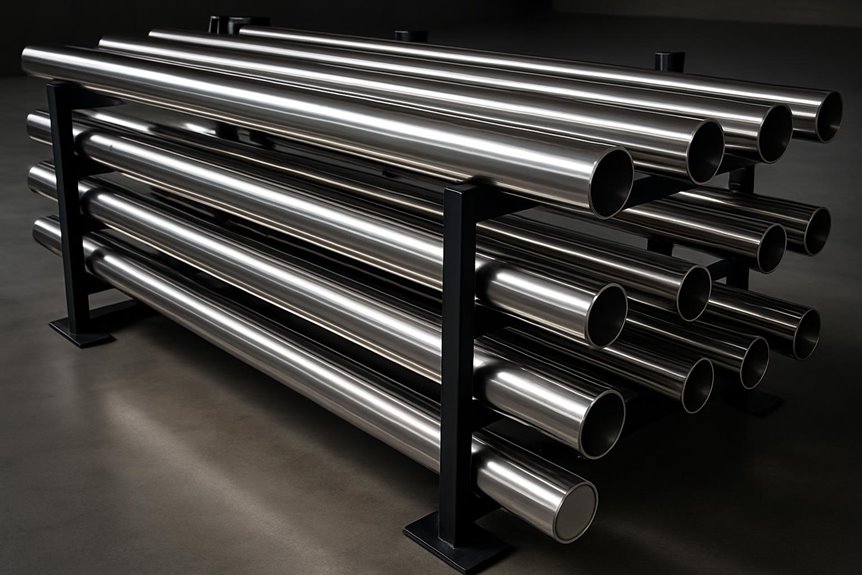
Elevate stainless steel pipes on clean, stable supports rather than placing them on soil, concrete, standing water, or contaminated steelwork. Raised storage keeps bundles clear of splash, drainage paths, and debris while allowing personnel to inspect and lift them safely.
Supports should carry the full bundle load without shifting, rolling, or concentrating weight at a few points. Support spacing should reflect pipe diameter, wall thickness, length, and bundle weight. Thin-wall tubes and polished sanitary tubing generally require closer intervals than heavy schedule pipe to maintain even support. Accurate wall thickness measurements can help determine appropriate support spacing and prevent deformation during storage.
Support surfaces should be clean, non-abrasive, and arranged level to reduce contamination risks. Suitable racks, sleepers, or cradles should also allow clear access for lifting equipment. This is especially important for sanitary tubing, which is used in food, beverage, and pharmaceutical applications where clean surfaces are essential. A high-quality surface finish also helps preserve corrosion resistance and product purity during handling and storage.
Protective packaging may remain in place where practical, provided it stays dry and does not trap water or contaminants against the pipes. Proper storage also helps maintain dimensional accuracy by limiting twisting, dents, and uneven loading during handling.
Proper elevated storage helps preserve the corrosion resistance expected from grades such as 304L and 316L.
Preventing mechanical damage requires controlled handling, stable support, and protection at all contact points. Effective stainless steel pipe handling prevents surface scoring, dents, and pipe deformation during storage, loading, and movement. Clean, non-abrasive spacers should separate pipes wherever rubbing could occur, while supports must remain level and evenly spaced. Proper handling helps preserve the material’s corrosion resistance and finished surface condition.
Regular quality control checks can identify handling damage before pipes are placed into service.
Bundles should never be dropped, and stacking heights should remain within safe limits. Uneven supports, excessive loads, and localized pressure can permanently distort pipes and compromise their appearance and dimensional integrity. Proper protection also preserves the pipe surface quality needed for reliable quality inspection and compliance with required standards. Stainless steel’s surface finish should also be protected because it contributes to both appearance and long-term corrosion performance. Clean pipes thoroughly with a wire brush, suitable cleaner, and clean cloth before storage to remove dirt and oils that could affect the base metal surface.
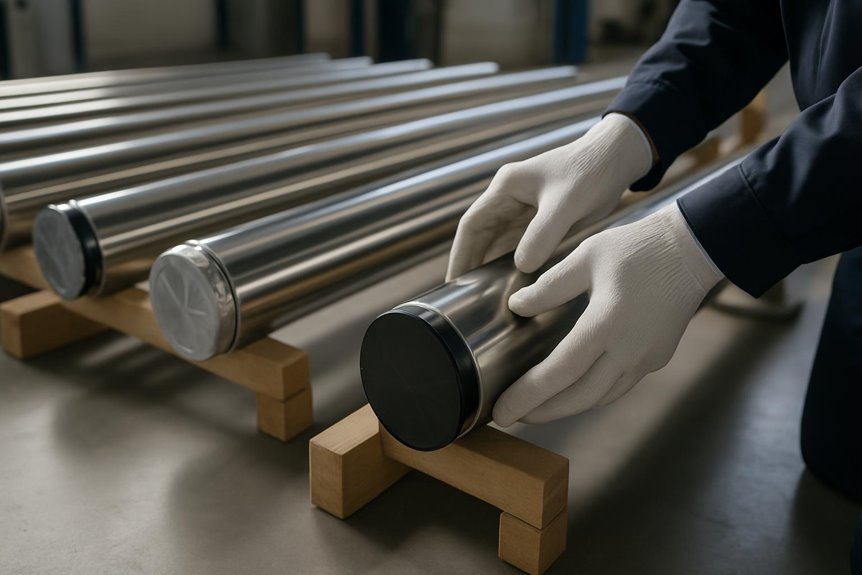
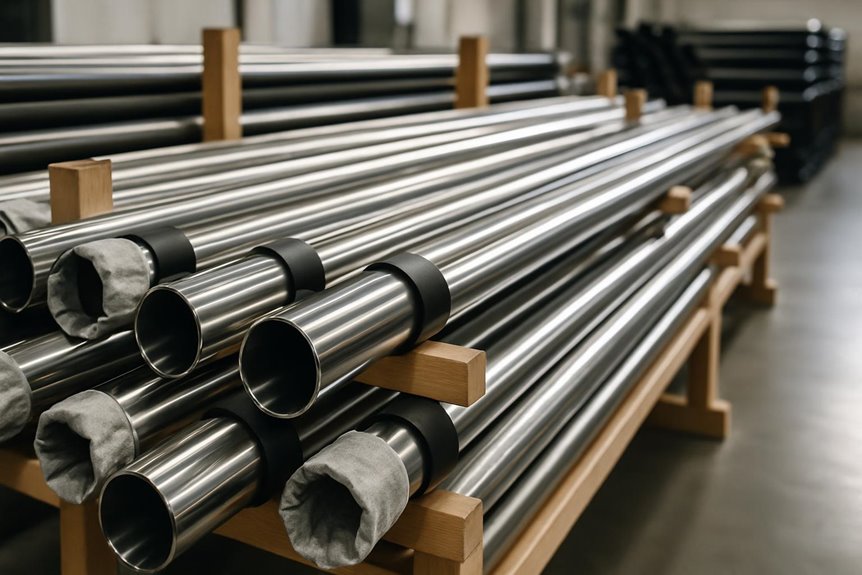
Seal each pipe end to keep the bore clean and ready for service, especially where welding quality, sanitary conditions, or product purity are important. Proper closures prevent rainwater, dust, insects, construction debris, chloride-bearing deposits, and other foreign materials from entering the bore during storage.
Suitable end caps or covers should be clean, securely fitted, and easy to remove without scratching or otherwise damaging the pipe. Their material and design should match the expected storage period and environmental conditions, including indoor warehousing or temporary outdoor protection. For high-purity systems, 316L stainless steel tubing should be protected from contamination that could compromise corrosion resistance or sanitary performance. Suppliers can provide custom tubing options and guidance to help match pipe specifications to demanding service conditions.
For installations requiring sanitary tube cleanliness or high-purity service, personnel should inspect the interior whenever a cap is removed. Smooth internal surfaces are particularly important in hygienic piping systems because they help reduce areas where contaminants can accumulate. In dairy processing applications, maintaining a hygienic internal finish supports reliable CIP and SIP cleaning and sterilization procedures. Any discovered contamination should be addressed before the pipe is returned to storage.
Caps should then be replaced promptly to maintain internal protection until fabrication, installation, or final use. This practice supports product purity by minimizing contamination risks in hygienic fluid-handling applications.
Polished and sanitary stainless steel tube requires heightened protection because even minor scratches, adhesive residue, embedded particles, or contaminated handling can impair appearance, cleanability, and service suitability.
Storage and movement should prevent surface damage while keeping finish quality consistent. Stainless steel’s corrosion resistance helps protect potable-water tubing, but contamination during storage can still compromise its surface condition.
1. Tubes should rest on clean, smooth plastic, wood, or padded separators rather than rough supports.
Dragging and unprotected contact must be avoided.
2. Personnel should use clean gloves and dedicated, cleaned handling tools.
Shared equipment can transfer iron contamination and leave particles that later produce staining.
3. Protective film should be checked periodically for tears, trapped moisture, or lifting edges.
It should be removed within the manufacturer’s recommended period, particularly after ultraviolet exposure or heat, which can degrade adhesive and leave residue.
Open ends should remain protected during handling to limit internal contamination.
Store tubing in a clean, dry area away from humidity and corrosive substances to preserve its polished surface and corrosion resistance.
For 2B-finish tubing, its non-directional surface also helps support consistent appearance and easier cleaning when stored properly.
This careful approach also supports the tubing’s easy maintenance by preventing surface contaminants from becoming difficult-to-remove stains.
Where finish requirements are especially strict, electropolishing can further improve surface cleanliness and corrosion resistance.
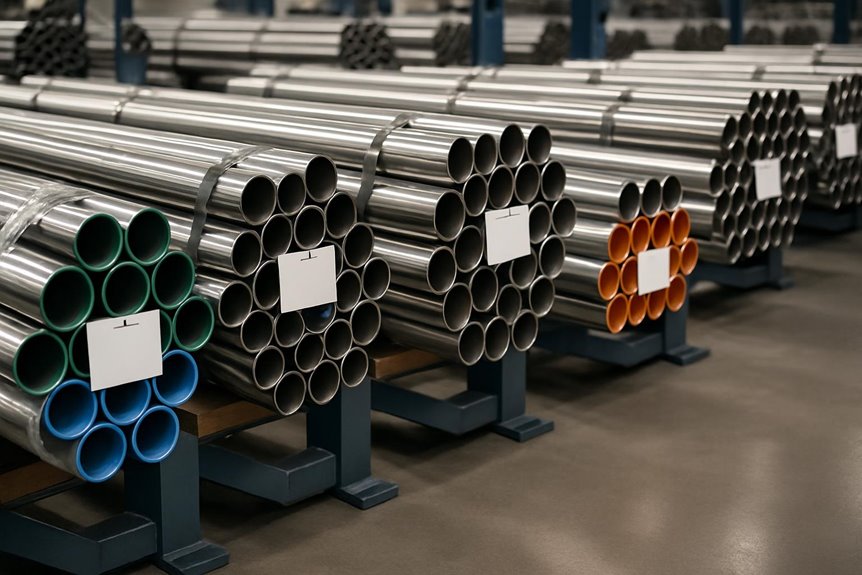
Maintain clear traceability for every stainless steel pipe or tube to avoid grade mix-ups, specification errors, and incorrect material use.
Storage personnel should separate stock by stainless steel grade, product standard, size, wall thickness or schedule, surface condition, heat number, and project or order reference. Effective grade segregation prevents incompatible materials from being placed together or issued for the wrong application. Product-standard identification is particularly important for pressure applications, where material requirements and quality controls can differ.
Identification should remain with each bundle and individual cut piece where practical. Bundle tags, durable pipe markings, warehouse location records, MTC references, and inbound and outbound logs support reliable heat-number traceability. Retaining material test reports with receiving records helps verify each pipe’s chemical composition and compliance status.
Cut-piece transfer procedures should preserve the original material identity after bundles are opened. Loose paperwork or a single label covering a mixed storage area is insufficient.
Material with missing, damaged, or uncertain identification should be isolated and withheld from issue until its grade and origin are verified.
Clear labeling is especially important when storing 304 and 316 stainless steel together, since their corrosion resistance and intended service environments differ. Grade 316 contains molybdenum and generally provides superior corrosion resistance compared with 304. Stainless steel grades can also differ in nickel content, which affects corrosion resistance and suitability for demanding environments.
Inspection intervals should be set according to storage risk rather than a fixed calendar schedule. Higher-risk conditions, including outdoor storage of stainless steel pipes, high humidity, salt exposure, extended holding periods, compromised packaging, and sanitary applications, require closer monitoring.
Pipe value, specification criticality, and exposure to nearby fabrication activities should also influence the review plan. This is especially important for 316 stainless steel, which is selected for improved resistance in chloride-containing environments. Its protective passive oxide layer helps stainless steel resist corrosion, but storage contaminants and trapped moisture should still be addressed promptly.
Each inspection should be recorded with the date, storage location, observed condition, and required follow-up. Documented checks provide traceability and demonstrate that storage controls remain appropriate as environmental conditions, packaging integrity, and inventory duration change. This documentation is particularly valuable for sanitary applications, where material condition and traceability are critical.
Because stainless steel pipe prices are affected by transportation costs, timely inspections can also help prevent avoidable damage and replacement expenses. Regular checks also help identify iron contamination, which can lead to rust staining when iron particles remain on the pipe surface.
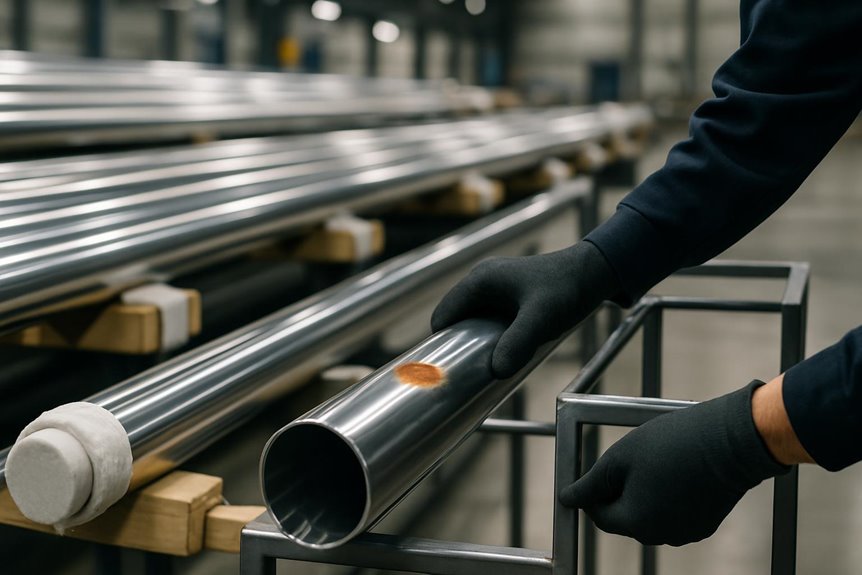
When contamination or damage is found, the affected stainless steel pipe or bundle should be isolated and withheld from fabrication or shipment until its condition is assessed.
Personnel should identify the likely source, such as free iron, chlorides, impact, or inadequate support during bundle storage. The corrective action must match the type and severity of the issue.
Suitable measures may include stainless-compatible cleaning, removal of free iron, and technically appropriate pickling or passivation. Damaged end protection should be replaced to prevent further exposure.
Pipes subjected to impact, bending, or poor support should have dimensions checked for deformation. If material grade identification is uncertain, positive material identification testing may be required.
Inspection findings, corrective actions, and traceability details should be recorded. Aggressive cleaning without technical control can worsen surface damage and undermine stainless steel pipe preservation.
Before release to fabrication, installation, or shipment, each stainless steel pipe bundle should undergo a documented final check. This verifies that how to store stainless steel tubes procedures have preserved identity, condition, and traceability throughout stainless steel tube warehouse storage.
This inspection prevents hidden storage-related defects from appearing after fabrication has begun.
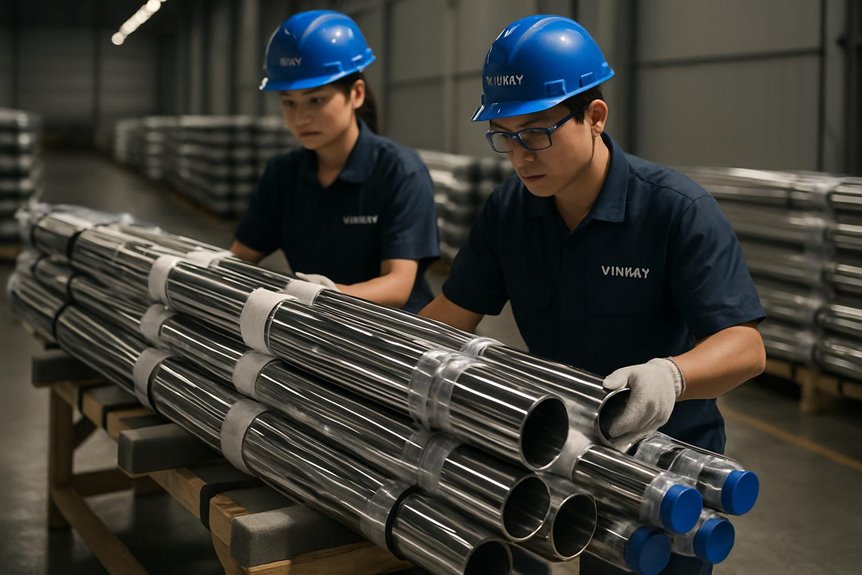
Vinmay applies packaging, identification, and inspection controls according to the tube grade, dimensions, surface finish, destination, and transport conditions.
Grade and heat-number markings help maintain traceability from production through delivery. Bundling, end caps, surface film, and protective separators can be used where appropriate to reduce exposure to dust, moisture, impact, and surface contact during handling and transit. Polished tubes receive additional protection to minimise scratching and finish damage.
Before dispatch, dimensional checks and pre-shipment inspection confirm that the tubes meet the agreed specification and packaging requirements. Material samples and online factory inspections can also be arranged when additional verification is required.
Export packaging is available for long-distance and international shipments, with protection adapted to the route, handling method, expected storage period, and environmental exposure after arrival.
Contact Vinmay with the required grade, size, finish, destination, and storage conditions to determine a suitable packaging and preservation plan for your stainless steel tubes.
Like ships wintering under tarps, stainless steel pipes may be stored outdoors temporarily, but indoor storage is preferable. They require elevation, waterproof breathable covers, drainage, separation from carbon steel, and regular inspection for moisture, staining, or corrosion.
A relative humidity below 60% is generally considered safe; 40–50% is preferable for long-term storage. The storage area should remain dry, ventilated, clean, and free from chlorides, condensation, and corrosive contaminants.
Absolutely not—anti-rust oils are not universally suitable for every stainless steel grade. Selection depends on alloy, surface finish, service requirements, and subsequent fabrication. Residues can trap contaminants or interfere with welding, passivation, and cleanliness standards.
Stainless steel pipes should be cleaned, dried, capped, wrapped in moisture-proof materials, cushioned with nonmetallic separators, securely bundled, labeled, and packed in sealed containers. Shipping restraints should prevent movement, abrasion, water ingress, and carbon-steel contamination.
A double-edged sword, plastic film can damage pipe surfaces in direct sunlight. Heat and ultraviolet exposure may degrade adhesive, leave residue, discolor finishes, or trap moisture. Covered pipes should be shaded, ventilated, and inspected regularly.
Stainless steel pipes retain their value when storage is treated as carefully as installation. Like a shield against unseen damage, clean, dry, segregated, and well-supported storage prevents corrosion, distortion, contamination, and surface defects. Routine inspections and prompt corrective action further protect material quality. By controlling handling, environment, identification, and release checks, businesses can guarantee pipes remain dimensionally accurate, visually clean, and ready to deliver reliable long-term performance in demanding applications.