Stainless steel tube pressure rating is not a single fixed value. It depends on working pressure, test pressure, burst pressure, wall thickness, outside diameter, material grade, temperature, and manufacturing route. Standards such as ASTM A269 define key requirements, but actual suitability must be confirmed through calculations, material certificates, and testing records. A safe specification begins by separating these pressure terms correctly, because each one serves a different engineering purpose.
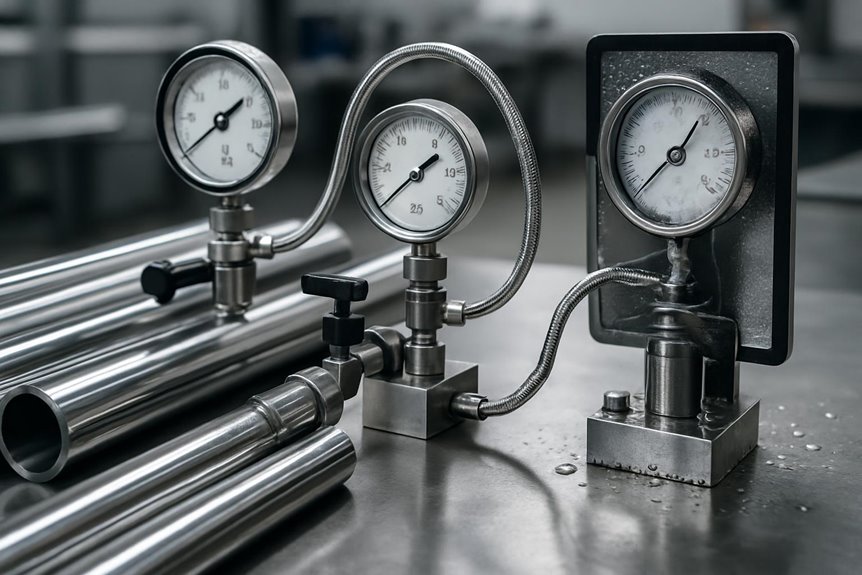
Pressure terminology is a common source of specification errors in stainless steel tube selection.
Working pressure, test pressure, and burst pressure are not interchangeable values. Working pressure is the permitted continuous operating limit under specified service conditions. Test pressure is a temporary proof pressure applied for inspection or integrity verification under the governing code, standard, or project specification. Burst pressure is the point at which the tube or assembly physically fails.
For controlled procurement, each stainless steel tubing pressure rating must identify the referenced pressure term.
Test pressure should not be assumed to equal a fixed multiple of working pressure unless the applicable specification states it. Stainless steel tube burst pressure supports qualification and design-factor evaluation, not normal operation.
A supplier’s quoted “pressure rating” should always state which value it represents.
Calculate stainless steel tube pressure rating by relating internal pressure to tube geometry and material strength: as pressure acts on the tube wall, higher outside diameter increases wall stress, while greater wall thickness and higher allowable material stress increase the permissible working pressure.
A simplified stainless steel tube pressure calculation is P = 2StF / OD, where P is pressure, S allowable stress, t wall thickness, F design or weld factor, and OD outside diameter.
Final values must follow the applicable code, standard, or qualified manufacturer data. Accurate pressure selection also depends on confirming outer diameter, wall thickness, length, and material grade against the required dimensional standard.
Example: for 304 tube, OD 1.000 in, wall 0.065 in, allowable stress 20,000 psi, factor 0.80, P = 2×20,000×0.065×0.80/1.000 = 2,080 psi.
The 304 stainless steel tube pressure rating falls if the wall is thinner, diameter increases, or allowable stress decreases. In pipe and tube selection, a higher pipe schedule generally indicates greater wall thickness and higher pressure capacity, though it can also reduce internal diameter and flow. Accurate wall thickness measurement is also critical because it directly affects structural integrity and pressure resistance.
Material selection should also account for stainless grade requirements, since ASTM standards help define chemical composition, heat treatment, and other attributes that affect allowable properties. Standards such as ASTM A312 also specify testing requirements that help verify tube integrity for corrosive or high-temperature service.
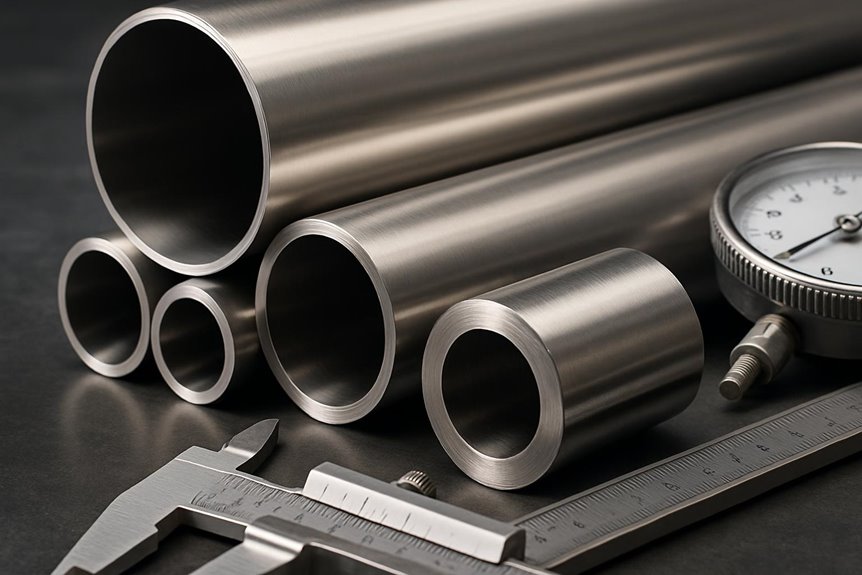
Tube dimensions have a direct effect on stainless steel pressure capability. Internal pressure creates circumferential, or hoop, stress in the tube wall. When the material and service conditions remain the same, a thicker wall provides more material to resist that stress, while a larger outside diameter increases the load acting around the tube circumference.
This is why two tubes manufactured from the same stainless steel grade can have very different allowable working pressures.
| Tube Configuration | Relative Pressure Capability |
|---|---|
| Small OD + thick wall | Higher |
| Small OD + thin wall | Lower |
| Large OD + same wall | Lower |
| Same OD + thicker wall | Higher |
In many specifications, dimensional differences have a greater influence on pressure capability than changing between common stainless steel grades. A quoted 316 stainless steel tube pressure rating, for example, is not meaningful unless the outside diameter and wall thickness are also known.
Dimensional tolerances therefore matter as well. ASTM A249 stainless steel tube includes requirements for wall thickness and dimensional control, helping ensure the supplied tube remains within the limits assumed during design. ASTM A269 stainless steel round tubing similarly establishes manufacturing and dimensional requirements for seamless and welded tubing used in general service.
Construction method should also be considered, but it should not be used as a shortcut for determining pressure capability. Seamless and welded stainless steel tubes are evaluated according to their applicable standard, manufacturing condition, inspection requirements, and design basis. Seamless construction eliminates the longitudinal manufacturing seam, while modern welded tubing can provide reliable pressure performance when weld quality and production control meet the required specification. You can also review the main types of stainless steel pipe when comparing construction options for different service conditions.
Material grade remains important, particularly where pressure is combined with corrosion exposure. 316 stainless steel is frequently specified for chloride-bearing or more corrosive environments because its molybdenum content improves resistance to localized corrosion compared with 304. However, grade selection and pressure rating are separate decisions: OD, wall thickness, temperature, material condition, and the governing design method must still be evaluated together.
Stainless steel grade can affect tube pressure rating, but 316L should not be assumed to carry higher pressure than 304L by default.
In pressure design, 304/304L and 316/316L are evaluated by their allowable mechanical properties at the specified temperature under applicable standards. Both 304 and 316 stainless steels have a density of about 8.0 g/cm³, so grade selection should not be based on weight assumptions alone. For 304 stainless steel welded tube, typical minimum mechanical values include 505 MPa tensile strength, 215 MPa yield strength, and 40% elongation, making mechanical properties central to pressure evaluation.
Grade selection is often governed more by corrosion resistance, chloride exposure, process chemistry, cleaning conditions, and operating temperature than by pressure capacity alone. Applicable ASTM standards such as ASTM A249 and ASTM A270 help define tube requirements for specific industrial uses.
For example, 316L is often chosen over 304L for chloride environments because its molybdenum content improves corrosion resistance rather than simply increasing pressure capacity. The lower carbon content of 316L can also support improved corrosion resistance in demanding welded applications.
Grade selection can influence a tube’s calculated pressure rating, but 304/304L and 316/316L should not be treated as having a universal “higher-pressure” winner.
The molybdenum in 316/316L improves pitting corrosion resistance in chloride-rich service, which can make it the better material choice even when the pressure calculation is similar.
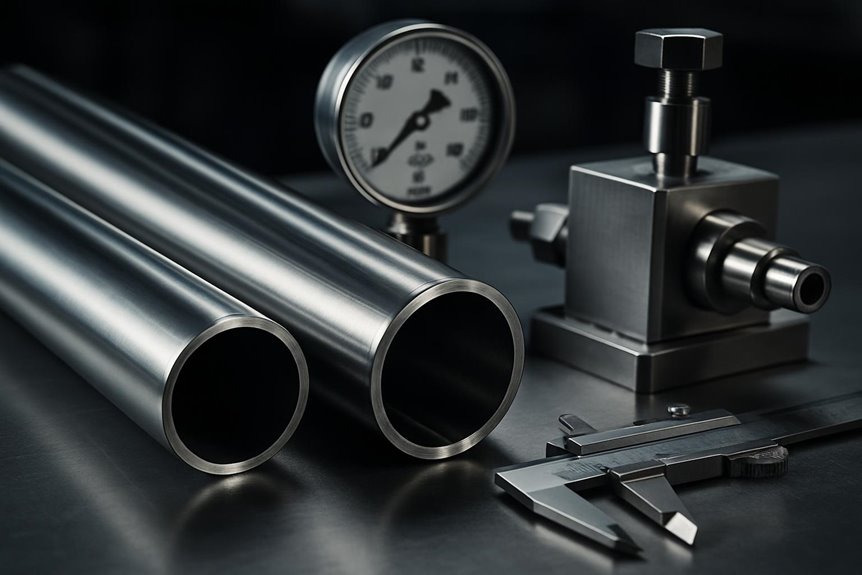
The manufacturing route can influence stainless steel tube pressure performance, but it does not determine the allowable working pressure by itself. A welded stainless steel tube pressure rating or seamless stainless steel tube pressure rating must be evaluated together with the tube dimensions, material grade, manufacturing standard, inspection requirements, and applicable design method.
| Control Point | Why It Matters |
|---|---|
| Weld quality | Ensures the longitudinal seam can withstand the required service conditions |
| Manufacturing standard | Defines material requirements, dimensions, testing, and acceptance criteria |
| Material condition | Influences strength, corrosion resistance, and allowable stress |
| Inspection requirements | Provides evidence that the tube meets the specified requirements |
For welded tubing, pressure performance depends heavily on factors such as weld consistency, heat treatment, and inspection scope. Properly manufactured welded tubes produced to recognised standards can provide reliable performance in many pressure applications.
Seamless tubing eliminates the longitudinal weld seam, but it still requires verification of material properties, dimensional accuracy, surface condition, and compliance with the applicable specification. Seamless construction alone does not automatically mean a higher allowable pressure rating.
The correct selection should therefore be based on the service requirements and documented qualification, rather than assuming one manufacturing route is always superior.
For example, stainless steel grade selection is often driven by the operating environment. 316/316L stainless steel is commonly selected over 304/304L when improved resistance to chloride-containing environments is required due to its molybdenum content. Learn more about the differences between these grades in our guide to 316 stainless steel square tube.
The applicable tube standard also plays an important role in defining manufacturing and inspection expectations. Standards such as ASTM A269 and ASTM A249 establish requirements for stainless steel tubing used in general service, heat exchanger, and pressure-related applications. For mechanical applications, ASTM A554 stainless steel welded tube provides requirements related to dimensions, mechanical properties, and surface finish.
Understanding the relationship between construction method, material grade, standards, and inspection records is essential when evaluating whether a stainless steel tube is suitable for a specific pressure application.
Although a stainless steel tube pressure rating may be published at room temperature, that value cannot be assumed valid at elevated service temperatures. Standards-based assessment requires temperature derating, because pressure capacity follows allowable stress, not dimensions alone.
Regular inspection and maintenance are especially important because chloride corrosion and other environmental factors can weaken stainless steel tubes before a pressure limit is reached.
For example, a tube rated 5,000 psi at 70°F might be limited near 3,500 psi at 600°F, depending on grade and governing design data.
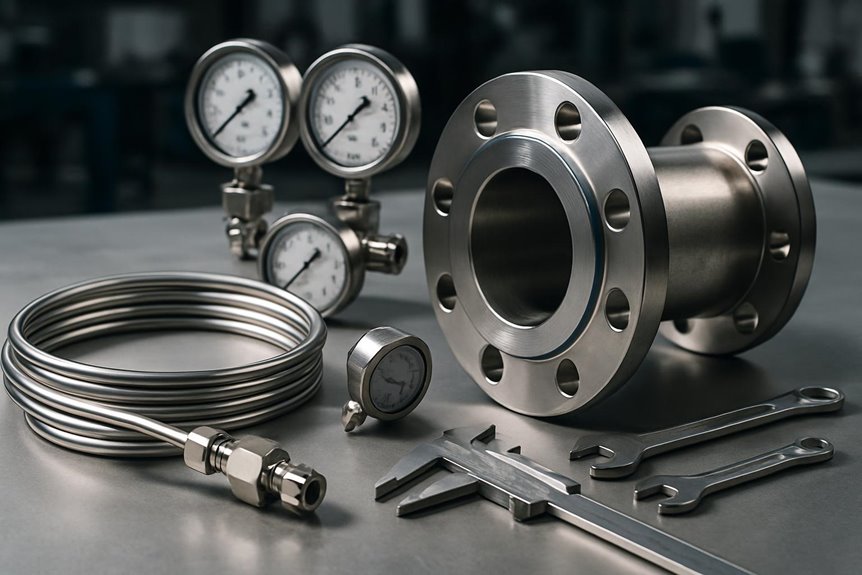
Instrumentation tubing and process pipe may both transport fluids, but they are specified and pressure-rated using different design approaches.
| Comparison Factor | Instrumentation Tubing | Process Pipe |
|---|---|---|
| Primary purpose | Measurement, control, sampling, and small-bore fluid connections | Transporting process fluids, gases, steam, and other media through industrial systems |
| Dimensional system | Outside diameter (OD) and wall thickness | Nominal Pipe Size (NPS) and schedule |
| Pressure rating basis | Manufacturer-published pressure tables for tubing and compatible fittings | Code-based pressure-temperature design calculations |
| Main rating factors | Tube size, wall thickness, material condition, fitting compatibility, and design factor | Allowable stress, pipe dimensions, temperature, corrosion allowance, joint efficiency, and code requirements |
| Typical standards/frameworks | ASTM tubing specifications, manufacturer qualification data, fitting system ratings | ASME B31.3 and applicable pipe product standards such as ASTM A312 |
| System limitation | The lowest-rated component controls the allowable pressure | The designed piping system determines allowable pressure |
| Common verification documents | Pressure tables, material test reports, tube specifications, fitting documentation | Material certificates, design calculations, inspection records, testing documentation |
| Typical applications | Instrumentation lines, control systems, sampling systems | Chemical processing, industrial plants, utility systems, process facilities |
Small-bore tubing systems used for measurement, control, and sampling are typically rated by reference to manufacturer-published pressure tables for the tube and compatible fittings rather than by the same approach used for process pipe. The published value should be treated as an assembly limit only after every pressure-retaining item is checked. ASTM guidelines and specifications can support consistent manufacturing, testing, and quality control for sanitary tubes used in cleanliness-critical applications.
Most process piping is rated through the applicable piping code rather than a manufacturer’s tubing chart, with design pressure established from allowable stress, pipe dimensions, design temperature, corrosion allowance, joint efficiency, and other code-required variables.
This approach treats the pipe as part of a governed pressure system, not as an isolated component. The rating depends on material properties at temperature, nominal size, wall schedule, weld or seamless construction, and required allowances for service degradation. Because stainless steel pipe dimensions are often organized by schedule, the selected wall thickness directly affects pressure capacity and code compliance.
Code calculations also control fabrication, examination, testing, and documentation expectations. ASME B31.3 is commonly used for process piping because it addresses design and construction requirements for safe pressure and temperature service. Proper heat management during welding is also important because excessive heat input can affect stainless steel integrity and weld quality. Effective shielding gas selection can also help protect the weld pool from contamination and support consistent stainless steel weld quality. For stainless steel process pipe, pressure capability consequently must be verified against the governing code, service conditions, and project specifications.
This gives the designer a controlled basis for acceptance, rather than relying on generic tubing pressure tables. Material selection and procurement should also account for market demand and raw material costs, since these factors can affect stainless steel pipe availability and project pricing.
Which standard governs pressure requirements depends on whether the document is a product specification or a system design code. Product standards define material, manufacture, dimensions, testing, and acceptance; the design code judges the installed system. Compliance is often verified through non-destructive testing and dimensional inspection during tube manufacturing.
ASME B31.3, where applicable, controls process-piping design for the complete system. Manufacturers may also maintain ISO certifications and ASTM compliance programs to support consistent quality assurance.
Meeting ASTM A269 never creates one universal ASTM A269 pressure rating; capability still depends on dimensions, material properties, temperature, and design basis selected. Standard lengths, wall thickness, and dimensional tolerances such as straightness tolerance can also influence whether tubing meets project-specific requirements. In sanitary systems, temperature resistance is a key selection factor because excessive heat can degrade unsuitable pipe materials and reduce reliability.
Material selection also affects pressure capability because grades such as 304 and 316 stainless steel differ in corrosion resistance and suitability for chloride-rich or aggressive environments.

A supplier’s pressure rating should be treated as a technical reference requiring verification, not as a standalone approval for a specific application. A valid pressure rating only applies when the quoted conditions match the actual tube specification and operating environment.
Before applying any pressure value, verify the relationship between:
The final allowable system pressure should also consider the complete assembly, as fittings, valves, threads, connections, and other components may have lower pressure limits than the tube itself.
| Verification Point | Control Question | Risk if Overlooked |
|---|---|---|
| Tube Geometry | Does the outside diameter and wall thickness match the pressure data? | Incorrect pressure assumptions |
| Material Grade | Is the pressure rating based on the specified stainless steel grade and condition? | Using unsuitable material data |
| Rating Basis | Is the value based on working pressure, test pressure, or burst pressure? | Misinterpreting the allowable limit |
| Temperature Basis | Does the rating apply at the actual operating temperature? | Overestimating pressure capability |
| Manufacturing Condition | Is the tube welded or seamless, and has any applicable factor been considered? | Applying incorrect rating data |
| System Components | Are fittings, valves, and connections rated equal to or above the tube? | The weakest component limits system pressure |
| Standards and Documentation | Does the rating align with the applicable ASTM, EN, ASME, or manufacturer specification? | Unverified technical assumptions |
A stainless steel tube pressure rating is therefore not determined by material grade alone. The correct value comes from the combination of tube dimensions, material properties, temperature, manufacturing condition, design basis, and the pressure capability of the complete system.
After supplier pressure ratings are checked against geometry, material, and system limits, the material test certificate and hydrostatic test record provide the next layer of verification.
Allowable pressure still requires the correct design basis, actual tube dimensions, temperature derating, material condition, applicable code, and manufacturer data.
Controlled acceptance depends on aligning all records with the intended service envelope before release.
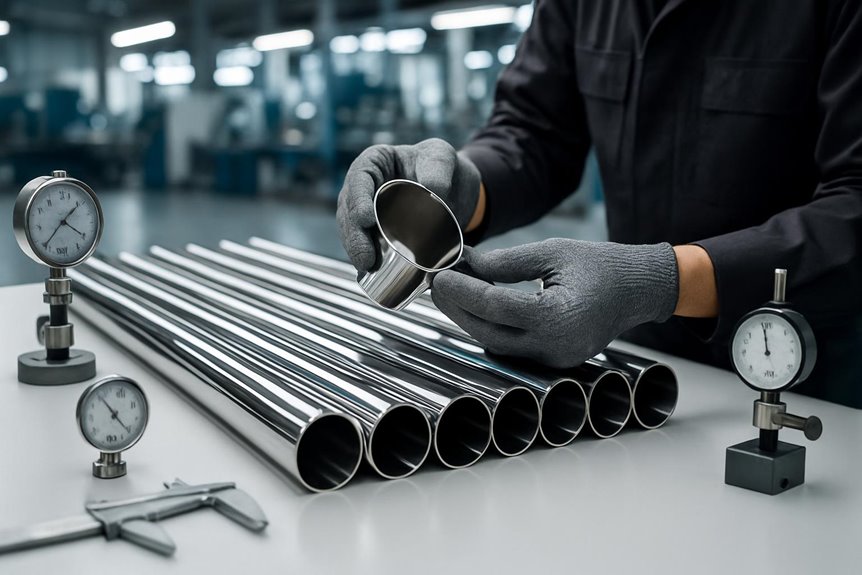
For pressure-critical applications, stainless steel tube selection depends on matching the material, dimensions, manufacturing process, and inspection requirements to the actual service conditions. Vinmay supports this process by providing welded stainless steel tubing with controlled specifications rather than relying on generic pressure ratings.
Vinmay supplies 304, 304L, and 316L stainless steel tubes manufactured according to applicable ASTM, EN, and DIN standards, with control over key factors that influence pressure performance, including dimensional accuracy, weld consistency, heat treatment, surface condition, and material traceability.
Each specification can be reviewed based on critical parameters such as tube grade, outside diameter, wall thickness, applicable standard, weld condition, tolerances, inspection requirements, material test certificates (MTCs), and pressure or integrity testing requirements.
To determine the most suitable tube specification, provide the required tube dimensions, material grade, operating pressure, temperature range, and applicable standard. Vinmay can then assist in verifying the appropriate product configuration and available quality documentation.
Contact Vinmay to discuss your stainless steel tube requirements and receive technical guidance on material selection, pressure specifications, and inspection documentation for your application.
Yes. Stainless steel tube pressure ratings can decrease after bending if wall thinning, ovality, work hardening, cracking, or surface damage occurs. An engineer should verify bend radius, material standard, inspection results, and applicable derating requirements.
Corrosion allowance lowers effective wall thickness over service life, so allowable working pressure must be calculated using remaining minimum wall. Designers apply standards, corrosion rates, temperature derating, and safety factors to preserve controlled pressure integrity.
Yes, like the weakest calibrated link, fittings can lower system pressure rating. The governing rating becomes the lowest certified component value, considering fitting design, material grade, temperature derating, sealing method, and applicable standards.
Pressure-rated tubing should be inspected before commissioning, after modifications, during scheduled maintenance, and more frequently in corrosive, high-temperature, cyclic-pressure, or safety-critical service. Inspection intervals should follow applicable codes, risk assessments, manufacturer guidance, and operating history.
Yes. Oval or square tubes have different pressure ratings because stress distribution differs from round tubing. Engineers should verify manufacturer data, applicable standards, wall thickness, weld quality, corner radii, material grade, temperature, and safety factors.
Stainless steel tube pressure rating is neither a single promise nor a guess; it is a calculated limit balanced against real-world risk. Working pressure guides service, test pressure verifies integrity, and burst pressure marks failure. Diameter, wall thickness, grade, temperature, and welded or seamless construction all shift the margin. By comparing standards, MTC data, hydrostatic results, and supplier claims, engineers separate safe specification from costly assumption—and guarantee each tube performs where pressure is routine, not surprising.