Stainless steel orbital welding can produce clean, repeatable welds, but quality is not created by automation alone. It depends on tube preparation, alignment, purge gas control, heat input, and the correct welding program. Material condition and applicable standards also shape the final result, especially in sanitary and high-purity systems. A sound weld begins before the arc starts, and the factors that decide success are often easy to overlook.
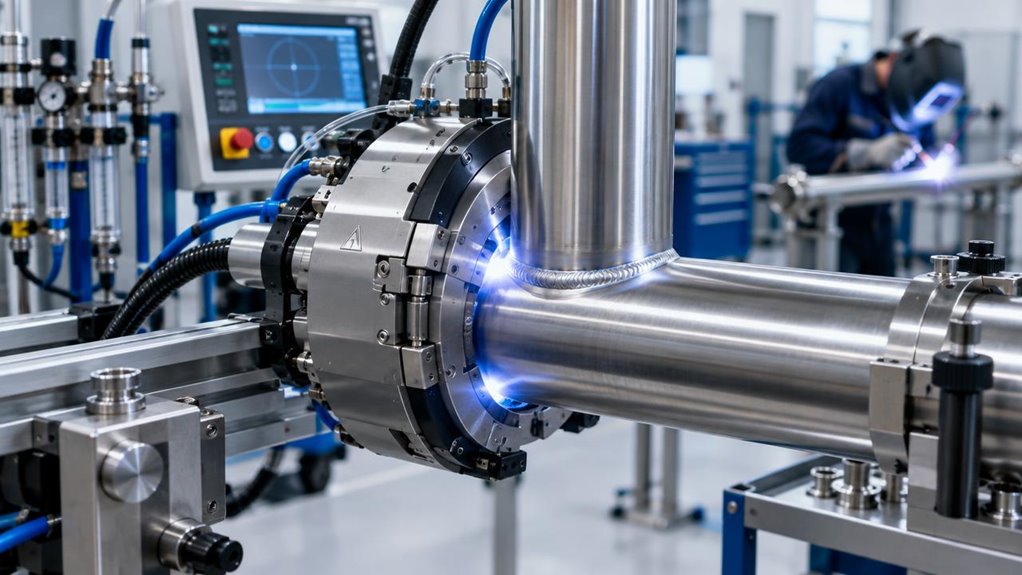
Orbital welding is usually preferred over manual TIG when the project requires repeatable weld quality, controlled penetration, high joint counts, documented parameters, and consistent internal weld profiles. The advantage is not that orbital welding is universally better, but that it reduces operator-to-operator variation when the same tube size and joint configuration must be welded repeatedly.
This is particularly valuable in sanitary and high-purity tubing, where internal weld condition directly affects cleanability and corrosion performance. Proper back purge welding helps protect the weld root from oxidation, while smooth, crevice-free joints are central to sanitary stainless steel welding where product contact surfaces must remain cleanable.
Orbital systems also make it easier to control and record critical welding parameters such as current, travel speed, pulse timing, and purge conditions. That repeatability is useful for validated or high-volume production, provided the tube ends are properly prepared and free from contaminants that could affect arc stability or shielding.
| Requirement | Orbital Welding | Manual TIG |
|---|---|---|
| Large number of repeat joints | Strong advantage | More operator variation |
| Tight weld repeatability | Strong advantage | Highly skill-dependent |
| Restricted access | Often advantageous | Can be difficult |
| Sanitary/high-purity tubing | Common choice | Possible with skilled control |
| One-off fabrication | May be unnecessary | Often practical |
| Irregular geometry | Less suitable | More flexible |
| Weld data recording | Easier to automate | More difficult |
For repetitive stainless steel tube joints with strict quality requirements, orbital welding usually provides the stronger process-control advantage. Manual TIG remains useful where joint geometry varies, access is irregular, or production volume does not justify an automated setup.
Start with the tube, not the arc: even a well-programmed orbital welder cannot overcome poor stainless steel tube preparation. In stainless steel orbital tube welding, the joint is largely determined before rotation begins.
Proper ventilation and protective gear are also essential because stainless steel welding can produce harmful fumes and gases.
Automatic stainless steel tube welding repeats the same current, speed, and timing from joint to joint. If geometry changes, penetration and bead profile can change too. Precision dimensional inspection helps verify diameter, length, and wall thickness before tubes reach critical welding operations. Controlled heat input also helps limit distortion and preserve corrosion resistance during stainless steel welding.
Because welded stainless steel tubes are formed from strip and joined by a seam, consistent dimensions and clean surfaces help reduce variation before orbital welding begins, while seamless tubes are often selected for high-pressure applications due to the absence of a weld seam. Material grade also matters, since 316 stainless steel contains molybdenum that improves corrosion resistance in marine and chemical processing environments.
Consistent tube manufacturing, such as Vinmay’s dimensional control, gives the programmed weld a stable starting condition.
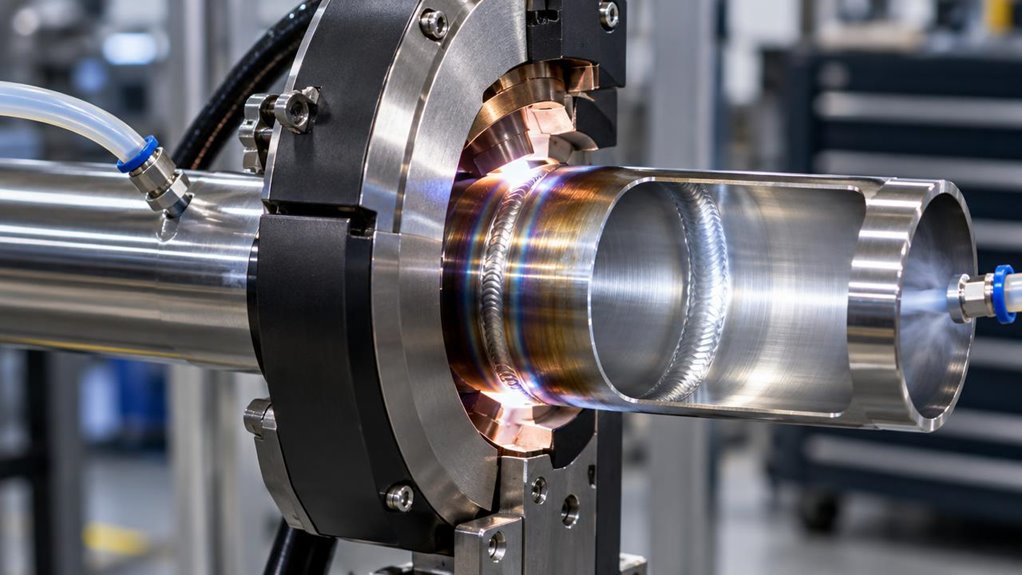
Protect the inside of the tube as carefully as the outside of the weld. Stainless steel exposed to oxygen during welding can form oxidation, heavy heat tint, sugaring, and rough internal weld surfaces that reduce corrosion performance.
In orbital welding high purity tubing, the internal purge is thus a quality control requirement, not an accessory. Controlled solution annealing can help restore corrosion resistance in stainless steel by dissolving carbides and reducing sensitization risk when appropriate for the material and application.
High-purity argon is commonly used for stainless steel and 316l orbital welding, but results depend on purge-gas purity, flow rate, purge time, oxygen level, joint sealing, and post-weld purge duration. For medical or high-purity tubing, a clean internal surface helps maintain corrosion resistance through repeated sterilization cycles and exposure to bodily fluids.
No single purge-flow value applies to every assembly because tube size, fixture design, weld head, and procedure change the setup. After welding, effective moisture control also helps prevent deposits and trapped water from undermining the stainless steel passive oxide layer.
For sanitary and high-purity service, internal discoloration should be compared with applicable acceptance criteria, not judged by appearance alone. Material Test Reports can also verify chemical analysis and mechanical properties so welded assemblies remain traceable to required specifications.
Smooth internal weld surfaces also support CIP and SIP cleaning by reducing areas where contamination or bacterial growth can occur.
Control of heat input is what allows stainless steel orbital welding to produce repeatable penetration from one tube joint to the next. In orbital welding stainless steel, the program defines how energy reaches the joint as the electrode travels around the tube.
Stainless steel relies on corrosion resistance from its chromium passive layer, so controlled welding conditions help preserve long-term performance.
Alignment and cleanliness before welding support consistent fusion and help reduce defects in accordance with pre-welding preparation practices.
For welded stainless tube, 316L is often selected because its low carbon content helps minimize carbide precipitation during welding.
This makes 316L especially suitable for applications with extensive welding requirements.
Its added molybdenum content also improves resistance to pitting and crevice corrosion in chloride-rich service environments.
Too little heat can leave incomplete penetration or lack of fusion.
Insufficient heat input can prevent full penetration and create lack of fusion defects.
Too much heat can cause distortion, undercut, discoloration, grain growth, or excessive penetration in orbital gtaw stainless steel.
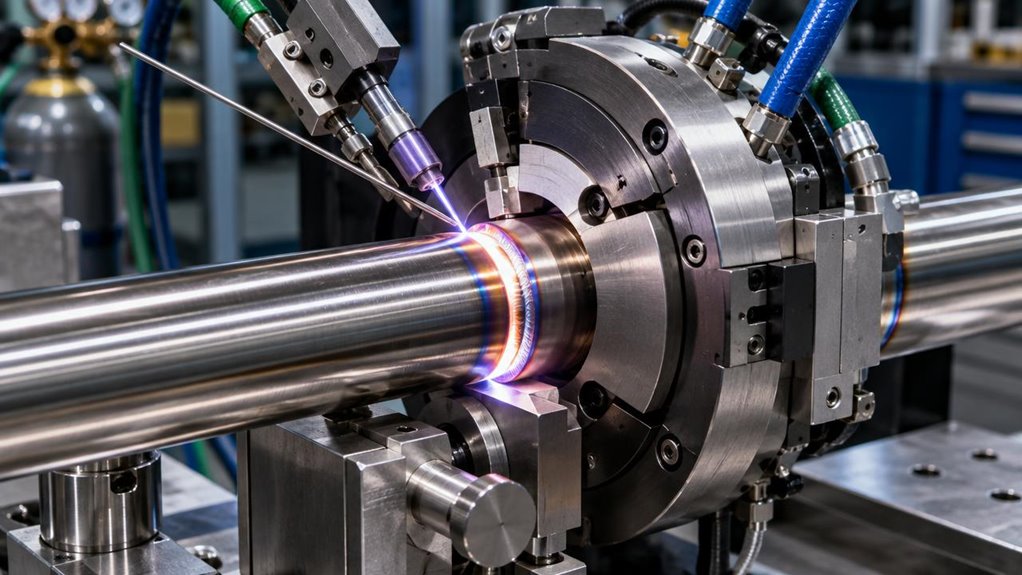
The choice between autogenous orbital welding and orbital welding with filler wire depends on joint geometry, wall thickness, material condition, and code requirements.
Autogenous welding can produce clean, repeatable fusion welds when fit-up and tube preparation are tightly controlled. In 316 stainless steel applications, molybdenum content improves resistance to pitting and crevice corrosion in chloride environments.
Filler-wire welding may be specified when added reinforcement, gap tolerance, or metallurgical adjustment is required. TIG and MIG processes are commonly used for strong joints, but joint preparation and cleanliness remain essential to weld quality. Pickling and passivation after fabrication can help remove contaminants and support formation of a protective oxide layer.
For ASTM A249 stainless steel tube, specified wall thickness tolerance can influence fit-up consistency and weld parameter control.
Post-weld non-destructive testing can verify weld integrity and compliance without damaging the stainless steel tube.
Most autogenous orbital welding for stainless steel tubing relies on fusing the prepared tube edges without adding filler metal. In this orbital welding process, weld quality depends on preparation, alignment, and a qualified program that delivers full penetration without excess heat.
Specified wall thickness and dimensional tolerances should be verified before welding because they influence pressure resistance, fit-up, and weld repeatability.
This method is favored where repeatability, cleanliness, and dimensional control are essential to final weld quality. In food, beverage, and pharmaceutical service, sanitary pipes also require smooth internal surfaces that help minimize bacterial growth.
Orbital welding with filler wire becomes appropriate when a joint cannot be completed reliably by autogenous fusion alone. Filler metal may be required for thicker wall sections, wider or less consistent joint gaps, demanding joint geometries, multipass welds, or applications where the qualified welding procedure requires added metal.
The decision should be based on the joint and service conditions rather than an assumption that autogenous welding is always preferable. In sanitary piping systems, filler selection, wire-feed consistency, purge quality, and heat input all need to support a smooth internal weld profile while preserving corrosion resistance and cleanability.
| Condition | Risk Without Suitable Filler | Potential Result |
|---|---|---|
| Thick wall | Incomplete penetration or fusion | Reduced joint integrity |
| Excessive joint gap | Burn-through or incomplete fill | Irregular internal weld profile |
| Multipass requirement | Insufficient deposited metal | Incomplete joint formation |
| Qualified procedure requires filler | Nonconforming weld procedure | Inspection or project rejection |
Low-carbon grades such as 304L and 316L are commonly used in welded stainless steel systems because they help reduce the risk of sensitization around the heat-affected zone. For more demanding corrosive service, the molybdenum content of 316L also provides additional resistance to localized corrosion.
Filler wire does not compensate for poor tube preparation or incorrect welding parameters. Tube alignment, joint cleanliness, shielding gas, purge conditions, heat input, and wire-feed rate must still remain controlled throughout the weld cycle.
Post-weld inspection should confirm penetration, bead profile, alignment, discoloration, and any visible weld imperfections in stainless steel tubing before the joint enters service. Where oxidation or heat tint remains around the weld, appropriate cleaning and surface restoration are also important because weld-zone contamination can reduce the corrosion performance expected from the base stainless steel.
Even with automated control, stainless steel orbital welding can fail when heat input, purge quality, tube preparation, fit-up, or programmed parameters are incorrect. Automation improves repeatability, but it can also repeat a poor weld consistently if the program or preparation is wrong. In service, chloride exposure from cleaning chemicals, saltwater, or industrial environments can accelerate pitting corrosion if weld discoloration or surface contamination is not properly addressed.
After welding, regular inspections for seal integrity and signs of leaks or corrosion help confirm the sanitary tube system remains reliable in service.
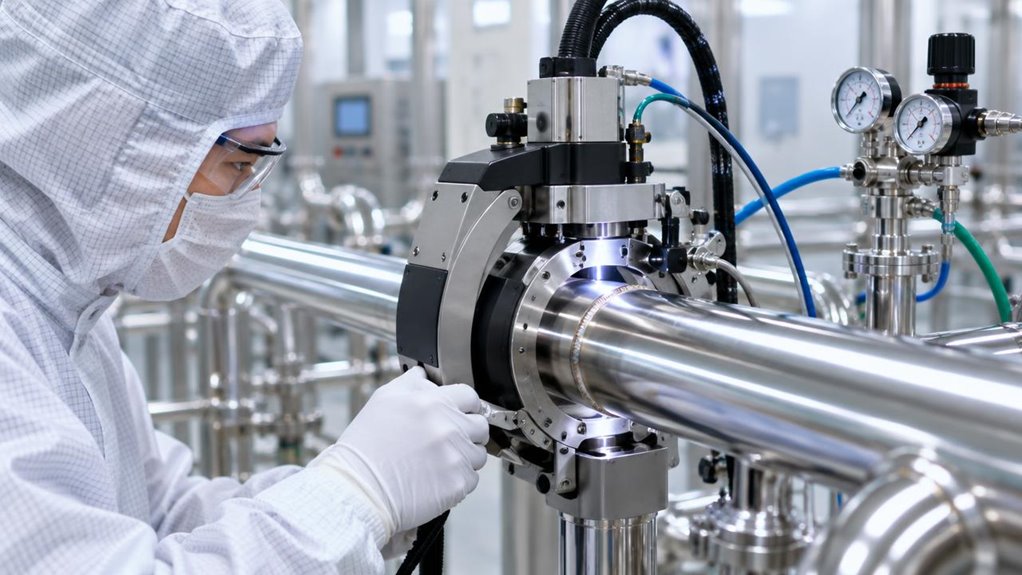
Material selection is the starting point for a reliable sanitary or high-purity orbital weld, and 316L stainless steel is often specified because it combines strong corrosion resistance with low carbon content and broad acceptance in pharmaceutical, biotech, semiconductor, and hygienic tubing systems.
Its chemistry supports resistance to many process fluids and cleaning conditions, while the low carbon level helps limit carbide precipitation concerns during welding. Bright annealing can also help restore corrosion resistance and support surface cleanliness after tube forming and welding.
In sanitary tubing, 316L also aligns with common high-purity tube specifications, documentation practices, and industry expectations. Consistent surface finish requirements also help reduce microbial adhesion and support cleanability in pharmaceutical and hygienic service. ASTM A270 covers seamless and welded stainless steel sanitary tubing used in dairy, food, and pharmaceutical systems, including 304 and 316L grades.
The alloy’s molybdenum content supports improved resistance to chloride-rich and marine-like environments compared with many stainless grades.
However, it should not be treated as the automatic choice for every service. 304L may be suitable where corrosion conditions are less demanding. In standard food-grade systems with less aggressive products and cleaning chemicals, 304 sanitary tubing can offer reliable performance at a lower material cost.
The essential rule is that orbital welding cannot correct an unsuitable alloy selection; the tube grade must match the fluid, temperature, and environment first.
Selecting a suitable stainless grade such as 316L establishes the baseline for corrosion resistance, but orbital welding adds the most value where the finished tube system must meet strict performance requirements for cleanliness, repeatability, penetration control, documentation, or leak-tight integrity.
Orbital welding is also valuable in power generation tubing, where temperature resistance and pressure integrity are essential for steam, boiler, heat exchanger, and condenser service.
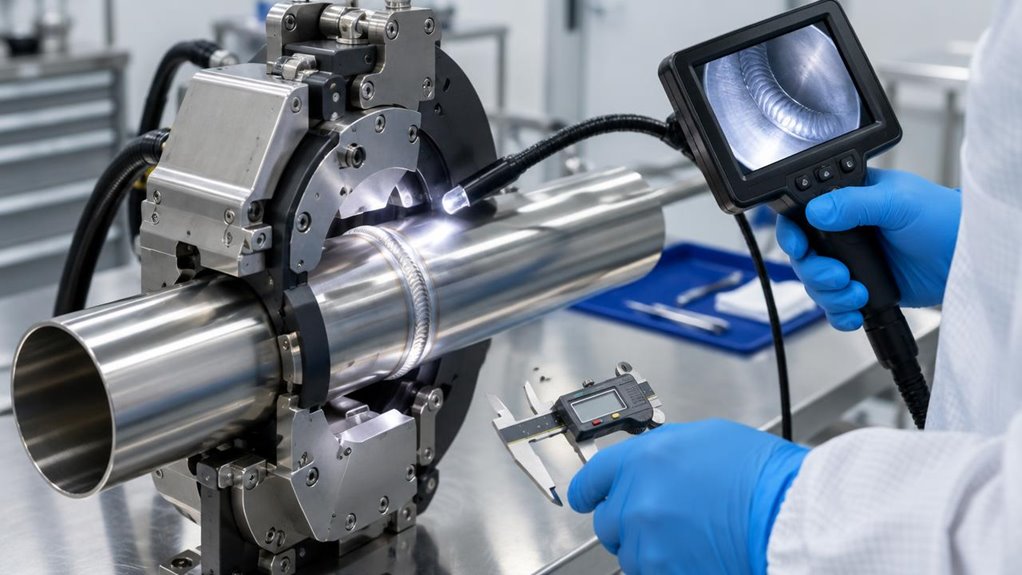
Verify orbital weld quality by comparing each completed joint against acceptance criteria defined before welding begins. Inspection commonly starts with visual review for bead uniformity, alignment, surface defects, and discoloration.
Internal borescope inspection may confirm penetration profile, root condition, oxidation, and cleanliness on the tube inside diameter. Dimensional checks verify weld size and fit-up results.
Additional verification may include weld coupons, destructive qualification testing when required, and leak or pressure testing for service integrity. Recorded weld parameters also support quality review by showing whether current, travel speed, purge conditions, and program settings stayed within the approved range.
For validated high-purity systems, records may identify weld number, location, operator, program, tube size, material heat, date and time, actual parameters, and inspection result for traceability throughout fabrication.
Standards define how stainless steel orbital welds are specified, qualified, inspected, and accepted.
ASME BPE addresses hygienic and high-purity process systems, while ASME Section IX governs welding procedure and personnel qualification.
Tube product standards also matter because base material chemistry, dimensions, and surface condition directly affect weld quality.
For bioprocessing and other high-purity systems, ASME BPE is one of the key standards shaping expectations for stainless steel tubing materials, joining practices, surface condition, cleanability, inspection, and documentation. It does not universally require orbital welding; however, orbital GTAW is commonly selected because it supports repeatable joints and documented process control aligned with demanding hygienic specifications.
Documentation becomes central when stainless steel orbital welding falls under a pressure, piping, or fabrication code that invokes ASME Section IX. This standard does not define product dimensions or cleanliness expectations; instead, it governs qualification of welding procedures and welding personnel where the governing code requires it.
For orbital GTAW, that typically means documenting the procedure variables used to produce an acceptable weld, then demonstrating that the procedure can meet required mechanical or examination criteria.
ASME Section IX also separates procedure qualification from welder or welding operator qualification. In automated orbital welding, the operator’s role may involve setup, programming, monitoring, and responding to alarms rather than manual torch manipulation.
When applicable, compliance depends on the project code, accepted qualification records, and controlled use of approved welding parameters.
After ASME Section IX addresses how a welding procedure or operator is qualified, the tube material itself may still need to comply with a separate product specification.
In stainless steel orbital welding, this distinction matters because material acceptance is not established by welder qualification alone.
Before stainless steel orbital welding starts, the project team should define the tube material, tube standard, dimensions, surface finish, joint preparation, welding method, purge requirements, qualified weld program, inspection criteria, and documentation requirements.
“Orbital welded” alone is not a complete specification; the process depends on details such as whether the tube is 304L or 316L, whether it meets ASTM A269, ASTM A270, or EN 10357, what OD and wall thickness are required, and whether the finish is BA, MP, EP, or another specified condition.
A practical checklist should also set cut quality, allowable gap, alignment, autogenous or filler-wire use, purge gas specification, and purge acceptance.
The weld program should state qualified parameters. Acceptance should cover penetration, discoloration limits, visual or borescope inspection, pressure/leak testing, weld logs, and traceability.
Vinmay supplies stainless steel welded tubing and matching fittings in grades including 304, 304L, and 316L, with options manufactured to standards such as ASTM A270, ASTM A269, ASTM A249, EN 10357, EN 10217-7, DIN 11850, and ASTM A554.
For hygienic and precision applications, its stainless steel sanitary tubing can be specified by OD, wall thickness, surface finish, heat treatment, and fabrication requirements to support consistent downstream orbital welding.
Send Vinmay your tube grade, standard, OD, wall thickness, surface finish, and welding requirements to discuss a suitable specification.
Small stainless orbital welds typically take 30 seconds to 3 minutes per joint. Timing depends on tube diameter, wall thickness, material, purge requirements, programmed current, travel speed, and inspection or setup procedures afterward.
Yes. Orbital welding can be performed on installed piping when access, clearance, purge control, alignment, and cleanliness are adequate. Technicians use compact weld heads, documented parameters, and inspection methods to achieve consistent, high-quality in-place welds.
It depends—but not casually. An operator typically requires training in orbital TIG principles, equipment programming, purge gas control, stainless preparation, weld inspection, documentation, safety, and applicable standards, plus supervised qualification on approved weld procedures.
Orbital welding equipment typically costs $20,000 to $100,000+, depending on power supply, weld head type, controllers, purge systems, and documentation features. Used systems may cost less, while high-purity stainless applications require greater investment.
Yes. Orbital welding can be used on non-stainless materials, including titanium, nickel alloys, duplex alloys, and some carbon steels. Suitability depends on metallurgy, wall thickness, purge control, shielding gas, cleanliness, and programmed heat input.
Stainless steel orbital welding quality depends on prepared parts, precise parameters, pure purge gas, and proven procedures. When clean cuts, careful clamping, controlled current, and compliant tubing come together, the result is repeatable, reliable welds for critical systems. Standards, inspection, and documentation further strengthen safety and consistency. For projects requiring sanitary surfaces or pressure performance, orbital welding offers disciplined, dependable joining—and Vinmay supports that success with stainless steel tubing ready for accurate, automated assembly.