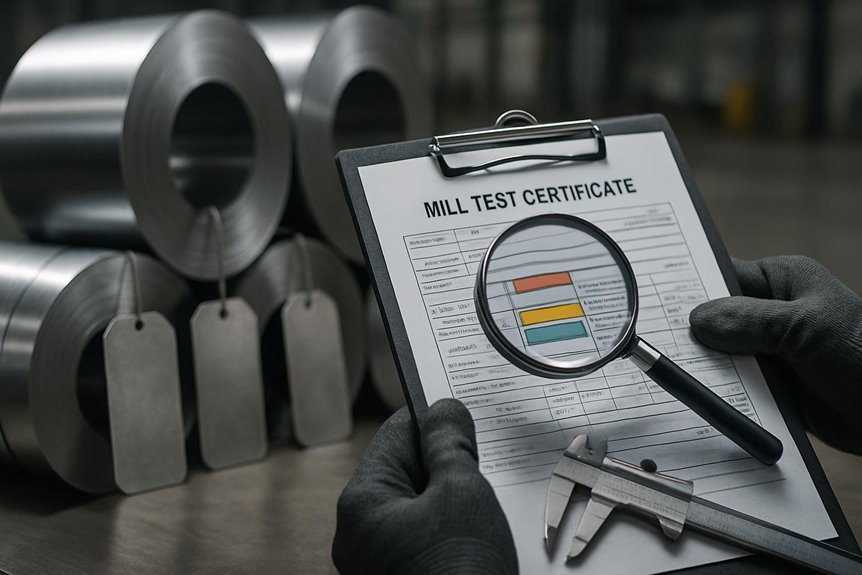
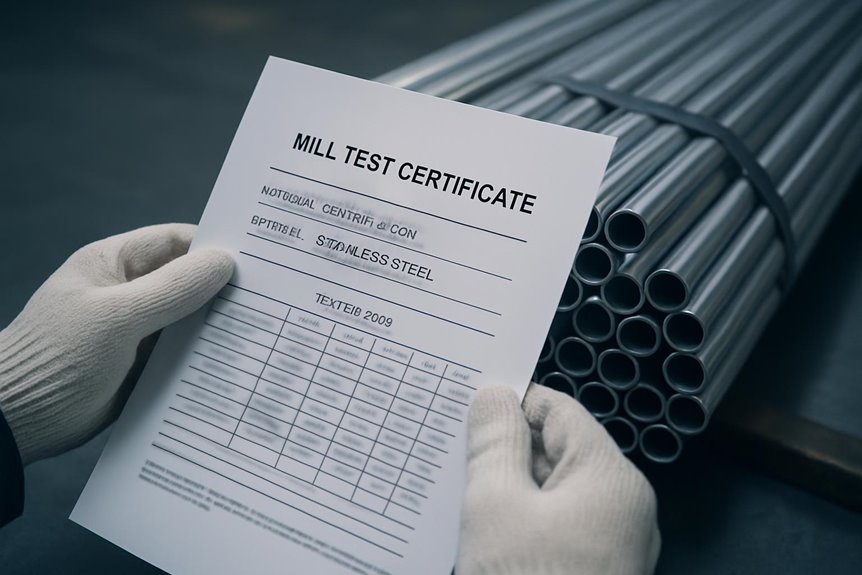
A stainless steel mill test certificate should be checked against the delivered material before acceptance. The reviewer should match the purchase order, delivery note, product form, grade, standard, dimensions, heat number, and physical markings. Chemical composition, mechanical properties, heat treatment, surface condition, NDT results, and required EN 10204 certificate type should then be verified against the specification. Any missing heat number, altered details, unclear traceability, or mismatched grade should trigger a hold and further checks below.

A stainless steel mill test certificate (MTC) is the manufacturer’s inspection document that links a specific production batch to its material identification and test results. It gives the buyer controlled evidence that the stated stainless steel grade was produced, tested, and recorded against defined requirements.
The document may also be called a Mill Test Report, material test report, Material Test Report, or inspection certificate; however, the required document type should be fixed by the purchase order and applicable standard.
Document names can vary, but the required certificate type should be fixed by order and standard.
A stainless steel mill test certificate can show material grade, product standard, chemical composition, mechanical properties, heat treatment condition, required tests, and manufacturing traceability.
It supports technical review before release, quarantine, or acceptance. However, the certificate alone does not prove the delivered physical material is the same material described.
The first step in reviewing a stainless steel mill test certificate is confirming that it belongs to the material received. Before relying on chemical composition or mechanical test results, compare the certificate with the purchase order, delivery documents, bundle labels, and physical product markings.
Material acceptance should be based on a continuous traceability link between the document and the shipment.
| Certificate Detail | What It Should Match |
|---|---|
| Manufacturer | Original producing mill or approved manufacturer |
| Order reference | Purchase order and delivery note |
| Product description | Pipe, tube, fitting, sheet, plate, or other supplied form |
| Grade | Material grade specified in the order |
| Product standard | Required ASTM, EN, DIN, or other specification |
| Dimensions | OD, wall thickness, schedule, length, or quantity |
| Heat number | Marking on the material, bundle, or identification label |
| Delivery condition | Annealed, solution-treated, pickled, polished, or other specified condition |
| Certificate number | Internal receiving and quality records |
The reviewer should also confirm that the manufacturing method and delivery condition shown on the certificate match the order requirements. For example, a certificate for seamless pipe should not be accepted for welded tube, even when the grade and chemical composition are correct.
A certificate cannot establish traceability if the heat number, product form, dimensions, or standard cannot be linked to the delivered material. Any mismatch should be resolved before the shipment is released for production, installation, or further processing.
These identifiers serve different purposes within the material traceability chain.
The heat number identifies the original melt from which the stainless steel was produced. It is the primary reference linking the material to its chemical composition, production origin, and heat-specific test results.
The lot or batch number identifies a defined group of material processed, inspected, or released together. Depending on the manufacturer and product standard, one heat may be divided into several production or inspection lots.
The certificate number identifies the mill test certificate itself, while the purchase order number connects the material and documentation to the commercial order.
During verification, the heat number shown on the certificate should match the markings on the tube, bundle tags, labels, production records, and any related inspection documents. If the material is cut, repacked, or separated into smaller quantities, this identification must remain traceable to the original heat.
A mismatch does not automatically indicate that the material is nonconforming, but it must be clarified before acceptance. Maintaining an unbroken link between the certificate and the physical material helps prevent substitution, mixing, and the release of unverified stock.
The EN 10204 certificate type determines what inspection information is provided, whether the results are specific to the supplied material, and who has validated the document. It should be identified before the material is released, accepted, or placed in quarantine.
| Certificate Type | Inspection and Validation Meaning |
|---|---|
| Type 2.1 | Manufacturer declaration that the product complies with the order, without test results. |
| Type 2.2 | Manufacturer declaration of compliance supported by non-specific inspection results that may not relate directly to the supplied batch. |
| Type 3.1 | Specific inspection results for the supplied material, validated by the manufacturer’s authorised inspection representative independent of the production department. |
| Type 3.2 | Specific inspection results validated by the manufacturer’s authorised representative and the purchaser’s representative or an independent inspector. |
An EN 10204 Type 3.1 certificate is commonly specified for industrial stainless steel pipe and tube because it links the reported chemical, mechanical, and inspection results to the supplied material through the manufacturer’s traceability system.
However, Type 3.1 does not constitute independent third-party certification. The document is validated under the manufacturer’s authority by an inspection representative who is organisationally independent of production.
A Type 3.2 certificate provides an additional level of independent validation, but it should not be requested by default. It is normally justified when required by the project specification, end user, applicable regulation, inspection and test plan, or the risk level of the intended service.
The certificate type alone does not confirm material acceptance. The reviewer must still verify that the heat number, grade, standard, dimensions, test results, and product description match the purchase order and the material delivered.
Material identification is the anchor point of the mill test certificate review. Before reading chemical composition, the reviewer should confirm that the stainless steel material certificate describes the exact product ordered, not merely an acceptable grade name.
This sequence gives procurement, QA, and engineering control before test values are considered. Misidentified material should remain on hold until reconciled.
Once the certificate has been matched to the correct stainless steel product, the reported chemical composition should be checked against the limits in the specified material standard.
A stainless steel MTC normally lists each alloying element as a percentage by mass. Depending on the grade, this may include carbon, chromium, nickel, molybdenum, manganese, silicon, phosphorus, sulfur, and nitrogen.
The review should confirm that every reported value falls within the permitted minimum or maximum range for the stated grade. Higher alloy content is not automatically acceptable. A value that exceeds the specified limit may indicate that the material does not conform to the grade, even if the change appears beneficial from a corrosion or strength perspective.
| Checkpoint | Reviewer action | Risk if overlooked |
|---|---|---|
| Grade limits | Compare each reported element with the limits in the named standard | Incorrect alloy may be accepted |
| Minimum and maximum values | Confirm every result remains within the permitted range | Nonconforming chemistry may be missed |
| Standard edition | Check that the certificate uses the required standard and revision | Results may be assessed against outdated limits |
| Analysis type | Identify whether the results are based on heat analysis or product analysis | The wrong acceptance tolerance may be applied |
| Units and notation | Confirm values are reported consistently as percentages | Results may be misread or compared incorrectly |
Where the material standard distinguishes between heat analysis and product analysis, the correct acceptance criteria must be applied.
The certificate should therefore be reviewed against the correct analysis basis rather than against a generic composition table.
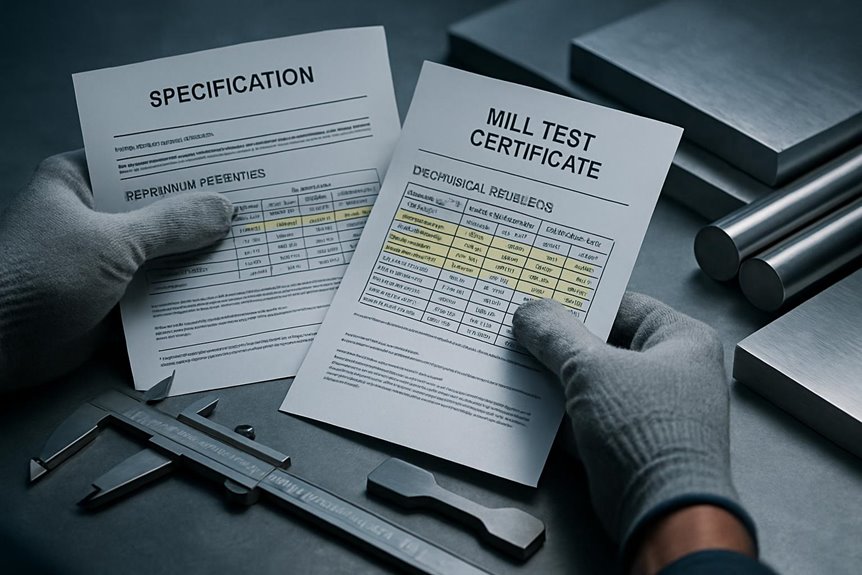
How should the reviewer confirm that the stainless steel has adequate strength and ductility? The MTC mechanical properties must be compared with the acceptance criteria in the applicable ASTM, ASME, or EN material standard, not with a generic online table. This check gives control over material acceptance.
If any reported value falls below the required limit, the material should be quarantined, clarified with the supplier, and withheld from use until conformity is proven.
Which tests should appear on an MTC for stainless steel pipe or tube depends on the product standard, supplementary requirements, and purchase order.
After verifying tensile strength and other mechanical values, the reviewer should look for required process or acceptance tests. Common entries may include hydrostatic testing, eddy-current testing, ultrasonic testing, flattening or reverse-flattening tests, flaring or flange tests, bend tests, intergranular-corrosion tests, positive material identification, dimensional inspection, and surface roughness measurement.
The absence of a test is not automatically a defect. Control comes from comparing the certificate against the ordered specification, not from expecting every possible test.
For pressure service, specified nondestructive testing should be clearly reported. If a required test is missing, unclear, or replaced without approval, the material should remain on hold.
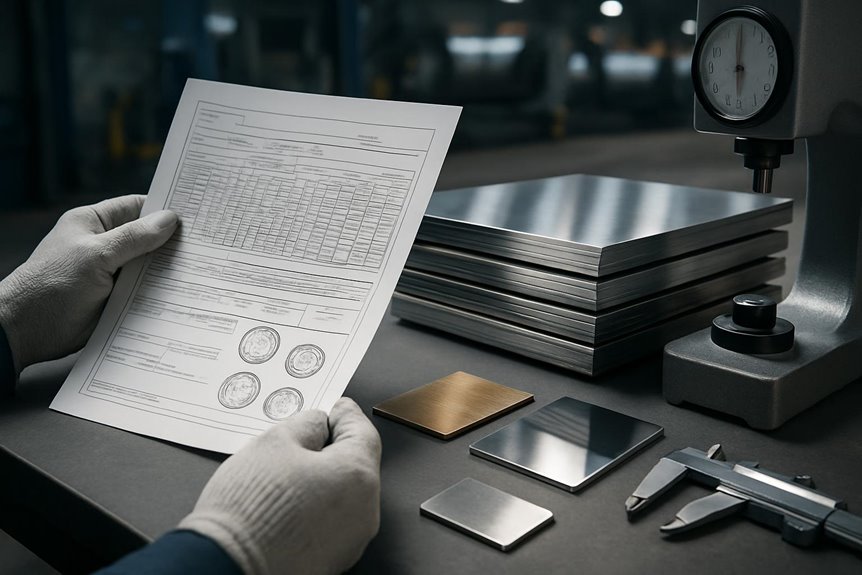
Confirm that the MTC states the required heat treatment and surface condition for the stainless steel pipe or tube. This section helps the reviewer control whether the delivered product matches the purchase order, standard, and intended service.
A mismatch between documented condition and delivered appearance reduces control over acceptance and service suitability.
When an MTC contains inconsistencies or unusual details, the reviewer should treat them as red flags that require further verification rather than immediate proof of fraud.
A controlled review looks for a missing heat number on the physical material, a certificate grade differing from the purchase order, or a product standard unsuitable for the supplied form. Altered mill names, changed headers, missing authorised signatures, or absent validation also weaken confidence.
Other warning signs include identical test values repeated across unrelated heats, dimensions or quantities that conflict with delivery documents, required supplementary tests not shown, editable certificate files, unclear links between trader, supplier, and original mill, or values without units or acceptance criteria.
In how to read a mill test certificate, these issues should trigger clarification, document verification, PMI, or third-party testing to protect heat traceability.
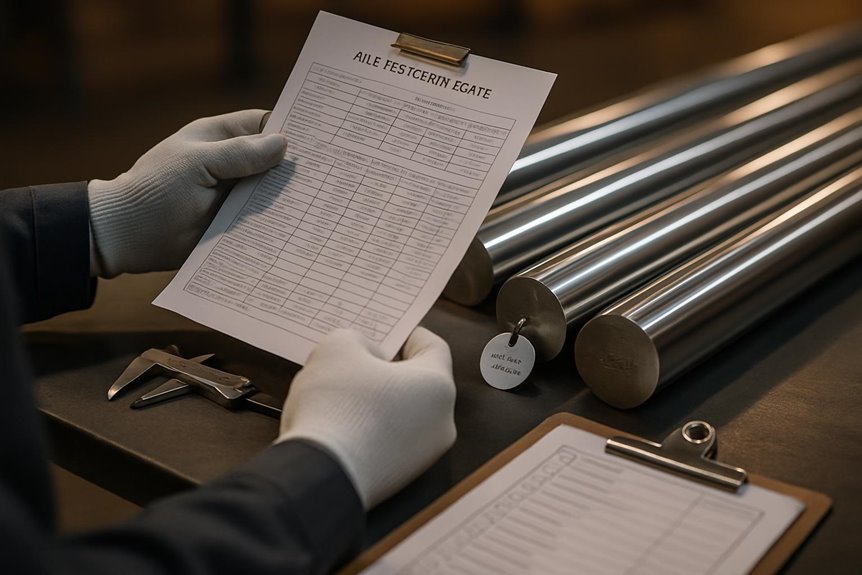
After red flags have been identified, the reviewer needs a controlled acceptance sequence rather than an ad hoc judgment. Each step should close one risk before the next is opened.
When every requirement is aligned, the certificate should be entered into the traceability system.
If discrepancies remain, the material should be isolated and clarification requested before release.
Why should a reviewer go beyond the mill test certificate? Independent testing is justified when acceptance risk cannot be controlled by paperwork alone.
PMI may be required for safety-critical service, corrosive duty, pressure systems, sanitary applications, or high-temperature operation. Laboratory chemical analysis or mechanical testing may be appropriate when certificate values conflict, traceability is incomplete, or the stainless steel heat number cannot be matched confidently to the material.
Third-party inspection is also necessary when the purchase order, client specification, or EN 10204 Type 3.2 requires validation by an authorised inspector.
Extra verification is prudent for material from a new or unqualified supplier, or where project rules demand independent confirmation. These checks reduce substitution risk, expose documentation errors, and give the reviewer controlled evidence before release.
Quill in hand, an organization should retain stainless steel mill test certificates for the structure’s working life; at minimum, ten years is common. Controlled retention supports audits, traceability, warranty claims, compliance, and risk governance.
Yes. A stainless steel MTC can be issued after shipment if verified test records exist and traceability remains intact. The recipient should require original documentation, matching heat numbers, standards, authorized signatures, and unaltered certificate data.
Manufacturers are responsible for correcting MTC errors. One wrong heat number can compromise 100% traceability, so buyers should demand revised originals, documented approvals, and supplier accountability before accepting records into controlled quality systems.
Yes, digital MTC copies may be accepted during audits if controlled properly. The organization should verify authenticity, completeness, traceability, signatures, heat numbers, and alteration protection, while maintaining centralized records, audit trails, and retention compliance.
Use a structured name: date, supplier, heat number, grade, product, certificate type, PO. Like locked drawers opening in sequence, it preserves control, traceability, audit speed, and prevents duplicates, confusion, or missing compliance evidence.
A stainless steel mill test certificate is often treated as routine paperwork, yet it may be the only thing standing between safe service and costly failure. The numbers look quiet, but they speak for every heat, test, dimension, and approval behind the material. Ironically, the easiest page to overlook can reveal the hardest problems to fix. Careful certificate review gives buyers, engineers, and inspectors the confidence to accept material—or the reason to stop it.