Selecting a stainless steel condenser tube requires more than choosing between 304L and 316L. Cooling-water chemistry, process fluid, operating temperature, flow velocity, tube dimensions, wall thickness, and fabrication quality all influence heat-transfer performance and service life.
304L may perform well in controlled, relatively mild conditions. 316L provides a greater corrosion margin where chloride exposure increases the risk of pitting and crevice corrosion. Neither grade should be selected in isolation from the condenser's actual operating conditions.
The most reliable specification balances corrosion resistance, heat transfer, pressure requirements, tube geometry, inspection, and lifecycle performance.
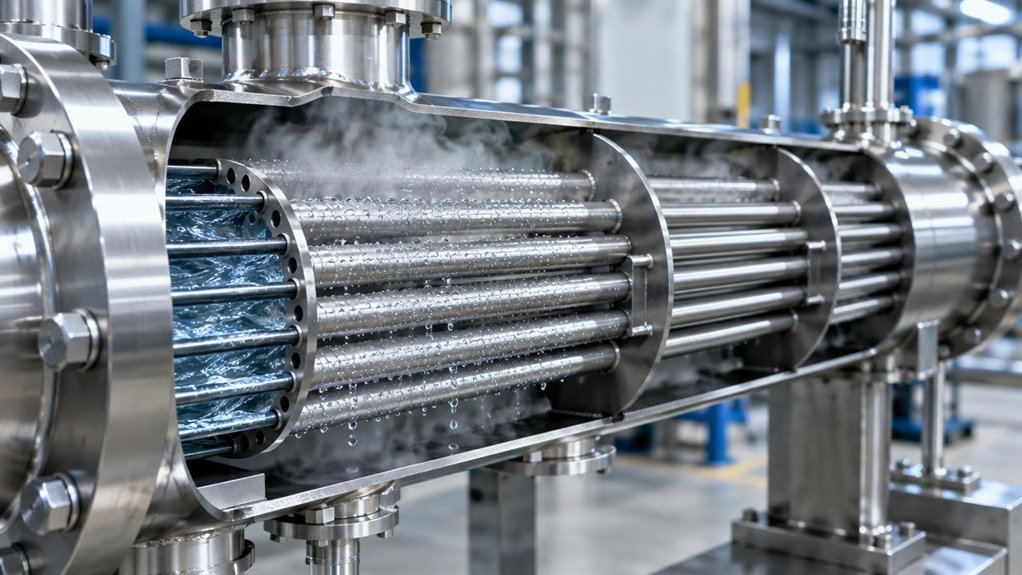
A stainless steel condenser tube forms the heat-transfer barrier between a condensing fluid and a cooling medium. One fluid passes through the tube while the other flows around it, or vice versa, depending on the condenser design.
Heat moves through the tube wall without allowing the two fluids to mix. As the hot vapour releases heat, it reaches its condensation temperature and changes into liquid.
The same basic heat-transfer principle applies across many stainless steel heat exchanger tube applications, but condenser service places particular importance on cooling-water chemistry, tube-wall thickness, and resistance to long-term fouling and corrosion.
The tube therefore has to perform several functions at the same time:
Surface condition also matters. A smoother internal surface can reduce areas where deposits accumulate, while a rough or contaminated surface can increase fouling and make cleaning more difficult.
Material selection should begin with the two environments touching the tube.
The cooling-water side may expose the material to chlorides, dissolved solids, biological growth, treatment chemicals, or stagnant conditions. At the same time, the process side may contain steam, refrigerant, chemicals, or other media with a completely different corrosion profile.
| Service Factor | Why It Matters |
|---|---|
| Cooling-water chlorides | Increase the risk of pitting and crevice corrosion |
| Water pH and dissolved solids | Influence scaling and corrosion |
| Process fluid | May attack the opposite tube surface |
| Operating temperature | Changes corrosion behaviour and material strength |
| Flow velocity | Influences heat transfer, erosion, and deposit formation |
| Fouling tendency | Reduces thermal efficiency |
| Cleaning chemistry | May be more aggressive than normal service |
| Shutdown conditions | Stagnant water can increase localized-corrosion risk |
A tube that performs reliably with clean cooling water may behave very differently in brackish water, chemically treated water, or stagnant shutdown conditions.
Localized attack is particularly important because pitting and crevice corrosion can penetrate stainless steel locally even when most of the tube surface still appears unaffected. Tubesheet joints, deposits, and stagnant zones therefore deserve as much attention as the bulk water chemistry.
Where the condenser handles chemically aggressive process media, the material should also be checked against the same temperature, concentration, and corrosion considerations used when specifying stainless steel pipe for chemical processing.
The choice between 304L and 316L should follow the actual corrosion environment rather than a general preference for one grade.
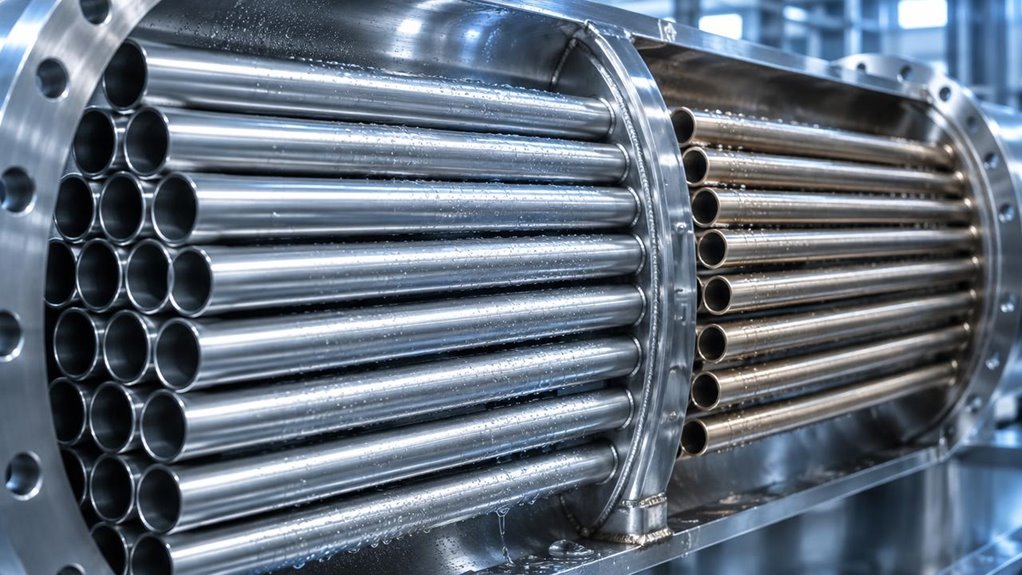
304L can be a practical option where:
Its lower carbon content is useful in welded systems because it reduces the risk of sensitization associated with chromium carbide precipitation.
For clean utility water, controlled plant water, and moderate-duty condenser systems, 304L can provide a useful balance between corrosion resistance, fabrication performance, and material cost.
316L contains molybdenum, which improves resistance to pitting and crevice corrosion compared with 304L.
It is often considered where:
| Selection Factor | 304L | 316L |
|---|---|---|
| General corrosion resistance | Good | Higher |
| Chloride resistance | More limited | Improved |
| Molybdenum addition | No intentional addition | Yes |
| Relative alloy cost | Lower | Higher |
| Typical selection | Mild, controlled service | More demanding service |
The broader differences between these materials—including corrosion resistance, cost, and typical service conditions—are also important when comparing 304 and 316 stainless steel tube.
316L should not, however, be assumed suitable for every chloride environment. Seawater and other severe conditions may require duplex, super duplex, titanium, or another material with greater localized-corrosion resistance.
For applications approaching that boundary, duplex 2205 stainless steel tube may be worth evaluating because its higher strength and improved chloride resistance can offer advantages over conventional austenitic grades.
Stainless steel condenser tubes are often chosen because they provide a useful combination of corrosion resistance, mechanical durability, and long service life.
The tradeoff is that stainless steel has lower thermal conductivity than some alternative condenser materials.
That does not automatically make stainless steel a poor heat-transfer material. Condenser performance depends on the complete thermal design, including:
A material with higher thermal conductivity may initially transfer heat more efficiently, but frequent corrosion, leakage, fouling, or tube replacement can reduce long-term system performance.
The better comparison is therefore:
heat-transfer efficiency + corrosion durability + maintenance requirement + service life
rather than thermal conductivity alone.
This is also why service life should be evaluated in context. The actual lifespan of stainless steel depends on grade, environment, surface condition, maintenance, and fabrication quality rather than on material name alone.
Tube dimensions influence both heat transfer and mechanical reliability.
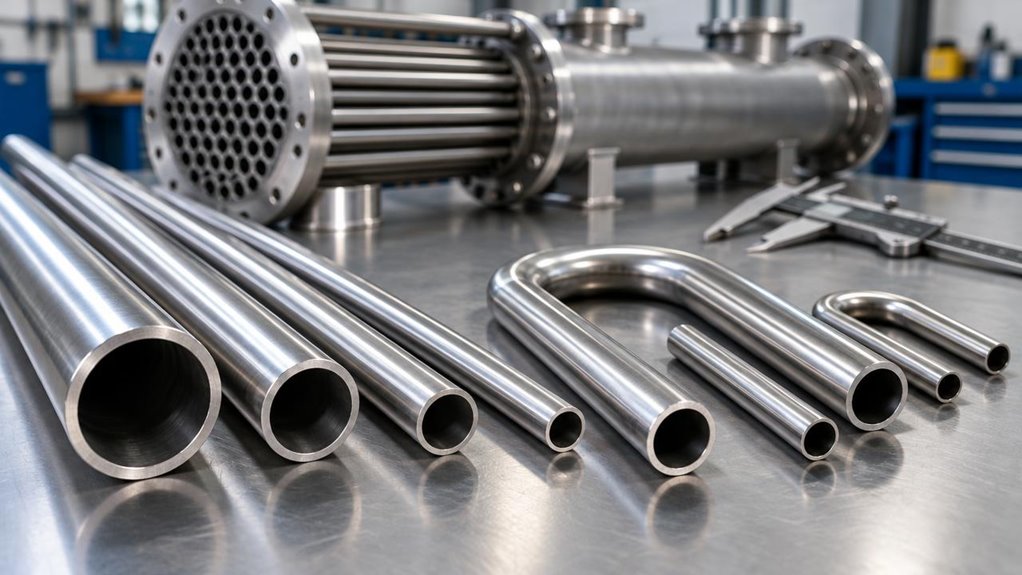
Outside diameter affects:
Wall thickness affects:
A thicker wall may increase mechanical margin, but it also creates greater resistance to heat moving through the tube wall. Thicker is therefore not automatically better.
Where pressure capability matters, OD and wall thickness should be evaluated together with material strength and operating temperature. The same variables determine the pressure rating of stainless steel tubing in other pressure-containing systems.
Condenser tubing may be supplied as:
For U-bend or formed tubes, the specification should also control:
Dimensional consistency becomes particularly important when tubes must be expanded, rolled, or welded into the tubesheet.
The choice between welded and seamless condenser tubing should be based on the applicable standard and operating requirements rather than the assumption that seamless material is always superior.
| Welded Tube | Seamless Tube | |
|---|---|---|
| Longitudinal seam | Present | None |
| Common relevant standard | ASTM A249 | ASTM A213 |
| Availability | Broad for many heat-transfer applications | Depends on grade and dimensions |
| Main quality focus | Weld integrity and dimensional consistency | Base-material integrity and dimensional consistency |
| Selection basis | Service and project specification | Service and project specification |
Properly manufactured welded condenser tubing can provide reliable service when weld quality, heat treatment, tolerances, and inspection are controlled.
For welded tubes, the main areas to verify include:
The differences between welded and seamless stainless steel tubing are therefore most useful when considered alongside the actual service conditions rather than as a simple quality ranking.
The product standard should match the tube's intended service.
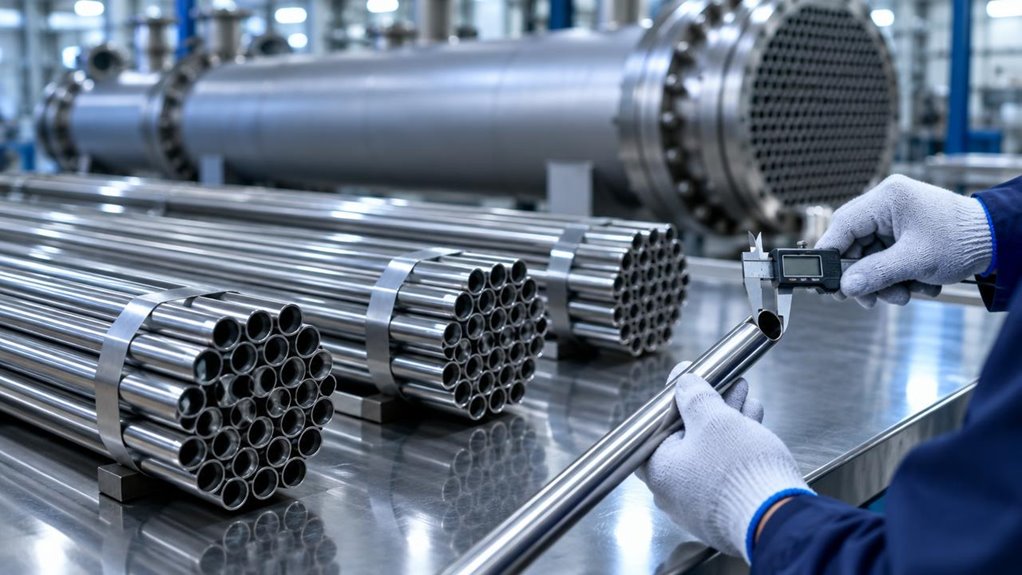
ASTM A249 is particularly relevant to welded austenitic stainless steel tubing used in:
For welded stainless steel condenser tubes, this is one of the most important specifications to establish at the quotation stage.
The standard covers requirements related to material, manufacture, heat treatment, mechanical properties, dimensions, and testing. For projects based on welded condenser tubing, the requirements of ASTM A249 stainless steel tube should therefore be confirmed before production begins.
ASTM A213 applies to seamless ferritic and austenitic alloy-steel tubing used in boilers, superheaters, and heat exchangers.
Where a condenser design specifically requires seamless heat-transfer tubing, A213 may therefore be the appropriate product standard.
Other standards may apply where the project involves:
ASTM A269 should not automatically replace A249 simply because both can involve stainless steel tubing. ASTM A269 stainless steel tube is primarily a general-service tubing specification, whereas A249 is directly written around boiler, superheater, heat-exchanger, and condenser service.
Tube damage should be diagnosed by its failure pattern rather than immediately assuming stainless steel was the wrong material.
| Tube Problem | Possible Cause |
|---|---|
| Pitting | Chlorides, deposits, unsuitable grade |
| Crevice corrosion | Tubesheet joints, deposits, stagnant zones |
| Fouling or scaling | Poor water chemistry or insufficient flow |
| Erosion | Excessive velocity or suspended solids |
| Leakage | Corrosion, mechanical damage, or joint failure |
| Vibration damage | Insufficient support or flow-induced vibration |
| Weld-related failure | Manufacturing or fabrication problem |
For example, localized attack around deposits or tubesheet joints may indicate restricted oxygen access and crevice conditions rather than uniform corrosion across the tube.
Likewise, erosion can indicate excessive flow velocity or abrasive suspended solids rather than insufficient alloy corrosion resistance.
Before changing material grade, identify whether the root cause is:
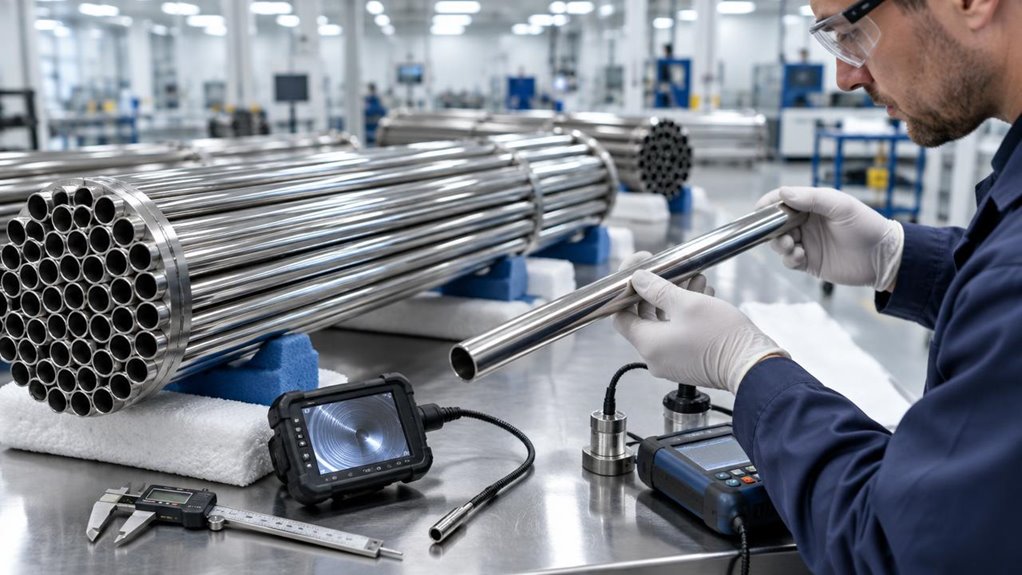
Acceptance should connect the purchase specification to measurable evidence.
Verify:
For welded condenser tubing, weld-seam integrity and dimensional consistency require particular attention.
Depending on the applicable standard and project specification, inspection may include:
During production, eddy current testing of stainless steel tubes can identify relevant electromagnetic indications without cutting or damaging the tube.
Pressure integrity may also be verified by a hydrostatic test of stainless steel pipe or tubing where the applicable standard or project specification requires it.
The accompanying stainless steel mill test certificate should then connect the delivered material to its heat number, grade, chemistry, mechanical results, heat treatment, and applicable inspection records.
“316L stainless steel condenser tube” is not a complete technical specification.
A reliable enquiry should define:
| Requirement | What to Specify |
|---|---|
| Condenser service | Steam, refrigeration, process cooling, etc. |
| Cooling medium | Water chemistry and chloride exposure |
| Process medium | Fluid contacting the opposite tube surface |
| Material grade | 304L, 316L, or specified alloy |
| Product standard | ASTM A249, A213, or project specification |
| Construction | Welded or seamless |
| Outside diameter | Required OD |
| Wall thickness | Required wall |
| Tube form | Straight, U-bend, coil, or other |
| Length | Fixed or project-specific |
| Surface condition | Annealed, pickled, BA, or specified finish |
| Testing | ECT, hydrostatic, or project-specific inspection |
| Documentation | MTC and heat traceability |
| Packaging | End and surface protection |
Surface condition should also be defined deliberately. Where a clean oxide-free surface is required after heat treatment or fabrication, processes such as pickling and passivation perform different roles and should not be treated as interchangeable finishing terms.
The specification should also identify any special dimensional tolerances, tube-end requirements, tubesheet joint requirements, or third-party inspection requirements before production begins.

Vinmay manufactures welded stainless steel tubing in grades including 304, 304L, and 316L for applications where dimensional consistency, weld quality, and material traceability are important.
For condenser-tube projects, requirements can be coordinated around:
Consistent OD, roundness, wall thickness, and tube-end condition are particularly important where condenser tubes must be expanded, rolled, or welded into tubesheets.
Vinmay can review the material and dimensional requirements against the cooling medium, condenser design, and applicable tube standard before production.
Contact Vinmay with the condenser service, cooling medium, stainless steel grade, tube standard, OD, wall thickness, tube form, length, and inspection requirements to discuss a suitable condenser tube specification.
A stainless steel condenser tube forms the heat-transfer surface between a condensing process fluid and a cooling medium while keeping the two fluids physically separated.
There is no universal best grade. 304L may suit mild, controlled conditions, while 316L provides improved resistance to pitting and crevice corrosion in more demanding chloride-bearing environments.
Yes. ASTM A249 specifically covers welded austenitic steel tubing used in boilers, superheaters, heat exchangers, and condensers.
Yes. Welded tubing can provide reliable condenser service when it meets the required product standard, dimensional tolerances, heat-treatment condition, and inspection requirements.
It should not automatically be assumed suitable. Seawater creates severe chloride exposure, and duplex, super duplex, titanium, or other materials may need to be evaluated depending on temperature, flow conditions, oxygen content, and system design.
Common causes include pitting, crevice corrosion, fouling, erosion, vibration, poor water chemistry, mechanical damage, weld defects, and tube-to-tubesheet joint problems.
Depending on the standard and purchase specification, testing may include dimensional inspection, surface examination, eddy current testing, hydrostatic testing, and other specified nondestructive examination.
Yes. Where U-bend tubes are required, the specification should define the grade, standard, OD, wall thickness, bend radius, leg length, heat-treatment condition, tolerances, and inspection requirements.
Selecting stainless steel condenser tubes should begin with the cooling medium and process conditions rather than the grade name alone.
304L can provide reliable performance in mild, controlled environments. 316L offers a greater corrosion margin when chloride exposure increases the risk of localized attack. More aggressive conditions may require higher-alloy materials.
The final specification should bring together:
cooling medium + process fluid + corrosion risk + thermal duty + grade + OD + wall thickness + tube form + product standard + inspection
When those factors are specified together, the condenser tube can provide the required corrosion resistance and mechanical reliability without compromising the heat-transfer performance the equipment was designed to achieve.