430 stainless steel tube is often selected where cost, appearance, magnetic properties, and moderate corrosion resistance matter more than the broader corrosion resistance and fabrication flexibility of 304.
As a ferritic stainless steel, Grade 430 contains roughly 17% chromium and very little nickel. This makes 430 stainless steel tubing attractive for indoor decorative uses, appliance components, automotive trim, and other mild-service applications where a bright or polished finish is required.
However, 430 should not be treated as a lower-cost substitute for 304 in every application. Chloride exposure, welding requirements, severe forming, operating temperature, and the applicable tube standard can all change the material decision.
The key question is not simply whether 430 costs less than 304. It is whether its properties match the actual service conditions.
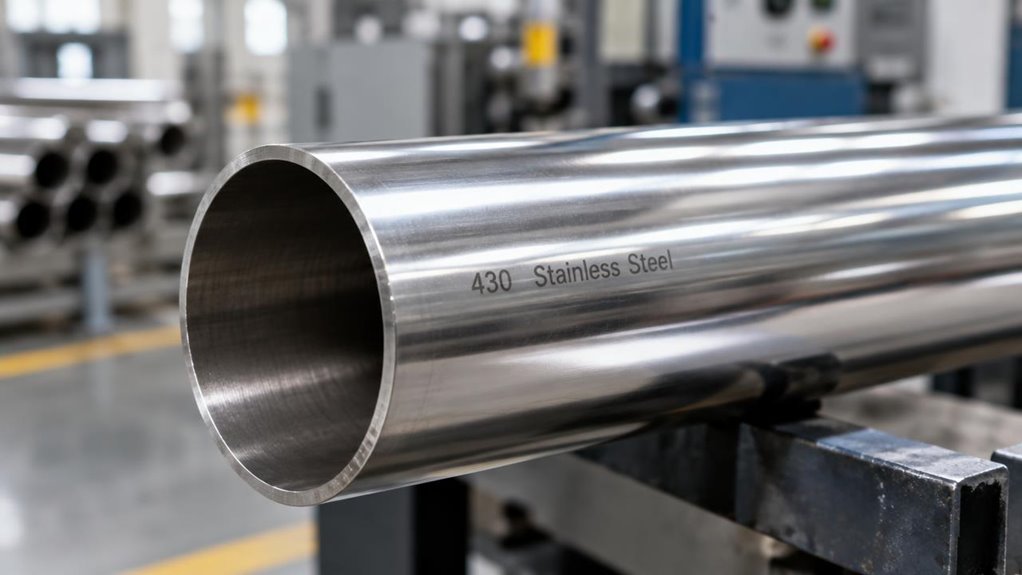
430 stainless steel tube is made from a ferritic, straight-chromium stainless steel identified as UNS S43000 and EN 1.4016.
Compared with austenitic grades such as 304, 430 contains much less nickel and has a different microstructure. This gives it several distinctive characteristics:
When evaluating 430 stainless steel tubing, it is important not to rely only on property data published for sheet or coil. The finished tube also depends on its manufacturing method, dimensions, surface condition, heat treatment, and applicable product standard.
For a broader overview of how ferritic and austenitic grades differ, see our guide to stainless steel tube and pipe grades.
430 stainless steel tubing is most attractive where the application requires a combination of moderate corrosion resistance, appearance, magnetic behaviour, and controlled material cost.
Typical suitable conditions include:
| Application Condition | Suitability of 430 |
|---|---|
| Indoor decorative tubing | Very suitable |
| Appliance and furniture components | Suitable |
| Mild atmospheric exposure | Generally suitable |
| Automotive trim and selected exhaust-related components | Common application |
| Visible polished tubing | Suitable |
| Chloride-rich environments | Generally unsuitable |
| Coastal or marine exposure | Usually not recommended |
| Aggressive chemical service | Usually another grade is preferred |
| Hygienic product-contact systems | 304L or 316L is usually preferred |
| Heavily welded process systems | Requires careful evaluation |
430 is therefore best viewed as a targeted material choice rather than a general-purpose replacement for 304.
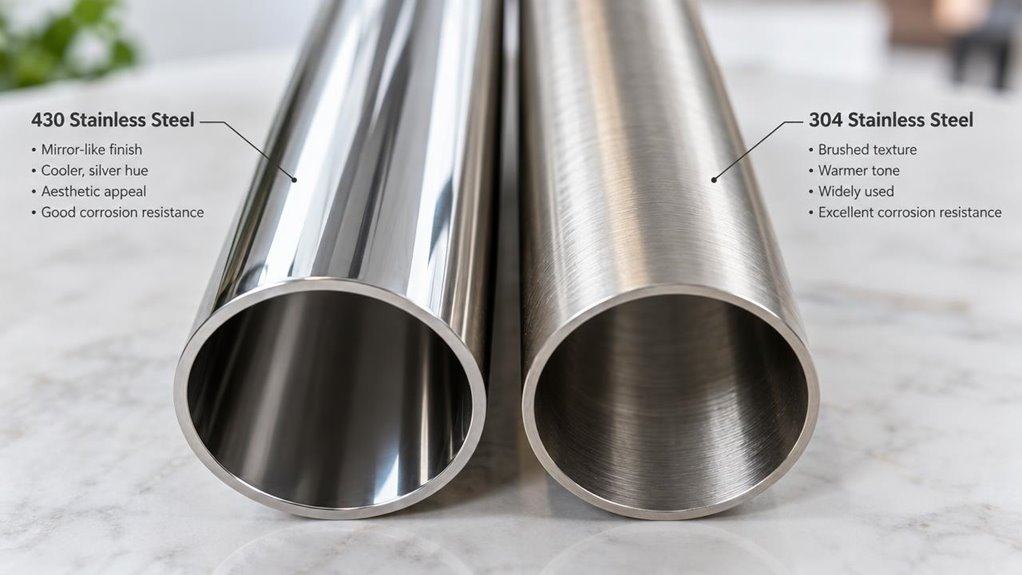
430 and 304 stainless steel tubes serve different priorities. Grade 430 is a ferritic stainless steel with very low nickel content, while 304 is an austenitic grade with higher nickel content and broader corrosion resistance.
The practical difference is that 430 is often chosen for mild-service applications where cost, appearance, and magnetic properties matter, while 304 is usually preferred where corrosion resistance, welding, and forming performance are more demanding.
| Property | 430 Stainless Steel Tube | 304 Stainless Steel Tube |
|---|---|---|
| Stainless family | Ferritic | Austenitic |
| Magnetic behaviour | Strongly magnetic | Generally non-magnetic when annealed |
| Nickel content | Very low | Higher |
| Corrosion resistance | Good in mild environments | Better across a wider range of environments |
| Formability | Suitable for moderate forming | Better for severe forming |
| Weldability | More restrictive | Generally easier to weld |
| Work hardening | Lower | Higher |
| Typical cost position | Usually lower alloy cost | Usually higher due to nickel content |
| Common use | Decorative, appliance, automotive, mechanical tubing | Industrial, architectural, fabricated, and more demanding service |
430 stainless steel tube is often suitable when:
304 stainless steel tube is usually more appropriate when:
The choice should therefore be based on service conditions rather than price alone. 430 can provide excellent value in the right environment, while 304 offers a broader safety margin where corrosion and fabrication requirements are more demanding.
Grade 430 performs well in many indoor and mildly corrosive environments, but its limits become more important as chloride exposure and chemical severity increase.
Conditions that require caution include:
In these environments, localized corrosion can become a greater concern.
A smooth surface can improve cleanability and reduce areas where contaminants accumulate, but polishing does not turn 430 into a marine-grade or highly chemical-resistant alloy.
Where pitting or crevice corrosion is a significant concern, 304, 316L, duplex, or another higher-alloy grade may provide a more appropriate corrosion margin.
The important point is that surface finish and alloy selection perform different roles. A good finish supports performance, but it cannot compensate for an unsuitable grade.
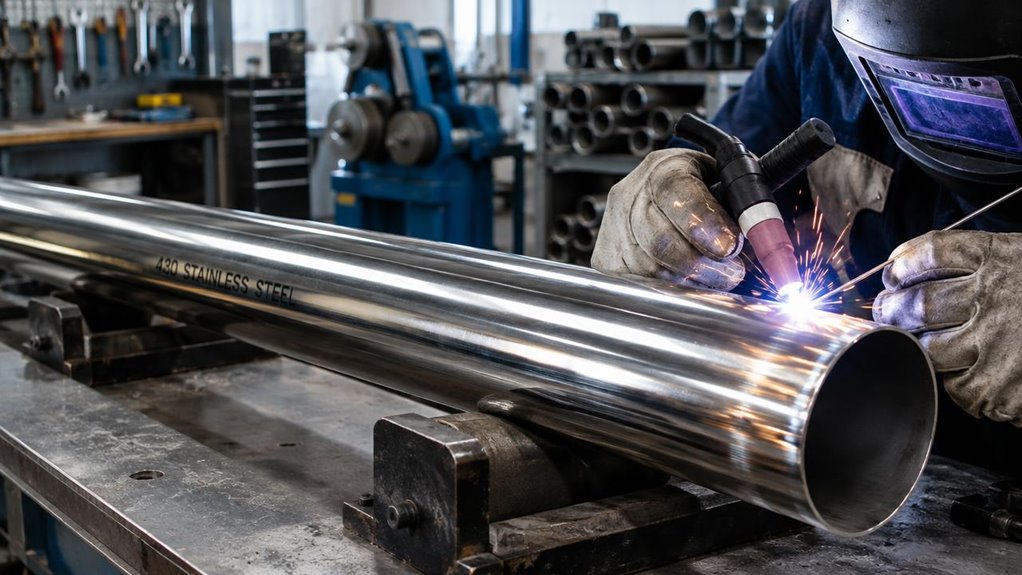
430 stainless steel tube can be formed and welded successfully, but its ferritic structure gives it different fabrication behaviour from austenitic grades such as 304.
430 has a relatively low work-hardening rate, which makes it suitable for many moderate forming operations, including bending, rolling, and decorative fabrication.
Its lower ductility compared with 304 means tighter bends and more severe deformation require greater control. Important factors include:
For simple or moderate forming, 430 can perform well. Where the design involves deep drawing, complex shapes, or repeated deformation, 304 may offer greater fabrication flexibility.
430 can be welded, but heat input must be controlled carefully because excessive heating can promote grain growth and reduce ductility in the heat-affected zone.
Welding procedure should consider:
Preheating or post-weld heat treatment may be used in some conditions, but these should be determined by the qualified welding procedure rather than applied as a universal rule.
Because ferritic grades respond differently to heat than common austenitic stainless steels, understanding typical stainless steel welding issues such as heat-affected-zone changes, distortion, oxidation, and loss of ductility can help reduce fabrication problems.
430 is therefore generally less attractive for heavily welded process systems than 304 or 316L.
430 stainless steel tube offers useful oxidation resistance at elevated temperatures, which is one reason it is used in appliance components, exhaust-related parts, and other heat-exposed applications.
Typical published guidance places its oxidation resistance at approximately:
These figures should be treated as material-reference values rather than universal design limits. Actual suitability depends on the atmosphere, load, exposure time, tube geometry, and fabrication condition.
Unlike martensitic stainless steels, Grade 430 cannot be hardened by conventional heat treatment. Annealing is instead used to restore ductility, reduce fabrication effects, and improve formability after cold working or welding. The same principles of temperature control, holding time, and cooling method discussed in heat treatment of stainless steel pipes are important because improper thermal treatment can alter the tube’s final mechanical and corrosion performance.
Because ferritic stainless steels can lose toughness after prolonged exposure within certain intermediate temperature ranges, the full thermal history of the tube should also be considered in repeated or sustained high-temperature service.
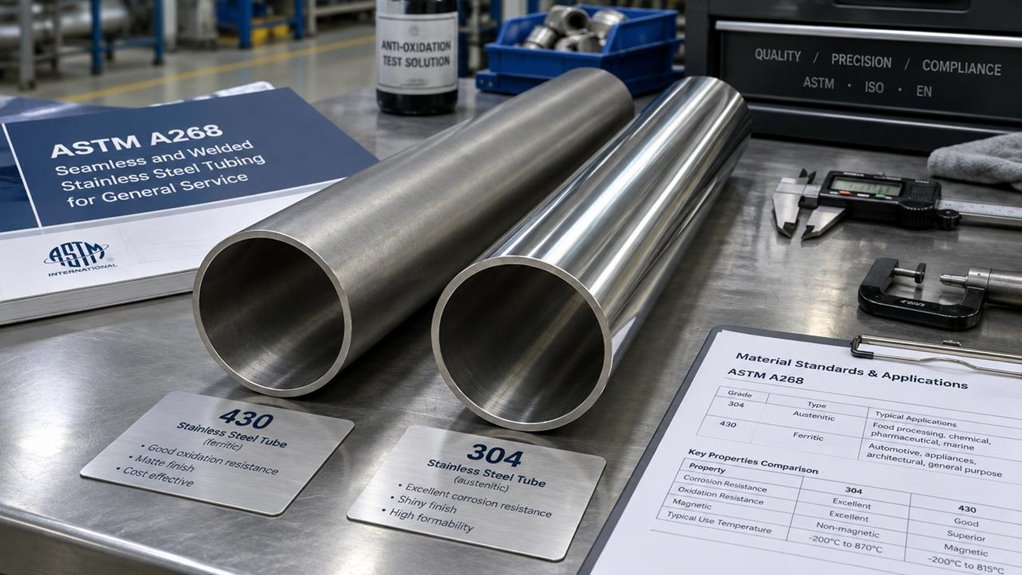
The correct standard for 430 stainless steel tube depends on how the tube will be used.
ASTM A268 is intended for seamless and welded ferritic and martensitic stainless steel tubing used in general corrosion-resistant and high-temperature service. It is the more relevant specification when the tube is being selected for functional performance, where material properties, heat treatment, dimensional tolerances, and inspection requirements are important.
ASTM A554, by contrast, applies to welded stainless steel mechanical tubing and is commonly used for architectural, decorative, furniture, appliance, and other visible mechanical applications. In these cases, dimensional consistency and surface appearance are often just as important as the base material grade.
| Standard | Typical Use | Main Focus |
|---|---|---|
| ASTM A268 | General corrosion-resistant or high-temperature tubing | Material properties, heat treatment, testing, dimensional control |
| ASTM A554 | Mechanical and decorative welded tubing | Dimensional consistency, fabrication, surface finish |
For 430 stainless steel tube used in visible or fabricated applications, the surface and dimensional requirements associated with ASTM A554 stainless steel welded tube can be particularly relevant. Where the tubing is expected to perform in a defined corrosion or temperature service, ASTM A268 is generally the more appropriate reference.
The important point is that the standard should follow the tube’s intended function, not simply the fact that the material is Grade 430.
Surface finish is an important consideration when selecting 430 stainless steel tube, particularly for decorative, architectural, and appliance applications where appearance matters. Grade 430 responds well to polishing and can achieve a bright, attractive surface when properly processed.
Common finish options include:
Choosing among these stainless steel tube surface finishes depends on the required appearance, surface roughness, maintenance conditions, and production cost. For visible welded tubing, consistency around the weld seam is particularly important, as variations in polishing can affect the appearance of the finished assembly.
Surface protection also matters after finishing. Clean handling, suitable separators, protective film where appropriate, and secure packaging help prevent scratches during storage and transportation.
Although a smoother finish can make 430 tubing easier to clean and reduce contaminant accumulation, it does not overcome the alloy's limitations in chloride-rich or highly corrosive environments.
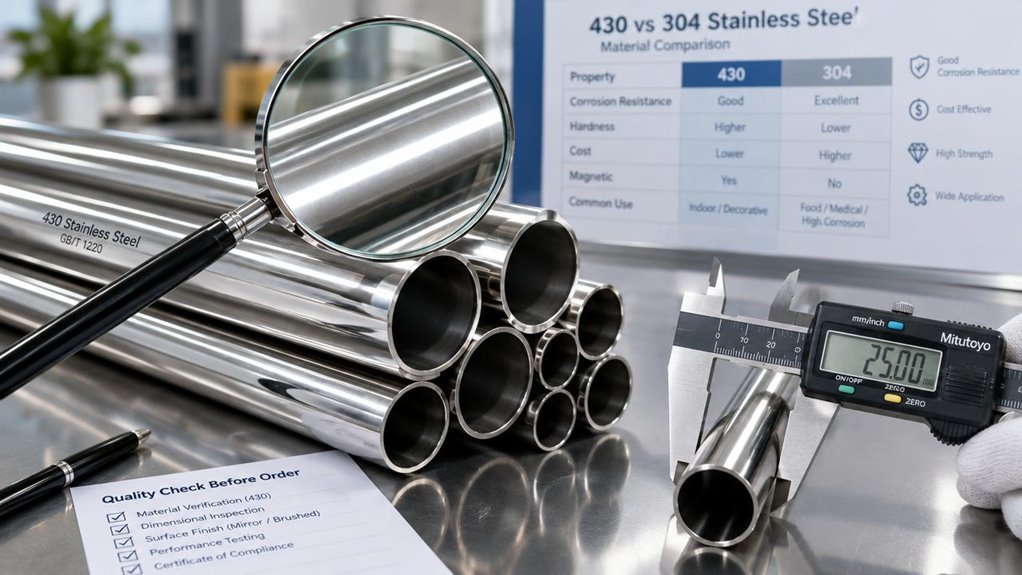
When ordering 430 stainless steel tube, material grade alone is not enough to ensure the product meets its intended application. Tube dimensions, manufacturing standards, surface finish, and fabrication requirements should all be defined before production.
The following specifications help establish clear manufacturing and quality expectations:
| Specification | What to Confirm |
|---|---|
| Material Grade | Grade 430 (UNS S43000 / EN 1.4016) |
| Product Standard | ASTM A268, ASTM A554, or applicable specification |
| Tube Construction | Welded or seamless, as required |
| Dimensions | Outside diameter, wall thickness, and length |
| Surface Finish | Bright annealed, mirror polished, brushed, or mill finish |
| Fabrication Requirements | Bending, forming, welding, or cutting |
| Service Environment | Indoor, outdoor, temperature, and corrosion exposure |
| Quality Documentation | Material test certificate and inspection requirements |
| Packaging | Surface protection, bundling, and shipping requirements |
For decorative and architectural tubing, surface consistency, dimensional accuracy, and scratch protection deserve particular attention. For mechanical or heat-exposed applications, material properties, fabrication conditions, and the appropriate product standard become more important.
Material identification should also be verified through the stainless steel mill test certificate, which provides traceability and relevant chemical and mechanical test results.
Providing these details when requesting a quotation helps avoid material mismatches, unnecessary processing costs, and delays caused by incomplete specifications.
When it comes to cost, 430 stainless steel offers more bang for the buck compared to 304. Its lower nickel content reduces expenses, making it an economical choice for applications where its properties suffice without compromising quality.
Generally no. 430 provides useful corrosion resistance in mild environments, but 304 normally offers broader resistance where moisture, outdoor exposure, or more demanding service conditions are present.
It is generally not recommended for marine applications because chloride exposure increases the risk of localized corrosion. Grades with greater chloride resistance, such as 316L, are normally evaluated for these conditions.
430F is a free-machining modification designed primarily to improve machinability. Its composition and corrosion behaviour differ from standard 430, so the two grades should not be treated as interchangeable.
Yes. Grade 430 has a ferritic microstructure and is strongly magnetic. This distinguishes it from annealed 304 stainless steel, which is generally considered non-magnetic.
430 has useful oxidation resistance at elevated temperatures and is used in selected heat-related applications. However, prolonged exposure within certain intermediate temperature ranges can reduce toughness, so the complete service temperature profile should be considered.
To summarize, 430 stainless steel tube is an excellent choice for applications where visual appeal and cost-efficiency are prioritized. Its polished finish and economical composition make it ideal for indoor decor and automotive trim. Remarkably, 430 contains approximately 0.5% nickel, considerably less than the 8% in 304, reducing costs without compromising moderate corrosion resistance. While not suited for harsh environments, its advantages make it a valuable option when aesthetics and budget are paramount.