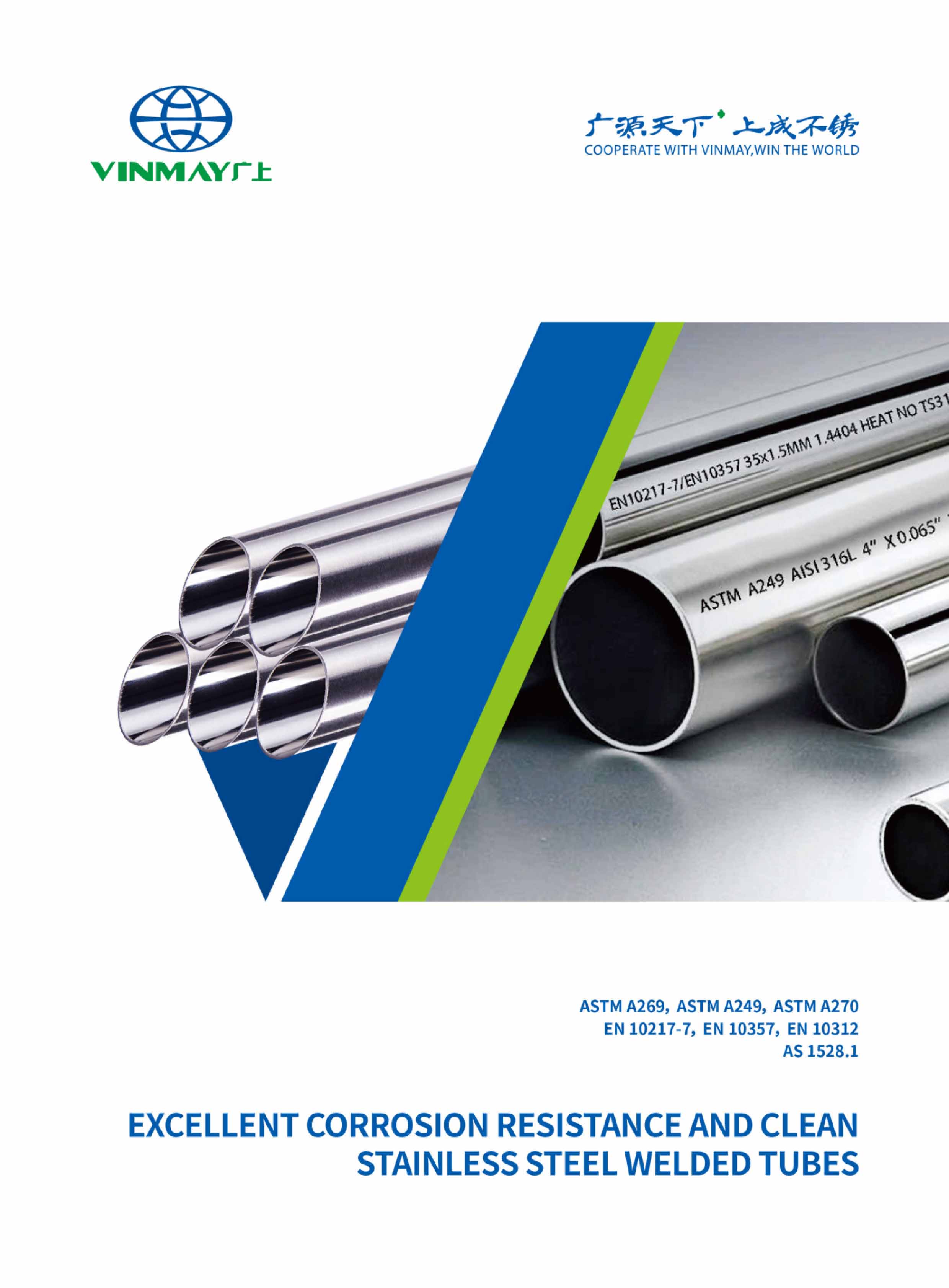
Stainless steel water pipe fittings are essential to efficient fluid handling systems, offering unmatched durability and resistance to corrosion. These fittings, including elbows, tees, and couplings, are designed for seamless integration into various applications. Selecting the appropriate material grade, such as 304 or 316, is vital for peak performance. Understanding technical specifications and industry standards is important to guarantee compliance and reliability. Explore the intricate details that distinguish these components in water systems.
Stainless steel fittings are extensively utilized in water systems due to their exceptional corrosion resistance and robust performance under various environmental conditions. Their environmental sustainability also supports eco-friendly projects through full recyclability and long service life. These attributes are complemented by high temperature resistance, enabling reliable operation in systems exposed to elevated temperatures and oxidizing conditions.
Stainless steel plumbing fittings offer unmatched durability, allowing them to withstand flow rates up to 20 times greater than copper lines, while maintaining structural integrity from -196˚C to 700˚C. Their longevity is further supported by sustainable practices and the high recyclability of stainless steel highlighted by industry organizations. As noted in sanitary applications, 304 or 316L grades provide excellent corrosion resistance and smooth surfaces that help deter contaminant buildup.
Stainless steel fittings endure extreme temperatures and flow rates far surpassing copper, ensuring reliable performance.
Corrosion-resistant water pipe fittings are highly advantageous in potable water applications, providing excellent resistance to varying chloride levels without requiring additional coatings.
Their formability simplifies installation, reducing system contamination and flushing times.
Additionally, these fittings present significant economic benefits; they minimize maintenance needs, reduce system downtime, and retain high residual scrap value, making them a financially prudent choice over the lifecycle of water handling systems.
For food-related water handling and sanitation lines, selecting grades like 304 or 316 with polished finishes supports superior hygiene due to the self-healing passive film.
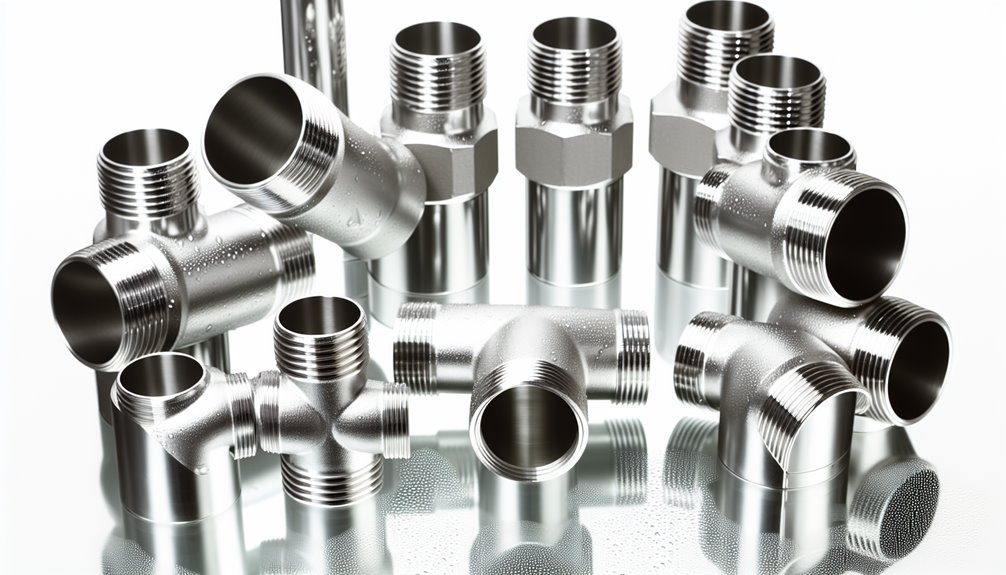
Stainless steel water pipe fittings encompass various components such as elbows, tees, couplings, reducers, and unions, each serving a specific function within a piping system.
Elbows facilitate directional changes, while tees allow for the branching of pipelines, enhancing the system's flexibility. For installations in demanding environments, selecting fittings compatible with seamless pipes helps ensure maximum integrity and performance. For enhanced longevity in aggressive environments, many systems specify 316-grade fittings due to their molybdenum content, which significantly improves corrosion resistance. Many projects also reference SAE and ASTM grading to ensure consistent material identification and compliance across applications.
Couplings, reducers, and unions provide secure connections, size adjustments, and easy disassembly, respectively, ensuring efficient flow management and adaptability in diverse applications. Accurate descriptions should include OD, WT, length, and material grade to ensure compliance with established standards.
They are commonly specified to comply with ASTM A-312 standards and selected by material grade (304 or 316) to match corrosion and pressure requirements.
Elbows are integral components of piping systems, providing directional changes for fluid flow with precision and efficiency. Among stainless steel water fittings, elbows are essential for altering the path of pipelines without sacrificing flow integrity. These fittings are manufactured with superior corrosion resistance, making them indispensable in high-demand environments.
Threaded stainless steel pipe fittings offer an additional advantage by facilitating easy assembly and disassembly, vital for maintenance-intensive applications. Available in various angles, commonly 45°, 90°, and 180°, elbows guarantee seamless fluid shifts, minimizing pressure loss and turbulence. Their robust design allows them to withstand extreme temperatures and pressures, consequently enhancing the durability and reliability of the piping infrastructure. Utilizing stainless steel elbows guarantees peak performance in both industrial and commercial settings.
Additionally, selecting elbows produced to ASTM A269 ensures quality for general service applications as outlined in industry standards. In addition, choosing elbows made from 316L stainless helps prevent carbide precipitation during welding, improving long-term corrosion resistance in chloride-rich and acidic environments. For applications involving elevated temperatures or aggressive media, selecting elbows in stainless steel grades such as 316 stainless can improve corrosion resistance and service life. Additionally, adherence to ASTM standards ensures consistent mechanical and chemical properties for stainless steel elbows used in critical systems. As part of the austenitic family, these alloys include molybdenum for enhanced chloride resistance, supporting reliability in marine and chemical environments.
Among the crucial components in pipeline systems, tees serve the essential function of joining three sections of pipe in a T-shaped configuration, facilitating the division or combination of fluid flow with high efficiency. Tees are indispensable in applications requiring precise control of fluid direction. The use of 316 stainless steel fittings for water supply guarantees superior resistance to chlorides and corrosion, making them ideal for challenging environments. Meanwhile, 304 stainless steel water fittings offer excellent corrosion resistance, suitable for general-purpose applications. The table below delineates the critical properties of these materials:
| Material | Corrosion Resistance | Application |
|---|---|---|
| 316 Stainless Steel | High | Marine, Chemical Processing |
| 304 Stainless Steel | Moderate | Food Processing, Plumbing |
These fittings are integral in maintaining pipeline integrity and functionality. For demanding systems, selecting 316 stainless tees with molybdenum content enhances resistance to chloride-induced pitting and crevice corrosion as validated by ASTM-compliant manufacturing and surface finishing options. Additionally, 316’s added pitting resistance makes it preferable in harsher, chloride-rich environments, while 304 remains the more cost-effective choice for general use. The superior impact resistance of 316’s austenitic structure further supports durability in systems subject to vibration and intermittent shock loads. Moreover, 316’s typical yield strength of 205 MPa helps ensure reliable performance in structurally loaded piping assemblies. For applications involving elevated temperatures or corrosive chlorides, 316’s SCC resistance helps mitigate stress corrosion cracking and supports longevity in marine and chemical processing systems.
Following the discussion on tees as pivotal components for directing fluid flow, couplings present another integral aspect of stainless steel water pipe fittings. They are essential for seamlessly joining pipe sections, guaranteeing the integrity of pipeline systems. Suppliers can also provide couplings tailored to specific material grades, wall thicknesses, and finishes to match project requirements across industries. For applications requiring stringent hygiene and corrosion performance, couplings are often specified to meet ASTM A270 sanitary tubing standards used in food, beverage, and pharmaceutical service. To balance performance and budget in non-aggressive environments, some projects may select couplings compatible with 201 stainless pipe due to its cost-effectiveness and adequate atmospheric corrosion resistance. Additionally, choosing couplings made from stainless steel supports sustainable practices because the material is recyclable and reduces environmental impact.
A reputable stainless steel pipe fittings manufacturer will offer a variety of coupling designs to cater to diverse needs, particularly in environments where potable water stainless steel fittings are critical. Their robust construction provides long-lasting performance and resistance to corrosion, making them suitable for high-pressure applications. In gas service, selecting couplings that comply with ASME B31.3 and compatible stainless grades (such as 304/316L) supports safety, leak prevention, and long-term reliability.
Reducers are essential components in the domain of stainless steel water pipe fittings, serving a critical role in connecting pipes of varying diameters within a system.
These fittings facilitate the smooth shift of fluid flow between different pipe sizes, guaranteeing minimal turbulence and pressure loss. In water system stainless steel fittings, reducers are implemented to adapt piping networks to specific flow requirements, accommodating alterations in pressure and volume. In sanitary applications, selecting reducers that comply with ASME BPE ensures hygienic design and compatibility with industry standards. Additionally, specifying reducers made from 316L stainless steel supports superior corrosion resistance and hygienic performance in regulated environments. To ensure long-term reliability, schedule periodic inspections every six months as part of a proactive corrosion prevention program.
Constructed from high-grade stainless steel, these reducers provide exceptional durability and corrosion resistance, crucial for sustaining high-performance and longevity in demanding environments.
Their ability to withstand substantial pressure and temperature variations makes them indispensable in industrial applications where reliability and efficiency are paramount. In addition, selecting appropriate stainless steel alloys such as 316 or 201 ensures optimal corrosion resistance and performance across specific environments.
Proper selection and installation of reducers guarantee peak system functionality and integrity.
They are commonly paired with elbows and tees to optimize flow transitions and maintain compliance with industry piping standards across sectors such as food and beverage, chemical processing, and water treatment.
Unions, a type of stainless steel water pipe fitting, are essential components designed to connect and disconnect pipes without the need for extensive disassembly. In sanitary and high-purity applications, selecting unions with appropriate surface finishes and compliance to hygienic standards helps minimize contamination risks and enhances cleanability. For hygiene-critical systems, choosing unions made from 316L stainless steel and finished to Ra 0.4 μm per 3A Standard supports cleanability and contamination control. In these environments, using unions compatible with orbital welding helps ensure consistent, crevice-free joints that meet stringent hygienic requirements. Marine-focused projects often favor 316L due to its molybdenum-enhanced resistance to pitting corrosion in chloride-rich environments.
These fittings are critical in systems requiring frequent maintenance or alterations. Stainless steel press-fit fittings enable swift installation, guaranteeing leak-proof connections while maintaining system integrity.
Key advantages include:
These characteristics make unions indispensable in industrial applications where reliability and durability are paramount.
Their design supports operational efficiency and adaptability, aligning with stringent industry demands. Additionally, many sanitary systems specify unions that meet ASME BPE standards to ensure hygienic performance and regulatory compliance.
In the domain of stainless steel water pipe fittings, caps and nipples serve distinct roles within piping systems. Caps are utilized to terminate the end of a pipe, ensuring leak prevention and protecting the system from external contaminants. Their design is essential for maintaining system integrity, especially in high-pressure environments. For installations subject to aggressive media or coastal exposure, selecting grades like 316 stainless improves resistance to chloride-induced corrosion and extends service life. As global demand grows, the stainless steel market is projected to exceed US$161.3 billion by 2025, underscoring the importance of choosing reputable manufacturers. Additionally, many caps and nipples are produced to meet ASTM standards, supporting quality, safety, and compatibility across industrial applications. Buyers sourcing from China should verify supplier's ISO 9001 certification and consider major hubs like Jiangsu and Guangdong for quality and cost-effective options.
Nipples, conversely, are short lengths of pipe that facilitate the extension or alteration of existing pipelines. They allow seamless shifts between different sizes or types of pipes, enhancing system flexibility and adaptability.
Both components are crafted from stainless steel, renowned for its corrosion resistance and durability, making them suitable for various industrial applications. Their precise functionality is integral to the efficient operation and longevity of piping infrastructures. For sourcing, reputable suppliers like Grainger, Ferguson and SupplyHouse.com are recognized for reliable stainless steel water pipe products.
When evaluating the types of stainless steel water pipe fittings, the decision between threaded, welded, and press-fit designs hinges on several technical factors. Incorporating fittings produced through rigorous quality inspection at each manufacturing stage helps ensure consistent performance and reliability in service. For applications where surface hygiene and corrosion performance are critical, specifying an appropriate surface finish per industry standards can enhance durability and cleanability.
Threaded fittings offer ease of installation, suitable for low-pressure systems with the potential for disassembly. For sanitary systems, verify the fitting materials align with chemical composition requirements noted in ASTM A270 to ensure corrosion resistance and performance.
Welded fittings guarantee a permanent, robust bond ideal for high-pressure, high-temperature applications but require skilled labor. Compliance with ASME B31.3 ensures safe design and construction practices for process piping systems in demanding service.
Press-fit designs provide a middle ground, offering ease and speed of installation without welding or threading.
Each fitting type presents unique advantages tailored to specific operational demands. In sanitary and food-grade systems, selecting fittings that meet ASTM A270 helps ensure hygienic performance and corrosion resistance.
Selecting the appropriate material grade for water pipe fittings is critical for ensuring performance and longevity, particularly in environments exposed to varying levels of chlorides and industrial conditions. Grade 304 stainless steel, with its excellent corrosion resistance, is suitable for general-purpose applications where exposure to chlorides is minimal. For sanitary applications, selecting tubing that meets ASTM A270 helps ensure hygienic quality and consistent corrosion performance. Additionally, 304 tubing used in structural contexts can conform to ASTM A554, offering reliable dimensional tolerances and finish options.
Conversely, 316L stainless steel, with added molybdenum, provides enhanced resistance to chlorides and is preferred for coastal or industrial water systems where higher corrosion potential exists. For cost-sensitive projects in non-demanding environments, 201 stainless steel can be considered, but its lower corrosion resistance compared to 304 makes it less suitable for harsh or chloride-rich conditions. When applications involve high temperatures or pressure, selecting tubing manufactured to ASTM A249 provides standardized tolerances, heat treatment, and testing for reliable performance.
Although various factors influence the selection of material grades for water pipe fittings, Grade 304 stainless steel often emerges as a preferred choice due to its excellent corrosion resistance and ease of fabrication.
This grade is particularly beneficial in environments where the presence of chlorides is minimal, guaranteeing longevity and performance.
Particularly, 304 stainless steel offers:
Selecting 304 stainless steel guarantees a balance between cost and performance for standard applications.
In environments characterized by high chloride concentrations, coastal water exposure, or industrial water applications, 316L stainless steel pipe fittings are the ideal choice due to their superior corrosion resistance.
This grade includes molybdenum, enhancing its capacity to withstand pitting and crevice corrosion, common in such aggressive settings. The metallurgy of 316L guarantees that it provides sustained performance where other stainless steels might fail, particularly in industrial water systems where chemical exposure is significant.
The low carbon content of 316L minimizes the risk of carbide precipitation during welding, maintaining the material's intrinsic properties. Its use is critical in securing the longevity and integrity of piping systems, making it a preferred material in marine, chemical, and high-chloride industrial environments.
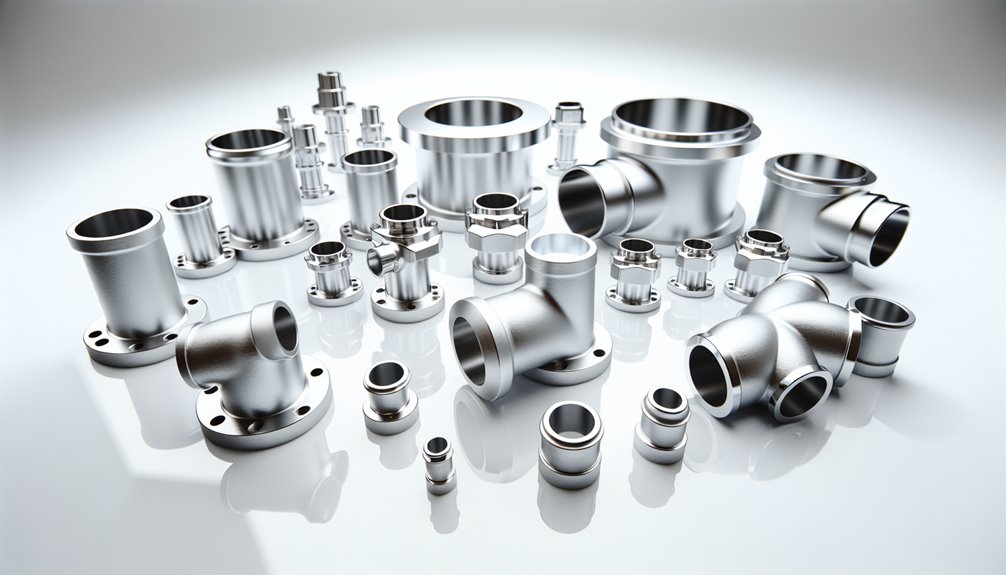
In determining the technical specifications for stainless steel water system fittings, it is vital to evaluate pressure ratings, temperature limits, and wall thickness to guarantee peak performance under various operational conditions.
Surface finishes such as pickled, passivated, and sanitary finish play a pivotal role in corrosion resistance and cleanliness, particularly in hygiene-sensitive applications.
Additionally, adherence to dimensional tolerance and thread standards like NPT, BSPP, and BSPT is essential for compatibility and leak-free connections.
Understanding pressure ratings, temperature limits, and wall thickness is essential for guaranteeing the safe and efficient operation of stainless steel water system fittings. These specifications dictate the performance and longevity of the fittings within a plumbing system.
The pressure rating must accommodate at least 1½ times the maximum operational pressure to guarantee reliability. Temperature limits should align with system requirements to prevent material degradation. Wall thickness impacts durability and resistance to internal pressures.
Consideration must also be given to:
These factors are crucial for the effective operation of the system.
While selecting the appropriate surface finish for stainless steel water system fittings, it is vital to evaluate the specific technical requirements that dictate performance and longevity. Corrosion resistance, environmental conditions, and installation requirements play a pivotal role in determining the suitable finish: pickled, passivated, or sanitary. Pickling removes oxides and scales, enhancing surface cleanliness. Passivation further enhances corrosion resistance by forming a protective oxide layer. Sanitary finishes offer high smoothness, essential for hygiene-sensitive applications. These finishes guarantee compatibility with operational parameters, minimizing dezincification and galvanic action risks.
| Surface Finish | Application | Benefits |
|---|---|---|
| Pickled | Industrial | Removes oxides |
| Passivated | Marine | Enhances resistance |
| Sanitary | Food & Beverage | Guarantees hygiene |
Selecting the correct finish is critical for system integrity.
Dimensional tolerance and thread standards are vital components in the design and functionality of water system fittings, guaranteeing tight and reliable connections between pipes.
These standards, such as NPT, BSPP, and BSPT, govern thread dimensions, pitch, and engagement, essential for pressure-tight connections. NPT, primarily used in the United States, features a 60° thread angle with specifications outlined in ANSI/ASME B1.20.1.
In contrast, BSP standards, including BSPP and BSPT, utilize a 55° thread angle and are prevalent in Europe and Asia.
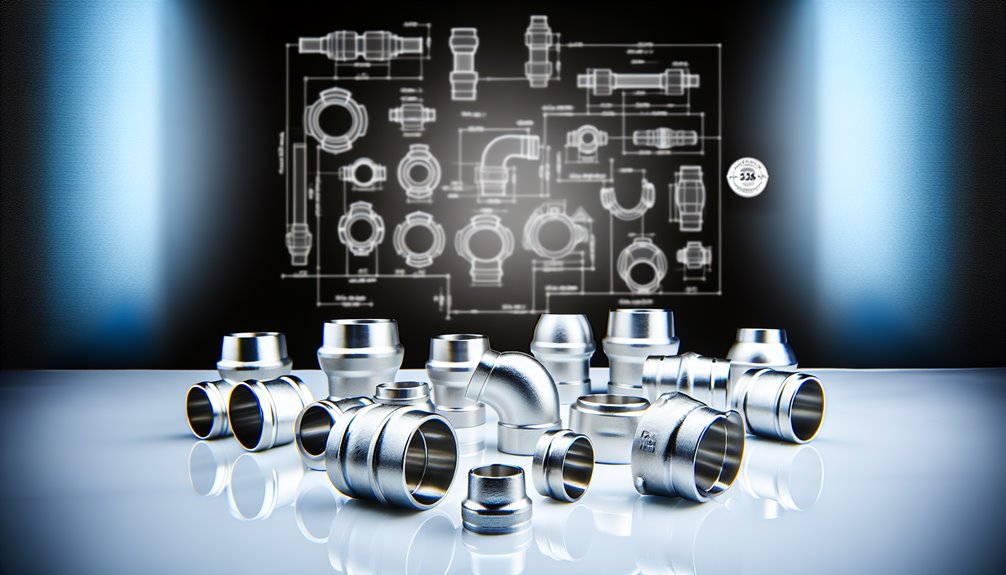
In the domain of water fittings, adherence to established standards and certifications is vital to guarantee safety, reliability, and interoperability.
ASTM, ANSI/ASME B16, ISO, DIN, JIS, and EN standards form the backbone of dimensional and material specifications, ensuring consistent quality and performance. These standards regulate the dimensions, materials, pressure ratings, and design considerations pertinent to various fittings.
Additionally, health compliance is essential, necessitating certifications like DVGW, WRAS, CE marking, and UPC standards. These certifications confirm that the fittings do not compromise water safety and are suitable for use in plumbing systems.
They are important for regulatory conformance and preventing contamination, thereby supporting public health and environmental safety.
Adherence to these standards and certifications is non-negotiable in industry practices.
Selecting the appropriate stainless steel fittings is critical for ensuring the integrity and functionality of potable water, HVAC, and industrial water lines.
Key considerations include evaluating material grades for resistance to high chloride environments and ensuring fittings can withstand high-pressure conditions.
A thorough procurement checklist should involve verifying compatibility with existing systems, adherence to industry standards, and supplier reliability.
Choosing the appropriate stainless steel fittings for potable water, HVAC, and industrial water lines requires a detailed evaluation of several critical factors. The selection process should consider material grade, system compatibility, and environmental conditions.
Stainless steel fittings offer numerous advantages, including corrosion resistance and durability, which are essential for system longevity and efficiency.
Key considerations include:
These considerations guarantee ideal performance and reliability.
When determining the appropriate stainless steel fittings for high chloride or high-pressure water systems, several vital factors must be meticulously evaluated to guarantee peak performance.
Material grade selection is paramount; Grade 316 stainless steel, known for its heightened chloride resistance, is often preferred.
Fittings must be scrutinized for dimensional accuracy to ascertain seamless integration with existing systems, preventing potential leaks or pressure drops.
Compatibility with the piping system is essential, demanding precise threading options for secure, leak-free connections.
Supplier credibility, confirmed through certifications such as ISO 9001, provides assurance of quality.
The high strength and corrosion resistance inherent in stainless steel fittings offer durability and longevity, making them ideal for demanding environments, thereby maintaining system integrity and efficiency.
Maneuvering the procurement process for stainless steel fittings necessitates a methodical approach to secure maximum system performance and longevity. Acquiring the right fittings involves evaluating several critical factors to guarantee alignment with operational demands.
Key considerations include:
Adhering to these criteria guarantees the chosen fittings meet both functional requirements and durability expectations.
Proper installation of stainless steel water pipe fittings is essential for ensuring system integrity and preventing leaks.
Threaded, welded, and press-fit connections each require specific techniques and torque requirements to maintain joint reliability and withstand operational pressures.
Thorough understanding and adherence to these methods will enhance the longevity and performance of the piping system.
Installing water pipe fittings involves meticulous attention to guarantee a secure, leak-free system. Proper methods for threaded, welded, and press-fit connections are critical. Each type requires specific techniques to maintain system integrity. Incorrect practices can lead to failures and costly repairs.
Consider the following key practices:
Adhering to these practices ensures reliable and durable connections.
Guaranteeing leak prevention, joint integrity, and adherence to torque requirements is essential for the successful installation of water pipe fittings.
Proper techniques include avoiding over-tightening fittings, which can damage threads and weaken joints. Initial hand-tightening followed by a partial wrench turn is recommended.
Avoid mixing incompatible materials to prevent galvanic corrosion, and clean pipe ends thoroughly to guarantee proper sealing. Use Teflon tape or sealant on threads to prevent leaks, wrapping 3 turns in the correct direction.
Even cuts and deburring are critical for alignment and leak prevention. Employ only new, certified fittings and verify specification matching to avoid weak points.
Pressure testing is mandatory to confirm system integrity, and curing periods for sealants must be respected.
Regular maintenance is essential for prolonging the lifespan and guaranteeing the ideal performance of stainless steel water pipe fittings.
To achieve optimal results, users should adhere to the following practices:
These measures guarantee the reliability and longevity of stainless steel water pipe fittings.
While choosing materials for pipeline systems, stainless steel water pipe fittings offer distinct lifecycle cost and performance advantages.
Their inherent resistance to corrosion markedly reduces maintenance expenses over time. The durability of stainless steel guarantees minimal replacement frequency, resulting in lower long-term costs compared to less resilient materials.
Performance-wise, these fittings can withstand high pressures and temperatures, making them suitable for demanding applications. A consistent and reliable seal minimizes leakage risks, further safeguarding operational efficiency.
Additionally, stainless steel's recyclability contributes to sustainable lifecycle management, aligning with environmental goals.

Considering the lifecycle cost and performance advantages of stainless steel fittings, it becomes pertinent to analyze how they compare against plastic and brass alternatives.
Stainless steel fittings offer superior resistance to corrosion, rust, and chemical exposure, making them ideal for demanding environments. In contrast, brass fittings provide moderate strength and durability but are heavier and more costly than plastic options.
Plastic fittings, while lightweight and economical, lack the high-pressure and temperature handling capabilities of stainless steel.
Vinmay offers stainless steel water pipe fittings produced with precise dimensional control and consistent material quality. All fittings are manufactured from certified 304/316L stainless steel and matched to the tolerances required for water distribution, building supply lines, HVAC systems, and industrial water processes.
Our production focuses on weld integrity, accurate wall thickness, and clean internal surfaces—critical factors for stable flow, corrosion resistance, and long-term performance in water systems. Each batch is supported by full material traceability and inspection records, including MTRs, PMI verification, and surface condition checks.
Fittings are produced to international specifications, ensuring compatibility with stainless steel water tubing standards used in global projects. Surface finish, threading accuracy, and sealing performance are tightly controlled to support reliable installation and leak-free operation.
Vinmay also provides stable lead times, export-ready packaging, coordinated logistics, and optional customization for size, finish, and connection type. This combination of certified materials, controlled manufacturing, and dependable delivery supports reliable performance across a wide range of water system applications.
Contact Vinmay for specifications, technical support, and product details. Our team can assist with material selection, documentation, and shipment arrangements for your upcoming projects.
Stainless steel fittings generally do not affect water taste and odor due to their inert nature and resistance to corrosion. Their non-reactive surface minimizes interaction with water, ensuring no metallic taste or odor is transferred to the water.
Yes, stainless steel fittings are recyclable, retaining their core properties even after extensive use. This recyclability guarantees minimal waste, promoting sustainable practices in industries that demand durability and efficiency while maintaining stringent control over environmental impact.
Common issues with stainless steel fittings in water systems include corrosion from chloride exposure, improper installation leading to leaks, thermal expansion causing stress fractures, and galvanic corrosion when connected with dissimilar metals, compromising the system's integrity and performance.
Environmental factors can dramatically accelerate the degradation of stainless steel fittings. Corrosive agents, extreme temperature fluctuations, and exposure to high chloride environments can lead to premature failure, compromising the integrity and longevity of stainless steel piping systems.
Stainless steel fittings are suitable for both hot and cold water applications due to their excellent thermal and corrosion resistance properties. They maintain structural integrity under varying temperatures, ensuring reliability in diverse plumbing systems.
In summary, stainless steel water pipe fittings, particularly in grades 304 and 316, offer unparalleled durability, corrosion resistance, and compliance with industry standards, making them indispensable in water systems. Their superior lifecycle cost-effectiveness and performance advantages over plastic and brass alternatives underscore their value in fluid handling applications. As evidenced by rigorous technical evaluations, selecting stainless steel fittings, such as those offered by Vinmay, ensures long-term reliability and optimal operational efficiency, reinforcing their status as the preferred choice for professionals in the field.