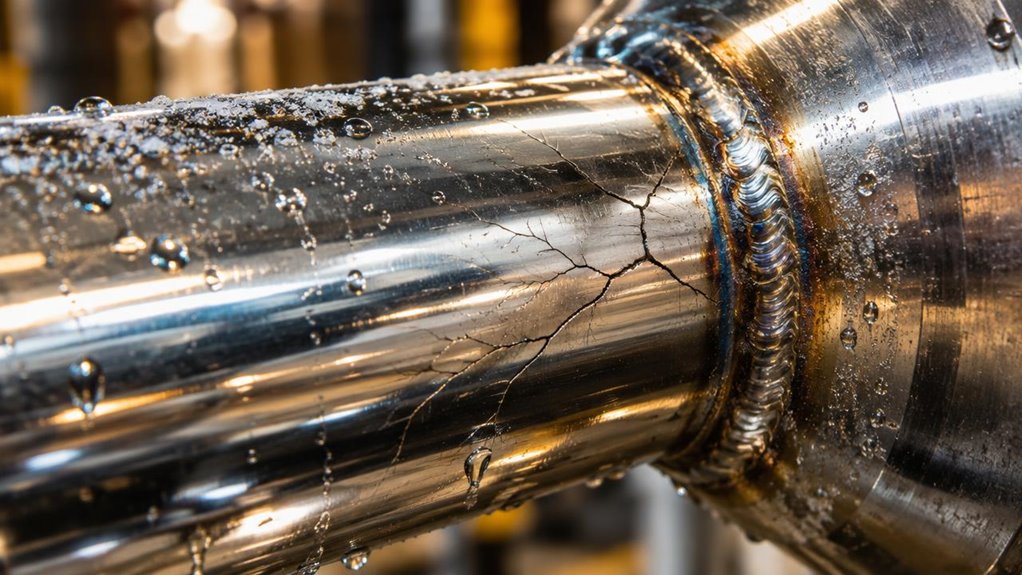
Stress corrosion cracking (SCC) can cause stainless steel to fail even when most of the surface still appears undamaged. Unlike uniform corrosion, which gradually removes metal across a broad area, SCC develops as localized cracks driven by the interaction between the material, its stress state, and the surrounding environment.
For stainless steel, chloride-containing environments are among the most important concerns. Austenitic grades such as 304/304L and 316/316L can both suffer chloride stress corrosion cracking when tensile stress, temperature, moisture, and chloride concentration combine under unfavorable conditions.
The key to understanding SCC is simple: susceptible material + tensile stress + aggressive environment
All three conditions must interact for cracking to develop. Effective prevention therefore focuses on breaking that combination rather than relying on corrosion-resistant stainless steel alone.
Stress corrosion cracking develops only when three conditions are present at the same time.
| SCC Requirement | Typical Stainless Steel Example |
|---|---|
| Susceptible material | 304L or 316L austenitic stainless steel |
| Tensile stress | Welding residual stress, bending, forming, operating load |
| Aggressive environment | Chlorides, elevated temperature, concentrated deposits |
The interaction between these conditions is more important than any one factor individually.
A stainless steel component can remain in a chloride-containing environment for years without SCC if the temperature and stress conditions are sufficiently mild. Likewise, a highly stressed tube will not develop chloride SCC without the appropriate corrosive environment.
The risk increases when all three factors overlap.
This explains why two sections of the same piping system can behave differently. A straight, relatively unstressed tube may remain intact while a nearby welded joint or cold-worked bend develops cracking under identical fluid conditions.
Austenitic stainless steels rely on a chromium-rich passive layer for corrosion resistance. Chlorides can destabilize this protective surface locally, particularly when temperature, concentration, and tensile stress are unfavorable.
Factors that increase chloride SCC risk include:
The bulk chloride concentration in the process fluid does not always represent the environment actually experienced by the tube surface.
For example, a system may contain relatively low chloride levels overall, but evaporation at a hot surface can leave concentrated chloride deposits behind. Wet/dry cycling can progressively increase this local concentration, creating a much more aggressive condition than the original water analysis suggests.
This is why there is no single universal chloride concentration that can be treated as safe for every stainless steel system.
Temperature, stress, pH, oxygen, surface condition, evaporation, and geometry all affect susceptibility.
SSINA's guidance on chloride stress corrosion cracking also highlights the importance of temperature and localized chloride concentration when evaluating austenitic stainless steels.
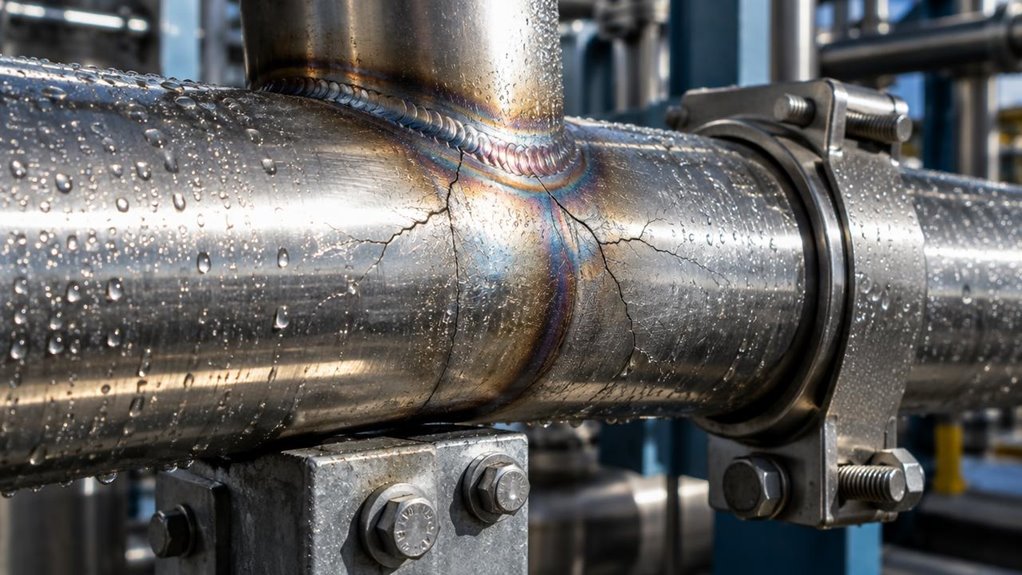
Tensile stress does not need to come only from system pressure or an external mechanical load.
Fabrication can leave significant residual stress locked into the stainless steel before the component ever enters service.
Common sources include:
Welding is particularly important because local heating and cooling can create substantial residual tensile stress around the weld and heat-affected zone.
The problem is not simply whether the weld looks acceptable. A visually sound joint can still contain residual stress that becomes important when the component later encounters chlorides and elevated temperature.
Likewise, tube bending stretches and compresses different regions of the material. A heavily cold-worked bend may therefore behave differently from an annealed straight tube exposed to the same service environment.
Good control of stainless steel welding issues such as heat input, distortion, joint preparation, and post-weld condition can help reduce unnecessary stress concentrations, but fabrication controls should always follow the applicable procedure rather than generic rules.
SCC can be difficult to recognize because extensive surface corrosion is not always present.
Typical chloride SCC in austenitic stainless steel may appear as:
The crack pattern is often described as branched or lightning-like.
In annealed austenitic stainless steel, chloride SCC commonly develops through the grains, although other crack paths can occur depending on the metallurgical condition and environment.
It is important to distinguish SCC from other localized corrosion mechanisms.
| Damage Mechanism | Typical Indication |
|---|---|
| Stress corrosion cracking | Fine, branched cracks with limited general metal loss |
| Pitting corrosion | Localized holes or cavities |
| Crevice corrosion | Localized attack beneath deposits, gaskets, or joints |
| Uniform corrosion | Broad surface metal loss |
| Corrosion fatigue | Cracking associated with cyclic stress and corrosive exposure |
Pitting and crevice corrosion can sometimes contribute to crack initiation, but they are not the same mechanism as SCC. Understanding the distinction between pitting and crevice corrosion is particularly useful when diagnosing localized stainless steel failures.
Yes. Both 304/304L and 316/316L are austenitic stainless steels and can suffer chloride stress corrosion cracking when the required environmental and stress conditions are present.
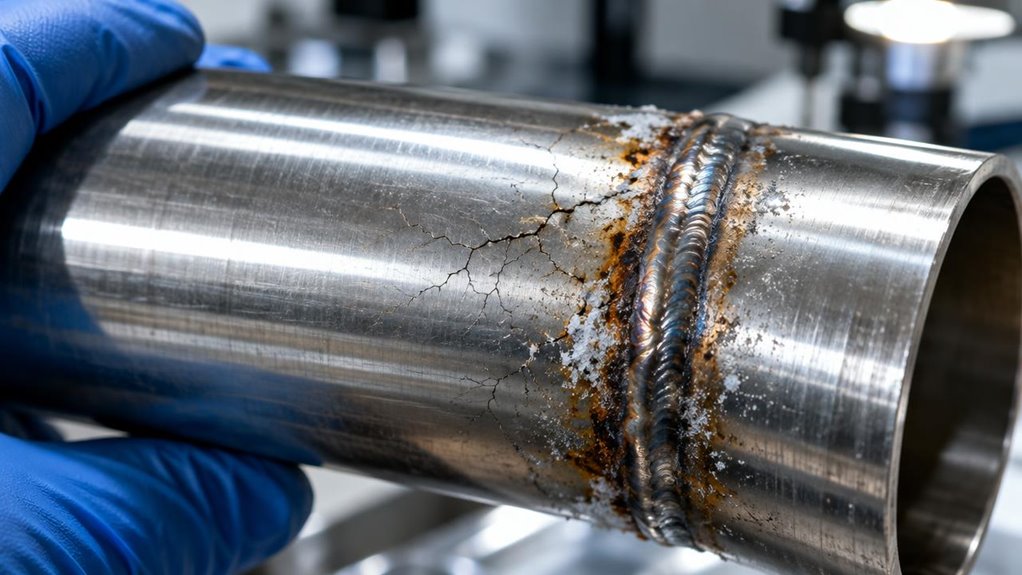
304 and 304L provide good general corrosion resistance for many industrial applications, but they remain susceptible to chloride SCC.
Common risk locations include:
The lower carbon content of 304L helps reduce sensitization during welding, but this should not be confused with improved immunity to chloride SCC.
Low carbon helps address one metallurgical corrosion concern; it does not remove the stress–chloride interaction that causes SCC.
316 and 316L contain molybdenum, giving them improved resistance to pitting and crevice corrosion compared with 304-family grades.
However, this does not make 316L immune to chloride SCC.
| Grade | Main Advantage | SCC Limitation |
|---|---|---|
| 304L | Good general corrosion resistance and weldability | Susceptible to chloride SCC |
| 316L | Improved localized-corrosion resistance | Still susceptible to chloride SCC |
This distinction is important because better pitting resistance is sometimes incorrectly interpreted as complete protection against all chloride-related corrosion.
The broader differences between 304 and 316 stainless steel tubing remain important when selecting materials, but SCC resistance needs to be evaluated separately from general corrosion performance.
When chloride stress corrosion cracking becomes a credible design risk, duplex stainless steel can provide a significant improvement over conventional austenitic grades.
Duplex stainless steels contain both ferritic and austenitic phases. This mixed microstructure generally provides much greater resistance to chloride SCC than standard 304L or 316L.
Duplex 2205 may be considered where:
More severe conditions may justify evaluation of:
The advantages and limitations of duplex 2205 stainless steel tube should still be evaluated against the actual process chemistry, temperature, fabrication method, pressure, and other corrosion mechanisms.
Duplex is more SCC-resistant, but no alloy should be treated as universally immune to environmentally assisted cracking.
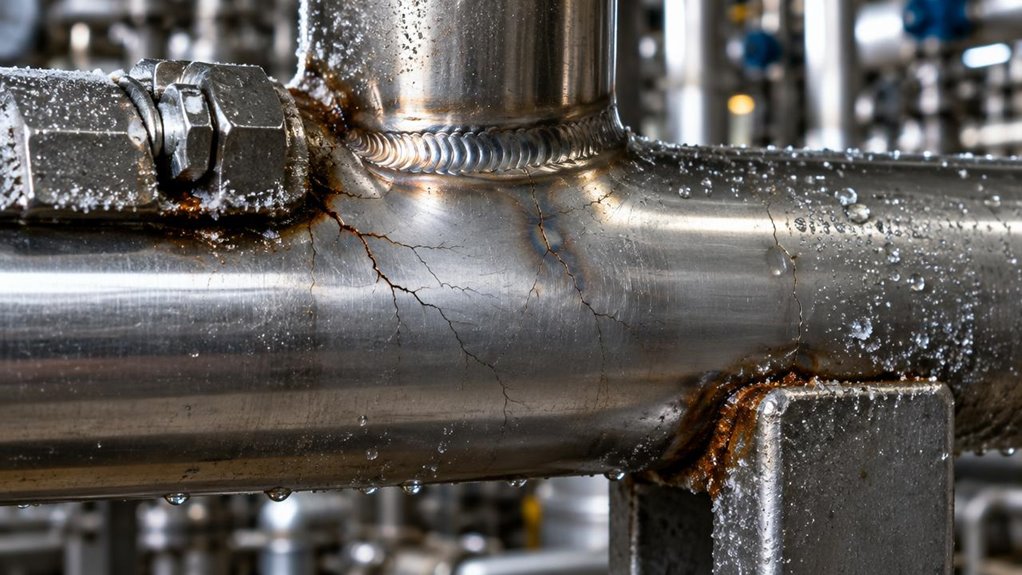
SCC usually develops where tensile stress and a locally aggressive environment overlap.
High-risk locations include:
Insulated stainless steel piping deserves particular attention.
Damaged or poorly sealed insulation can allow water to reach the pipe surface. If that moisture contains chlorides, the insulation can retain the solution against warm stainless steel while evaporation progressively concentrates salts.
The combination can include:
This makes corrosion under insulation particularly difficult because cracking may progress beneath the insulation without obvious external warning.
Good design should therefore consider:
SCC prevention should follow the same three-factor model that explains the failure.
The goal is to control: environment + tensile stress + material susceptibility
Where practical:
Low bulk chloride concentration alone is not sufficient if evaporation or deposits can create a much more concentrated local environment.
Fabrication and system design should avoid unnecessary stress concentrations.
Important considerations include:
Where residual stress is a significant concern, stress-reduction methods should be evaluated against the alloy, fabrication condition, and applicable engineering procedure.
Thermal stress relief should not be treated as a universal SCC solution for austenitic stainless steels. An unsuitable heat-treatment cycle can create other metallurgical problems.
Where heat treatment is appropriate, the principles involved in heat treatment of stainless steel pipes should be considered alongside the specific grade and applicable product standard.
Where the environment or stress cannot reasonably be reduced, material selection becomes the main control.
Possible options include:
Selection should be based on measured service conditions rather than appearance or general claims of corrosion resistance.
Passivation can improve the cleanliness and passive condition of the stainless surface, but it does not remove the underlying combination of tensile stress, temperature, and aggressive chloride exposure.
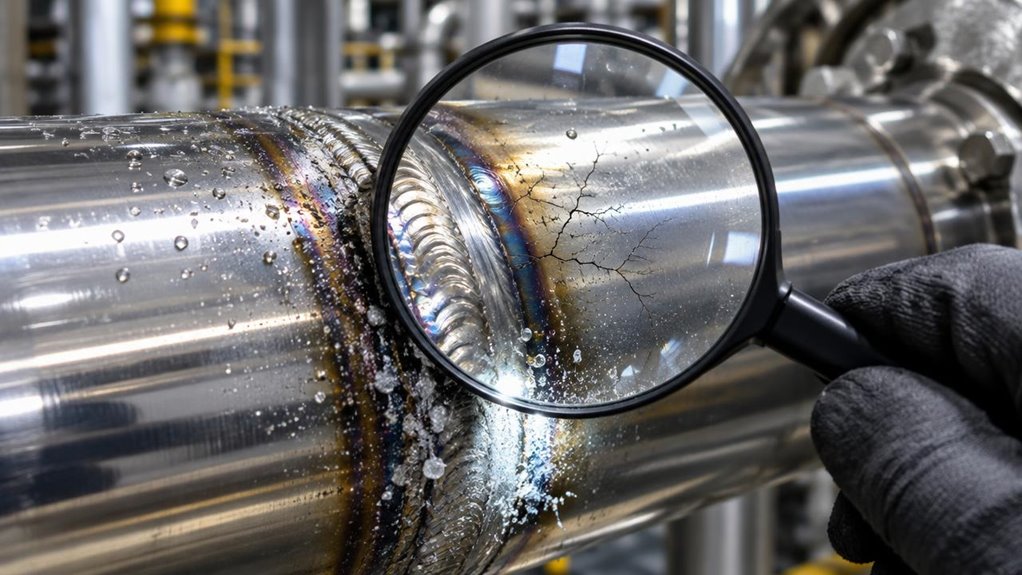
Visual inspection alone may not be enough because SCC cracks can be very fine and overall metal loss may be minimal.
Depending on the component and access conditions, investigation may include:
Liquid penetrant testing can reveal surface-breaking cracks.
Ultrasonic techniques may help evaluate crack depth or extent.
For suitable tubing geometries, eddy current testing may provide additional information about localized discontinuities.
However, confirming the actual failure mechanism often requires metallographic or fracture-surface examination. Microscopy can reveal:
ASTM G36 is commonly used as an accelerated laboratory method for comparing chloride SCC susceptibility using boiling magnesium chloride. It is useful for comparative evaluation, but the aggressive laboratory environment should not be treated as a direct prediction of actual field service life.
Where chloride SCC is a credible risk, material selection should be supported by an evaluation of the complete service condition.
| Factor | What to Confirm |
|---|---|
| Process environment | Chloride concentration, pH, contaminants |
| Temperature | Normal, maximum, and shutdown conditions |
| Moisture condition | Immersion, condensation, wet/dry cycling |
| Stainless grade | Suitable SCC resistance for the environment |
| Fabrication | Welds, bends, cold-worked areas |
| Stress condition | Applied and residual tensile stress |
| Insulation | Moisture and chloride ingress risk |
| Inspection | Suitable method and frequency |
| Documentation | Grade and MTC traceability |
The review should not focus only on the cracked area.
If one component has suffered SCC, similar locations exposed to the same combination of:
may also require inspection.
Where material identity forms part of the investigation, the stainless steel mill test certificate should be checked against the actual heat number and supplied grade rather than relying only on component appearance or historical records.
Yes. 316L provides better resistance to pitting and crevice corrosion than 304L, but it remains susceptible to chloride stress corrosion cracking when tensile stress and sufficiently aggressive environmental conditions are present.
Yes, although chloride SCC is generally less common in fully immersed austenitic stainless steel at lower temperatures.
Local conditions can change the risk significantly. Evaporation, deposits, chloride concentration, wet/dry cycling, and certain atmospheric environments can produce SCC even when the bulk operating temperature appears relatively moderate.
Therefore, 60°C should not be treated as a universal threshold.
It can. Welding introduces thermal expansion and contraction that can leave high residual tensile stress around the weld and heat-affected zone.
If that stressed area is later exposed to an appropriate chloride environment, susceptibility to SCC can increase.
Duplex stainless steels generally provide substantially greater resistance to chloride SCC than conventional 304/316 austenitic grades.
However, they should not be described as immune to every form of environmentally assisted cracking. Material suitability still depends on temperature, chemistry, fabrication, and service conditions.
Not by itself. Passivation can improve the passive condition and cleanliness of a stainless steel surface, but it cannot eliminate SCC if a susceptible material remains under tensile stress in an aggressive environment.
Pitting corrosion produces localized cavities or holes.
Stress corrosion cracking produces cracks driven by the combined action of tensile stress and a specific corrosive environment.
Pits can sometimes act as initiation sites for cracking, but the two mechanisms are not the same.
Surface-breaking cracks may be found using visual or penetrant inspection, while ultrasonic or eddy current methods may provide additional information.
Metallographic or fracture-surface examination is often needed to confirm the actual crack morphology and failure mechanism.
Stress corrosion cracking does not mean stainless steel has suddenly lost all of its corrosion resistance.
Failure occurs when three conditions align:
susceptible material + tensile stress + aggressive environment
Prevention follows the same logic.
Reduce chloride concentration, moisture, or temperature where possible. Control residual and applied tensile stress through suitable fabrication and system design. Where those conditions cannot be managed adequately, select a stainless steel or alloy with greater SCC resistance.
The most reliable material decision therefore considers alloy grade, fabrication history, stress state, temperature, process chemistry, and local operating conditions together.
For stainless steel tube applications where chloride exposure and fabrication stress create SCC concerns, contact Vinmay with the grade, dimensions, service environment, and fabrication requirements to discuss an appropriate tube specification.