Pickling and passivation are distinct surface treatments for stainless steel. Pickling uses aggressive acids (HF/HNO3) to remove heat tint, weld scale, and embedded iron, restoring chromium-depleted areas but potentially roughening the surface. Passivation, typically with nitric or citric acid, does not remove scale; it enriches the chromium-oxide film on a clean, oxide-free surface to enhance corrosion resistance without changing geometry. Proper sequencing is degrease, pickle, rinse/neutralize, then passivate, rinse, dry. Applications, alloy specifics, and safety controls govern selection and execution further.
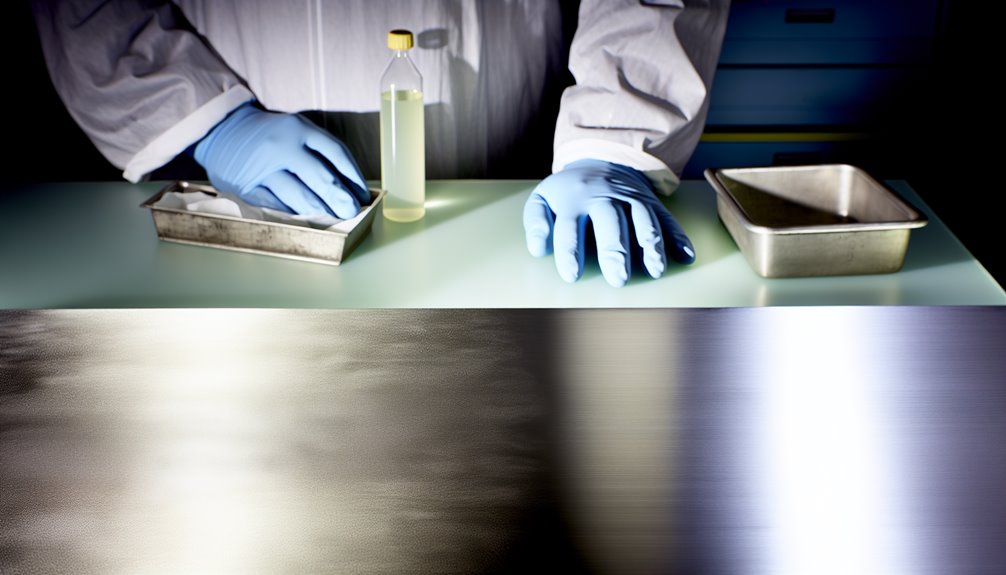
Surface treatment of stainless steel defines the condition of its outermost layer to meet targeted corrosion performance, appearance, and functional requirements. Incorporating routine inspections to spot early signs of corrosion helps maintain surface integrity and prolong service life.
Surface treatment tailors stainless steel’s outermost layer for corrosion resistance, appearance, and functional performance.
In controlled manufacturing, stainless steel surface treatment aligns finish, roughness, and passive film quality with application demands and cost constraints. Mill and mechanically polished finishes establish baseline morphology; subsequent chemical steps refine chemistry and stability. Regular inspection and maintenance help identify early signs of damage and prevent structural integrity loss that can lead to leaks and failures. Proper surface preparation also enhances weld quality by supporting consistent shielding gas performance and reducing contamination during joining. For welded tubing, controlling heat input and considering back purge during fabrication helps preserve surface chemistry and prevent weld-related contamination.
In the pickling vs passivation decision, the objective determines sequence and aggressiveness. The pickling and passivation process is selected to deliver specified Ra, restore uniform chromium enrichment, and minimize inclusions that seed localized attack.
Standards-based routing (e.g., No. 1, 2D, 3, 4, 8) integrates cleaning, inspection, and verification of oxide integrity, ensuring consistent friction, adhesion, and weldability.
Process control maintains reproducible outcomes across thickness, temper, and lot variability.
Additionally, pickling removes oxides using acids while passivation builds a protective layer, improving corrosion resistance and surface quality in stainless steel tubes.
Pickling of stainless steel is a chemical descaling process that uses nitric, hydrofluoric, or mixed-acid solutions to dissolve weld scale, heat tint, and embedded contamination.
Applied after welding or high-heat fabrication, it renews the surface by removing chromium-depleted layers and restores corrosion performance.
Trade-offs include operator and environmental hazards, regulated waste disposal, and potential surface roughening from micro-etching.
Among stainless steel finishing treatments, common pickling solutions rely on strong mineral acids—primarily nitric (HNO3), hydrofluoric (HF), or their mixed-acid blends—to dissolve heat tint, oxide scale, and chromium-depleted layers while removing embedded iron.
In the context of pickling vs passivation stainless steel, these chemistries actively remove metal, unlike nitric acid passivation stainless steel, which promotes passive film formation. Selection of stainless steel pickling acid depends on alloy, defect morphology, and compliance limits.
1) Solution architecture: HF attacks chromium oxides and penetrates scale; HNO3 oxidizes and dissolves iron species, suppressing smut; mixed acid balances scale penetration with controlled metal removal.
2) Process control: define temperature, acid ratio, agitation, and time; pre-clean organics; verify with ferric sulfate or copper sulfate tests.
3) Risk management: constrain acid aging, hexavalent byproducts, and etch geometry; validate via corrosion testing and rinse-neutralization protocols.
After welding, heat treatment, or fabrication that introduces oxide scale, heat tint, or embedded contamination, stainless steel is pickled to restore corrosion-resistant surface chemistry. In hygienic service, pickling supports compliance with 3-A sanitary and related standards by ensuring cleanable, corrosion-resistant surfaces in contact with product. In addition, selecting pickling parameters should consider the stainless alloy type and thickness noted in welding specifications to avoid over-etching or insufficient oxide removal. Because sanitary tubing must meet stringent industry expectations, pickled surfaces help maintain the smooth surface and cleanability required in food, beverage, and pharmaceutical applications. In sanitary fabrication, pairing pickling with orbital welding practices supports smooth, crevice-free joints that resist microbial growth.
Pickling removes weld scale and chromium-depleted layers, dissolving oxides and metallic inclusions that mechanical methods can smear. It is selected when localized discoloration, spatter, arc strikes, or embedded iron are present, or when prior abrasive finishing risks contamination.
In the context of pickling vs passivation of stainless steel, the difference between pickling and passivation is functional: pickling chemically strips damaged surface and contaminants; passivation (per ASTM A967 passivation) promotes a chromium-rich film on a clean, oxide-free surface.
Typical deployment includes full-immersion or targeted paste application at welds, followed by thorough rinse and verification by water-break-free checks or iron contamination tests.
Regular inspections and cleaning help prevent surface contamination that can lead to corrosion and blockages in sanitary stainless tube systems.
Surface renewal through chemical descaling delivers the primary advantage of stainless steel pickling: restoration of corrosion-resistant surface chemistry by removing heat tint, weld scale, chromium-depleted layers, and embedded metallic contamination. Integrating pickling with proper cleaning and rust inhibitors strengthens long-term corrosion control by minimizing moisture-driven pitting and preserving the passive film in service. For tubing used in marine or chemical environments, pickling supports the high pitting resistance of 316 by preparing the surface for consistent passivation performance that complements its molybdenum-enhanced corrosion resistance.
As a pre-passivation treatment, astm a380 pickling standardizes removal of oxide scale and iron particulates, enabling rapid repassivation and uniform performance across complex geometries and weldments.
The resulting surface promotes stable chromium-oxide formation and mitigates initiation sites for pitting and crevice corrosion, especially prior to citric acid passivation stainless steel steps or fabrication of a pickled and passivated stainless steel tube.
1) Surface renewal: controlled metal dissolution eliminates damaged layers, resetting the passive foundation.
2) Corrosion prevention: removal of inclusions and tint reduces galvanic micro-cells and under-deposit attack.
3) Process readiness: clean, micro-etched topography improves downstream passivation consistency and qualification.
In medical applications, pickling helps ensure compliance with ISO 13485 by preparing stainless steel surfaces for reliable passivation and biocompatible performance in critical devices.
While effective at removing heat tint and scale, pickling introduces notable drawbacks tied to safety, waste management, and surface condition.
The process relies on aggressive acids (commonly hydrochloric or sulfuric) that present acute operator hazards, demand controlled ventilation, and require rigorous PPE and spill containment.
Acid attack is imprecise; aging bath chemistry and local variability can over-etch, dull the surface, and increase roughness, undermining downstream cleanliness or sealing performance.
Metal removal also liberates dissolved heavy metals, creating hazardous effluent subject to strict EPA regulations, monitored neutralization, and solids handling—adding compliance risk and cost.
Compared with electropolishing’s precise, repeatable metal removal, pickling’s variability reduces process capability and dimensional control, particularly near welds and inclusions, and can complicate subsequent passivation consistency.
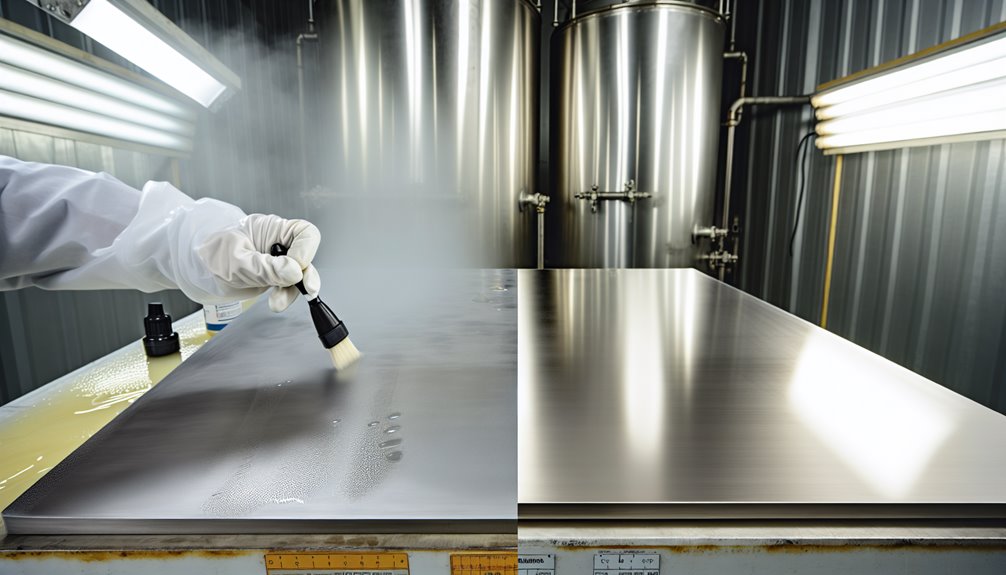
Passivation of stainless steel is a post-cleaning, fine-finishing treatment that uses nitric or citric acid solutions to remove free iron and accelerate formation of a chromium-rich oxide film.
Applied after fabrication and degreasing, it enhances corrosion resistance and extends component service life without altering surface geometry.
It is not intended to remove heavy scale, heat tint, or weld oxides, which require prior pickling or electropolishing.
Nitric and citric acid solutions are the primary chemistries used to passivate stainless steel, selected to dissolve free iron without attacking chromium-rich phases.
Nitric formulations (with or without sodium dichromate) have long industrial pedigree under ASTM A967 and AMS 2700, providing robust iron removal kinetics and consistent oxide enrichment.
Citric systems, adopted widely since the 1990s, offer safer handling and lower environmental burden while achieving equivalent chromium-to-iron surface ratios when process controls are tight.
Selection is driven by alloy grade, contamination profile, and specification compliance. Pre-cleaning, DI rinsing, controlled immersion, and verification testing are mandatory to prevent flash attack and variability.
1) Control levers: acid type, concentration, temperature, pH, time, and dissolved metal limits.
2) Risk controls: segregated baths by alloy, continuous solution monitoring, validated rinsing.
3) Acceptance: copper sulfate, high humidity, or salt spray per specification.
After fabrication and final cleaning, stainless steel components are typically passivated to restore and optimize corrosion resistance before service. ASTM standards provide consistent criteria for testing, inspection, and dimensional control of stainless steel tubes, supporting quality and reliability through defined mechanical properties. These frameworks include widely used tube specifications such as ASTM A312, which help ensure consistency and compliance across manufacturers.
Passivation is applied after machining, welding, grinding, or handling steps that introduce free iron or shop debris. The process sequence generally includes alkaline degreasing, DI/RO water rinse, controlled immersion in nitric or citric acid per ASTM A967 or AMS 2700, followed by DI rinses and drying.
The acid selectively dissolves free iron and sulfides without removing base metal, enabling rapid re-formation of a chromium-rich oxide film.
Use cases include post-cleaning of precision parts, welded assemblies, and medical or food-contact hardware where surface chemistry uniformity and low particle burden are required.
Batch segregation by alloy prevents galvanic effects; solution control avoids flash attack and cross-contamination.
Verification employs standardized tests.
In regulated piping and pressure applications, passivation is often performed after welding qualification and fabrication in accordance with ASME B31.3 and related standards to ensure consistent corrosion performance and compliance.
Reliability begins at the surface: by selectively dissolving free iron and sulfides with controlled nitric or citric acid treatments per ASTM A967 or AMS 2700, stainless steel develops a chromium‑rich oxide film that resists localized attack. Compared to galvanized steel, stainless steel’s self‑repairing passive layer provides longer service in harsh environments, while galvanized relies on a consumable zinc coating as shown in corrosion resistance.
This engineered passive state stabilizes surface chemistry after machining, grinding, or welding, where smeared iron and shop debris otherwise seed corrosion. Because chromium is preserved while iron is removed, the surface exhibits a higher Cr/Fe ratio and faster repassivation in service, extending component life in moisture-, chemical-, or bio-exposed environments. In chloride-rich or acidic conditions, choosing 316 stainless for its molybdenum‑enhanced corrosion resistance can further improve longevity alongside proper passivation. The use of molybdenum content in 316 (2%) enhances resistance to pitting and crevice corrosion in marine and chemical environments. Even though 304 offers good corrosion resistance, it can still rust in harsh environments due to factors like crevice and pitting corrosion, making robust passivation and maintenance critical.
1) Quantifiable corrosion improvement: copper sulfate or free-iron tests confirm contaminant removal; humidity and salt spray validate durability.
2) Lifecycle gains: extended maintenance intervals, fewer unscheduled interventions, improved uptime.
3) Process control leverage: documented chemistries, DI rinses, and bath segregation minimize variability and galvanic risks.
Additionally, passivation complements the superior weldability and corrosion resistance of 316L stainless steel, helping welded assemblies maintain integrity in harsh, chloride-rich environments.
While passivation improves corrosion performance by enriching the chromium-oxide film, it is not a substitute for scale or oxide removal.
Passivation chemistries (nitric or citric) are designed to dissolve free iron and sulfur-bearing inclusions without attacking chromium, nickel, or molybdenum. Consequently, they do not remove heat tint, weld scale, or heavy oxides, nor do they etch through chromium-depleted layers created by thermal processing.
When stainless steel exhibits discoloration from welding, hot working, or heat treatment, a preceding metal-removal step—pickling with HF/HNO3, targeted pickling paste, or electropolishing—is required to strip oxide scale and restore surface chemistry.
Only after such descaling should passivation be applied per ASTM A967 or AMS 2700 to optimize the passive film. Skipping prior oxide removal risks underperforming corrosion resistance and false-positive test results.
This section contrasts pickling and passivation by purpose (contaminant removal vs corrosion protection), chemistry and reaction mode (HF/HNO3 metal-removal etching vs citric/nitric oxide-film promotion), and their placement in a treatment sequence.
It outlines process steps from precleaning to acid exposure and rinsing, then notes expected surface outcomes—matte, uniformly etched after pickling versus unchanged appearance with enhanced passive film after passivation.
A concise comparison table will summarize inputs, mechanisms, sequence, and visual/quality results.
Purpose defines the divergence: pickling is a cleaning operation that chemically dissolves surface oxides, scale, heat tint, and embedded iron using aggressive acids, removing a thin layer of base metal and often dulling the finish; passivation is a protective treatment that, with milder acids such as nitric or citric, strips free iron contaminants and accelerates formation of a chromium-rich oxide film without metal removal, preserving appearance and elevating corrosion resistance.
Having distinguished cleaning from protection, focus shifts to the chemistries and their reaction pathways.
Pickling solutions are aggressive, typically nitric–hydrofluoric acid blends that dissolve surface oxides, heat tint, and chromium-depleted layers by acid dissolution and complexation; limited base metal removal occurs, producing heavy-metal-bearing waste and a matte micro-etched finish. The dominant reaction type is oxide and metal dissolution, not film formation.
Passivation solutions are milder, commonly nitric or citric acid, formulated to remove free iron and exogenous metallic contamination without attacking the chromium-rich matrix.
The governing reaction is selective decontamination and promotion of rapid chromium-oxide repassivation from alloy constituents, with negligible metal loss and no change in appearance.
Consequently, pickling is subtractive chemistry; passivation is conditioning chemistry that enables stable passive film regeneration.
Define the sequence, then execute: stainless steel surfaces are first degreased with an alkaline cleaner to remove oils, then rinsed.
Controlled pickling follows where required: immerse or apply nitric–hydrofluoric acid to dissolve heat tint, weld scale, and chromium-depleted layers; monitor temperature, acid ratio, and dwell to limit base-metal removal; then thorough water rinse and neutralization.
Passivation is next: expose the clean, pickled or mechanically cleaned surface to nitric or citric acid to remove free iron and accelerate chromium-oxide regeneration; rinse and dry to prevent flash contamination.
Sequencing is gated by surface condition, alloy grade, and downstream specifications.
1) Acceptance criteria: no oil, grease, or free iron before passivation; no visible scale before passivation.
2) Controls: chemistry concentration, pH, temperature, dwell, agitation, rinse quality.
3) Compliance: ASTM A380/A967 process selection and verification.
With process steps and sequencing established, surface outcomes become the practical measure of effectiveness.
Pickling chemically removes oxides, heat tint, weld scale, and chromium-depleted layers, producing a uniform, matte grey finish from controlled micro‑etching. This etch can slightly adjust roughness, reveal fabrication defects, and reset surface chemistry to near mill condition, improving downstream coating adhesion.
Over‑pickling risks dimensional loss and nonuniform appearance; strict control of acid strength, temperature, and dwell time is decisive.
Passivation, using milder chemistries, removes free iron without metal removal, preserving the existing finish and geometry.
The visual result is fundamentally unchanged yet cleaner, with a more stable chromium‑oxide film.
Surface quality verification relies on water‑break-free rinsing, absence of discoloration, and contamination checks, confirming readiness for service or subsequent finishing.
| Aspect | Pickling | Passivation |
|---|---|---|
| Purpose | Removes weld scale, heat tint, and surface oxides to restore clean metal. | Forms a thin, protective chromium oxide film that enhances corrosion resistance. |
| Process Type | Chemical cleaning using strong acid mixtures (often nitric + hydrofluoric acid). | Mild chemical treatment using nitric or citric acid to promote passive layer formation. |
| Primary Function | Cleansing and descaling of the stainless steel surface. | Chemical oxidation for surface protection and restoration of corrosion resistance. |
| Surface Condition Treated | Used after welding, heat treatment, or fabrication when heavy scale or discoloration exists. | Applied after cleaning or pickling, on clean surfaces to maintain or enhance passivity. |
| Effect on Surface | Slightly etches or dulls the surface, removing contaminants and impurities. | Produces a smooth, bright, and chemically stable surface. |
| Chemical Composition | Typically nitric acid (HNO₃) + hydrofluoric acid (HF). | Typically nitric acid (HNO₃) or citric acid (C₆H₈O₇). |
| When to Use | When stainless steel shows weld burns, heat tint, or embedded iron contamination. | After pickling or cleaning to finalise corrosion protection. |
| Safety Considerations | Requires strict handling and neutralisation due to strong acids. | Safer and more environmentally friendly; citric-based alternatives available. |
| Resulting Surface | Clean, oxide-free, chemically active metal surface ready for passivation. | Chemically passive surface that resists corrosion in service. |
| Standards Reference | ASTM A380 – Cleaning, Descaling, and Passivation of Stainless Steel Parts. | ASTM A967 – Chemical Passivation Treatments for Stainless Steel Parts. |
Ensuring stainless steel pipes achieve and maintain optimal corrosion resistance depends on correctly performed pickling and passivation. These treatments control surface chemistry precisely where failures often begin — at weld seams, heat-affected zones, and mechanically abraded sections.
Pickling removes heat tint, chromium-depleted layers, and embedded ferritic particles that can initiate corrosion, while passivation restores a chromium-rich oxide film, stabilizing the metal’s electrochemical potential. In pressurised systems, this dual treatment reduces pitting initiation, under-deposit corrosion, and rouge formation, preserving flow integrity and internal cleanliness.
In regulated industries, adherence to sanitary standards ensures hygienic design and material suitability across all fluid-handling systems. Using grades like 304 stainless steel supports these processes by offering excellent corrosion resistance and ease of sanitation for food, beverage, and potable water applications. Stainless steel pipes intended for drinking water systems should comply with NSF/ANSI 61 certification, confirming material safety and hygienic performance.
Incorporating routine eddy current testing complements chemical surface treatments by detecting surface and near-surface defects that could compromise long-term corrosion performance. Selecting appropriate material grades and wall thicknesses, in consultation with certified suppliers like Vinmay, further aligns corrosion protection with mechanical demands and service environments.
| Pipe Environment | Primary Risk | Controlled Outcome |
|---|---|---|
| Chloride-bearing media | Pitting and crevice attack | Stable passive film |
| High-purity water | Rouge or metal ion shedding | Low extractables |
| CIP/SIP cycling | Passive film breakdown | Rapid repassivation |
Documented procedures — including surface preparation, acid selection, dwell time, temperature control, and rinse/neutralisation — ensure reproducible results. When aligned with ASTM A380 and ASTM A967 standards, these processes maintain consistent corrosion resistance and long-term reliability across the entire lifecycle of stainless steel piping systems.
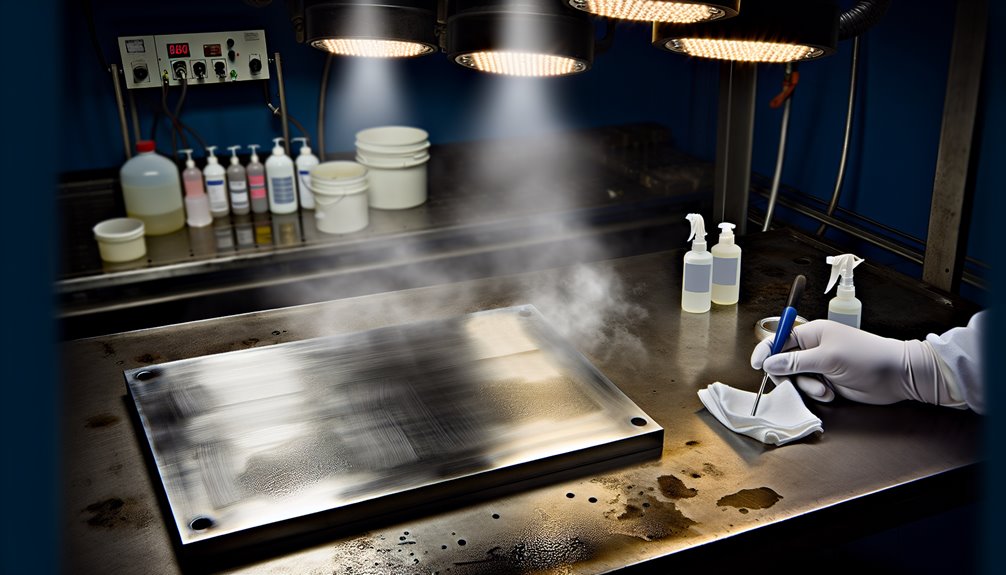
When should stainless fabrications be pickled versus passivated? Selection hinges on surface condition and performance targets.
Pickling is specified when weld scale, heat tint, rust, or fabrication oxides are present, because hydrofluoric/nitric mixtures dissolve these oxides and remove a thin layer of base metal, restoring uniform chemistry.
Pickling removes weld scale, tint, rust, and oxides, dissolving surface metal to restore uniform stainless chemistry.
Passivation is selected for clean, oxide-free surfaces to accelerate chromium-oxide film formation with milder nitric or citric acids, removing only free iron and leaving the appearance unchanged.
In many workflows, pickling precedes passivation to both descale and then optimize passive film quality for service.
1) Surface state: visible discoloration/scale requires pickling; clean machined or polished surfaces favor passivation.
2) Functional intent: de-scaling and reconditioning versus final corrosion performance stabilization.
3) Finish control: accept matte etch (pickling) versus preserve finish (passivation).
igorous safety and environmental controls are essential during pickling and passivation because both processes involve strong acids, fume generation, and metal-bearing effluents.
Hydrofluoric/nitric acid pickling presents higher risks due to acute toxicity, fluoride exposure, and increased dissolved metal content in rinse water. In contrast, nitric or citric acid passivation poses lower hazards but still requires engineered ventilation, effluent treatment, and strict operator protection.
To maintain safe and compliant operations, facilities should use closed treatment systems, mist and NOx capture units, and acid-resistant PPE. Continuous monitoring of pH, fluoride, and chromium levels ensures process control and regulatory compliance.
Waste minimisation strategies—including drag-out reduction, counter-current rinsing, and bath life extension through chemical analytics—help limit resource consumption and environmental impact.
All operations should conform to ASTM A380/A967, local wastewater discharge standards, and hazardous waste regulations governing acid handling and neutralisation.
| Control Focus | Process Actions |
|---|---|
| Exposure Control | Local exhaust ventilation, scrubbers, and process enclosure |
| Chemical Control | Monitoring acid concentration, temperature, and dwell time |
| Effluent Control | Neutralisation, precipitation, and fluoride removal systems |
| Verification | Coupon corrosion testing, surface iron checks, and documentation |
They verify effectiveness using on-site tests: ASTM A967 copper sulfate or salt spray exposure, ferroxyl for free iron, contact-angle/water-break-free check, and corrosion potential measurements; confirm neutral pH rinsing, conductivity of final rinse, and documented time–temperature–chemistry parameters.
ASTM A967/A967M, ASTM A380/A380M, and ASTM B912 cover passivation and verification; ISO 16048 and ISO 9587/9588 specify methods. Practitioners apply copper sulfate, high-humidity, salt-spray, and electrochemical (potentiodynamic/galvanostatic) tests per alloy, finish, and process history.
Yes, often. Electropolishing removes heat tint, scale, and embedded contaminants while producing a chromium-enriched passive film. However, heavy mill scale or thick weld oxide may still require preliminary pickling; subsequent passivation is generally unnecessary if rinsing and verification testing confirm passivity.
Surface roughness dictates process: ultra-smooth finishes favor passivation; rough, weld-affected, or heat-tinted surfaces demand pickling; mirror-level control prefers electropolishing. Initially, finish screams louder than thunder, yet specifications govern: clean first, pickle if scale exists, passivate last for stable chromium-oxide.
Store parts dry, below 50% RH and 18–24 °C, in clean, inert packaging. Use a deionized-water final rinse, forced-air drying, and desiccants or nitrogen-purged bags. Avoid chloride sources, fingerprints, and condensation; keep carbon steel separate. Monitor with humidity/temperature loggers and chloride test kits to confirm safe storage conditions.
In conclusion, pickling resets stainless steel surfaces by removing heat tint and chromium-depleted layers, while passivation refines them by dissolving free iron and accelerating chromium oxide regeneration. For piping, proper sequencing after welding safeguards corrosion resistance and cleanliness. One vivid metric: a heat-tinted weld can lose up to 80% of baseline pitting resistance until pickled, then restored by passivation. Process choice should align with standards, media, and finish requirements, while observing stringent acid handling and waste-neutralization controls.